

It is the first question almost everyone asks about a walk-in screen, and it sounds like it should have a one-number answer: how wide does the panel need to be? It doesn’t — and any installer who gives you a width without asking about your shower head is guessing. A fixed screen does not stop splash the way a door does, by sealing a hole. It works by standing in the water’s path: the panel has to cover the zone where spray actually lands, and still leave you an entry gap you can walk through without stepping through the spray to reach it. Width is one part of that geometry. Head position is the second part, and the entry gap — the dimension most people never think about — is the third. This page works through all three, with the working widths installers actually use, framed honestly: they are typical figures, and the confirmed width for your bathroom is set at measurement, against your head, your pressure and your floor.
At a glance
- There is no universal minimum width. The panel must reach past where your shower’s spray lands — that distance is set by the head type and where it is mounted, not by the panel catalogue.
- Typical working range: for a standard fixed head, screens commonly land between roughly 900mm and 1,200mm wide. Below about 700–800mm, a panel is mostly decorative — it breaks the direct spray but leaves the bounce zone open.
- The entry gap matters as much as the panel. Panel plus gap equals your total run. If you can see the shower head standing in the entry gap, spray has a straight line out.
- A deflector fin or small return at the open edge catches the water that rounds the panel’s end — often a better spend than more width.
- Some showers no width can screen: a handheld head used as the main shower, body jets, or a very short run. Those need a door, not a wider panel.
Where splash actually travels
Start with the water, not the glass. A shower throws water in three ways, and a screen has to deal with each. The first is the direct spray — the cone or column leaving the head. A rainfall head points straight down, so its direct spray lands in a disc roughly under the head. A wall-mounted head on an angled arm throws its spray in an arc that lands further into the room, typically starting a few hundred millimetres out from the wall and extending well past a metre at full pressure. The second is bounce: water that hits your body, the walls and the floor and ricochets outward at low angles. Bounce travels surprisingly far — on a hard tiled floor, fine spray and droplets commonly reach 900mm or more from the shower position, which is why a floor can be wet well beyond the visible spray cone. The third is run-off and mist: the sheet of water running down the glass and wall, and the fine airborne mist that drifts with bathroom air currents and settles everywhere gently.
A fixed screen’s job is narrower than people assume. It cannot do anything about mist — no open format can. It manages the first two: it blocks the direct spray’s line and intercepts the bounce zone. That is why the honest question is never “how wide is the panel?” but “does the panel cover where this shower’s water lands, with something to spare?” A 1,000mm panel positioned so its end sits inside the bounce zone will leak more than a 900mm panel whose end clears it.
Panel width vs shower head position
The head decides the spray zone; the panel is then sized against it. Three set-ups cover most bathrooms:
Rainfall head, ceiling- or wall-mounted high, pointing down. The easiest case. The direct spray falls almost vertically, so the wet zone is compact and predictable. The panel needs to extend past the falling column and its bounce — in practice, the screen’s open edge typically wants to be at least 300mm or so beyond the edge of the direct spray, and total widths in the 900–1,100mm range usually achieve that comfortably in a standard ensuite.
Wall-mounted head on an angled arm. The spray arcs out and lands further from the wall, so the zone the panel must cover is longer — and, critically, it starts further into the room, closer to where the panel’s open edge will be. These are the set-ups where a nominally “wide enough” screen still lets water out: the panel is wide, but the spray lands near its end and bounce does the rest. Widths toward 1,100–1,200mm, or repositioning the head, are the usual answers.
Handheld head on a slider rail or hook. The honest problem case. The spray goes where the last user pointed it, which means the spray zone is wherever they felt like standing. No fixed width covers a moving target — more on this below, because it changes the recommendation, not just the number.
Position matters in one more way: the panel is normally fixed at the head end of the run, and the entry is at the far, drier end. A screen fitted with the head at the open end — it happens, usually to suit plumbing — starts with its worst face forward, and no sensible width fully rescues it.
The entry gap: the forgotten dimension
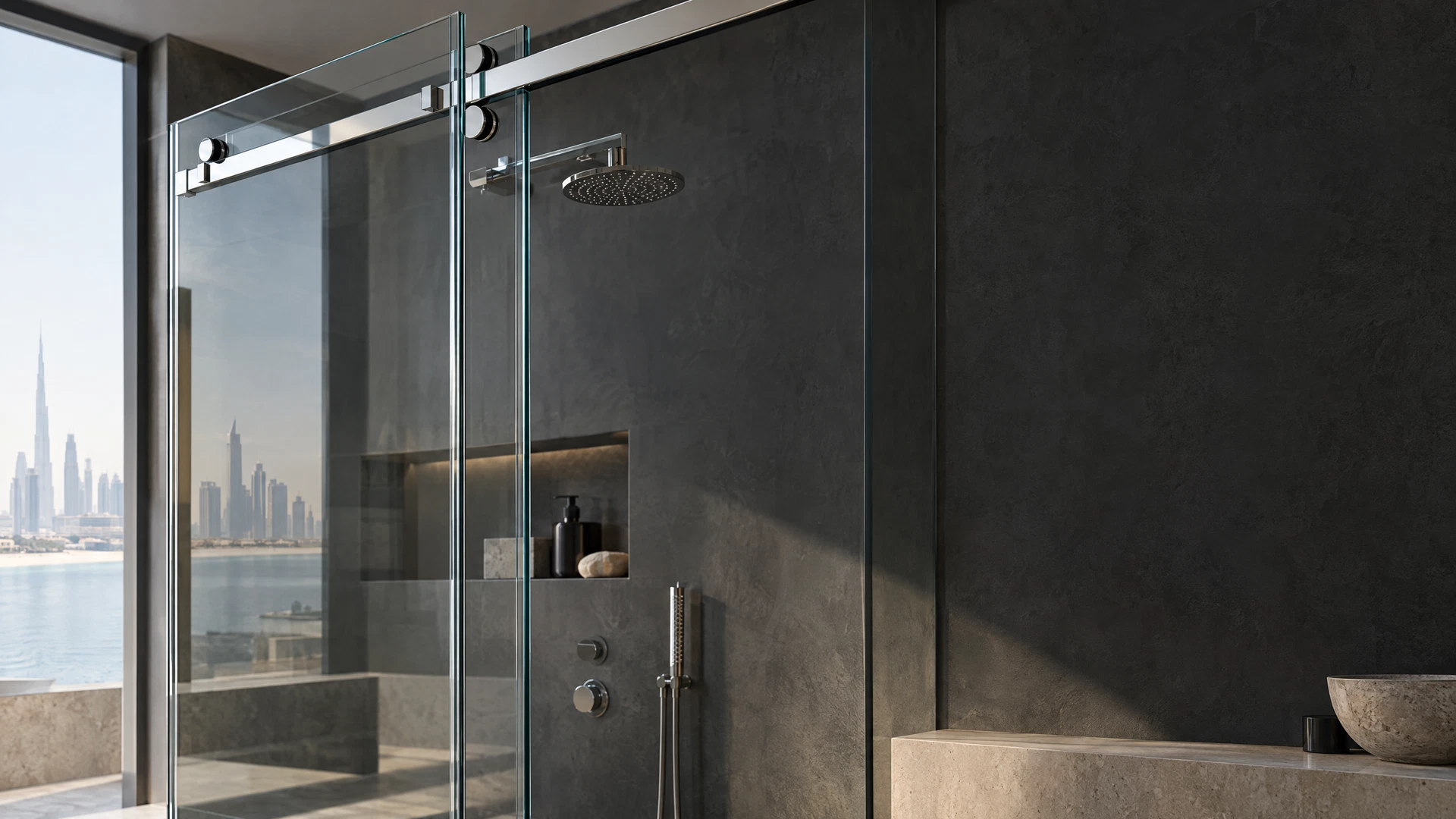
Every walk-in run is two numbers added together: the panel, and the gap you walk through. A comfortable entry gap is typically around 500–650mm — much below 500mm becomes a squeeze, especially carrying a shower stool or steadying a child. So on a 1,600mm shower run, a 1,000mm panel leaves a 600mm entry: a workable, common layout. On a 1,300mm run, the same 1,000mm panel leaves only 300mm to enter through — which means either a narrower panel (and a wetter floor) or accepting that this run wants a door instead.
There is a simple test that cuts through all of it: stand where you would enter, and look for the shower head. If you can see the head around the panel’s open edge, spray has a line of sight out of the shower — and water follows lines of sight. The panel and gap are right when the head is fully hidden behind the glass from the entry position, with the panel’s edge still a margin beyond the spray zone. That overlap — panel edge past spray zone, head hidden from the gap — is what “wide enough” actually means, and it is the first thing checked when we measure a walk-in, before any width is quoted.
Deflector fins and returns
When the run is nearly right — panel covering the spray, but bounce escaping around the open edge — the fix is often not more width but a small piece of glass at the edge. A deflector fin is a narrow panel, typically in the 150–300mm range, fitted at the open end of the screen: either fixed at an angle or as a short return running back toward the opposite wall, or as a small hinged flipper that swings out of the way for entry and sits in line while you shower. Its job is to catch exactly the water a straight panel misses — the low, angled bounce that rounds the edge — and shed it back inside.
A return is the same idea at full scale: the screen turns a corner at its open end and runs back part-way, which suits corner and three-sided layouts. (Two-panel and corner layouts in full are their own subject; here the point is only that an edge treatment and raw width are substitutes for each other, and on a tight run the fin is frequently the better of the two — it defends the gap without eating into it.) Whether a fin can be added to a screen that is already fitted depends on the panel’s edge position and what it can be fixed to; it is a photo-and-visit question, not a yes we give blind.
When width alone cannot solve it
Some showers should not be walk-ins at any width, and a sizing guide that won’t say so is a sales page. That question — whether a walk-in screen suits your bathroom at all — comes before width. Width alone cannot solve it when:
- The handheld head is the main shower. If the head lives in a hand and points everywhere, the spray zone is the whole enclosure. A screen becomes a splash reducer, not a splash stopper — and if a dry floor outside matters, that bathroom needs a door.
- The run is too short. If panel plus a passable entry gap cannot fit the total length with the head hidden from the gap, the geometry fails before the glass is chosen. Short ensuites hit this constantly.
- Body jets or a head aimed across the opening. Spray directed at the gap will use it. Moving or re-aiming the head is sometimes the actual fix; no panel width outruns a jet pointed at the door line.
- The floor falls the wrong way. If the floor slopes toward the entry, water that lands inside walks out under its own power. That is a drainage question first and a glass question second.
In each case the honest answer is a door — hinged or sliding, or a screen-plus-door combination — which trades a little of the walk-in’s openness for an enclosure that actually seals. Our shower screens page sets out the formats; what matters here is that “wider” stops being the answer at the point where the spray, not the panel, is the problem.
Frequently asked questions
What is the minimum width for a fixed shower screen?
As a working figure, treat roughly 900mm as the starting point for a standard fixed head, with 900–1,200mm being the range most successful walk-ins land in. Panels under about 700–800mm break the direct spray but leave the bounce zone open, so the floor still gets wet. These are typical trade figures, not guarantees — the confirmed width for your bathroom is set at measurement, against your head position and water pressure.
Does a wider screen always stop more splash?
Only up to the point where the panel’s edge clears the spray zone. Beyond that, extra width adds nothing except a narrower entry gap — and if the gap shrinks below a comfortable walk-through, the layout gets worse, not better. Position beats width: a screen whose edge sits past the spray, with the head hidden from the entry, outperforms a wider screen placed badly.
My shower head is handheld. Will a fixed screen work?
It is the hardest case, honestly. A handheld head points wherever the user points it, so no fixed width covers the spray. If the handheld is used mainly parked in its holder, a screen can work like the fixed-head case. If it is the way the household actually showers — children, hair washing, rinsing the enclosure down — expect a wet floor, and consider a door or a screen-plus-door layout instead.
Some water still gets out of my walk-in. Is the screen too narrow?
Not necessarily. Fine mist escapes every open shower, and a few droplets beyond the panel are the format working as designed. The fault worth chasing is a pattern: a wet patch in line with the entry gap, or wetness that reaches the doorway or vanity. That pattern points to the panel edge sitting inside the spray zone, a head repositioned since fitting, or bounce rounding the edge — the last of which a deflector fin often fixes without touching the panel.
Can a deflector fin be added to my existing screen?
Often, yes — where the existing panel’s open edge has room for the fin and something sound to fix to. It depends on the panel’s position and hardware, so it is decided from a photo and, where needed, a visit, rather than promised in advance. Send us a photo of the screen and the wet patch it leaves, and we will tell you whether a fin, a wider panel or a door is the real answer.
Talk to us about your screen width
If you are planning a fixed screen, message us on WhatsApp on 052 443 2655 with a photo of the shower area, the rough length of the run, and where the shower head sits — fixed, rainfall or handheld. We will tell you the width the spray zone actually needs and whether a screen alone will hold your water, before anything is measured or made.
This guide is part of our Shower Screens & Fixed/Walk-in Glass series. Next: Fixed Panels: Brackets vs U-Channel Fixing →
