
Bath Screen Seals: Where Leaks Start and How to Prevent Them
The leak map: where bath screen seals fail and how to prevent it.
Fitting Glass on a Bathtub: How Bath Screen Installation Works
How a bath screen is measured, templated, made and fitted, from the first photo to the final seal.
Sliding vs Fixed Screens Over a Bath
Tracks versus a single panel: hardware, seals, cleaning and the baths each one actually suits.
Bath Screen Sizing: Length, Height and the Splash Zone
Sizing from the water backwards: coverage length and height against the spray.
SCREEN TYPES
Fixed panel
One panel, clamped, sealed, done. A fixed bath screen covers the shower end of the bath and simply stands there — no hinges, no seals to wear, nothing to adjust. For a bath that is mostly a shower, it is the cheapest and most robust screen per centimetre there is, and the fixed screens we install are the fastest jobs in this section: templated, made, fitted, sealed.
Hinged panel
A hinged screen is a fixed panel that can swing. It gives you full-length coverage when it is closed and unobstructed access to the whole bath when it is open — bathing children, cleaning the far end without gymnastics, reaching the taps. The hinges are the price, the seals are the maintenance, and the swing space is the constraint: a hinged panel needs room to open that a fixed panel never asks for.
Half door
A half glass door is a wider door panel — typically 700 to 900mm — hinged from the wall, sealing more of the bath’s length than a short fixed panel. It is the middle answer for splashy households and daily family use: more coverage than a fixed panel, and proper access when it swings open.
Sliding systems
A bath slider runs two or three panels on a track the length of the bath. It gives the most complete coverage of any bath screen system, at the cost of the most hardware, the most seals, and the least easy-cleaned geometry of the four — tracks collect what tracks collect.
A fixed glass panel for your bathtub
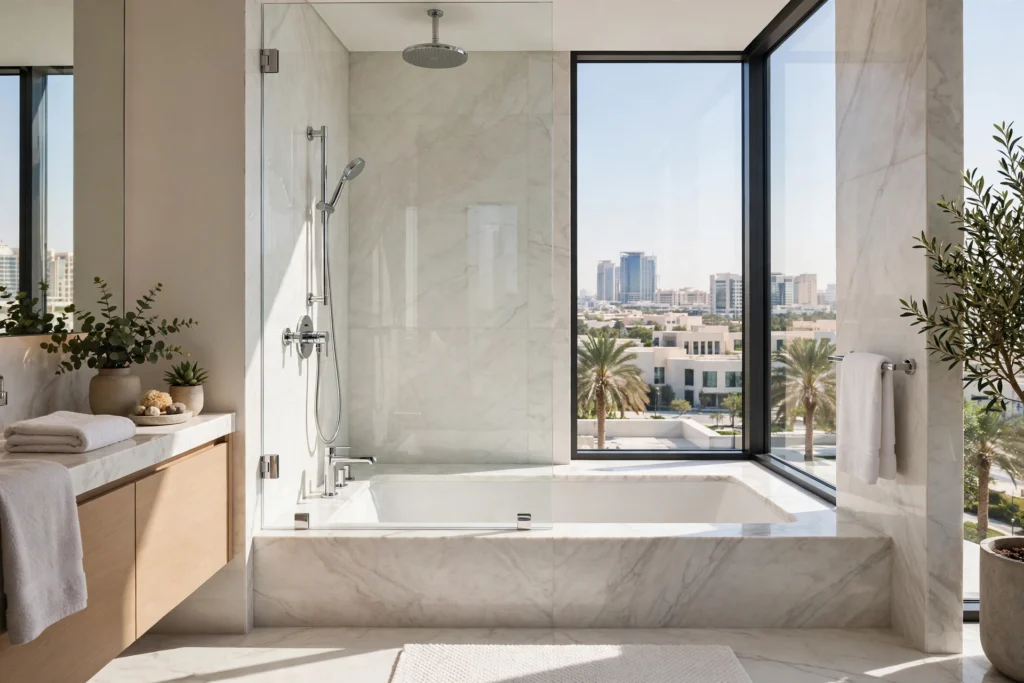
The simplest bath screen is a single fixed glass panel for your bathtub: one toughened panel, sealed along the bath edge and fixed at the wall, with no moving parts to align or wear. Widths are set by the splash zone your shower actually creates and heights by the shower head and ceiling — our guide to bath screen sizing works through the numbers. A fixed panel is also the starting point of our price range: fixed bath glass from AED 1,500, exact quote after measurement — what moves the figure is set out in our guide to bathtub glass screen prices.
SPLASH CONTROL — THE REALITY
No bath screen is a full enclosure, and we would rather tell you that here than have you discover it under a mop. What decides how close to “dry floor” you actually get is not the screen type alone: it is where your shower head stands relative to the screen’s coverage. A fixed head positioned within the covered length, spraying into the covered zone, keeps the floor dry with any type. Move the head beyond the screen’s coverage — or aim a hand shower past the end of the glass — and every type leaks the same way: through the open end. Coverage length, screen height and honest use of the hand shower are what get you a dry floor; the product name is secondary. See our bath screen sizing guide and our seals guide for what each part of that really involves.
SIZING: LENGTH, HEIGHT AND THE SPLASH ZONE
Screen length is established from the water, not the bath’s catalogue length or the neighbour’s bathroom. Coverage should reach past the far edge of the shower’s splash zone — the distance the spray actually wets along the rim — which is why stock sizes fail real bathrooms: the zone differs from bath to bath. As an orientation, most baths here run 1,500 to 1,800mm; a fixed panel usually covers 800 to 1,100mm of the shower end, though the zone, not the typical figure, is the answer. Height: standard panels stand 1,400–1,500mm; a tall rainfall head, a tall bather, or a powerful mix outlet all push you towards a taller panel. Undersizing is the complaint we hear most, and it is almost always length: enough glass to look right and not enough to catch the spray arc.
THE BATH EDGE DECIDES
Before hardware, look at what the screen fixes to. On most baths the rim is flat, level and wide enough, and any type fixes cleanly. On a rolled, stepped, sloped or narrow rim — as little as 50mm of usable landing in some cases, against 80mm and more on a generous bath — the fixing choice changes: bracket systems adapt where a channel will not, seals have to match the rim profile rather than merely being cut to length, and the rim’s evenness over the panel’s length matters more than its width at any point. Our narrow and uneven bath edge guide works through the decision and the cases where the honest answer is a curtain until the rim is sorted.
SEALS: WHERE BATH SCREENS LEAK
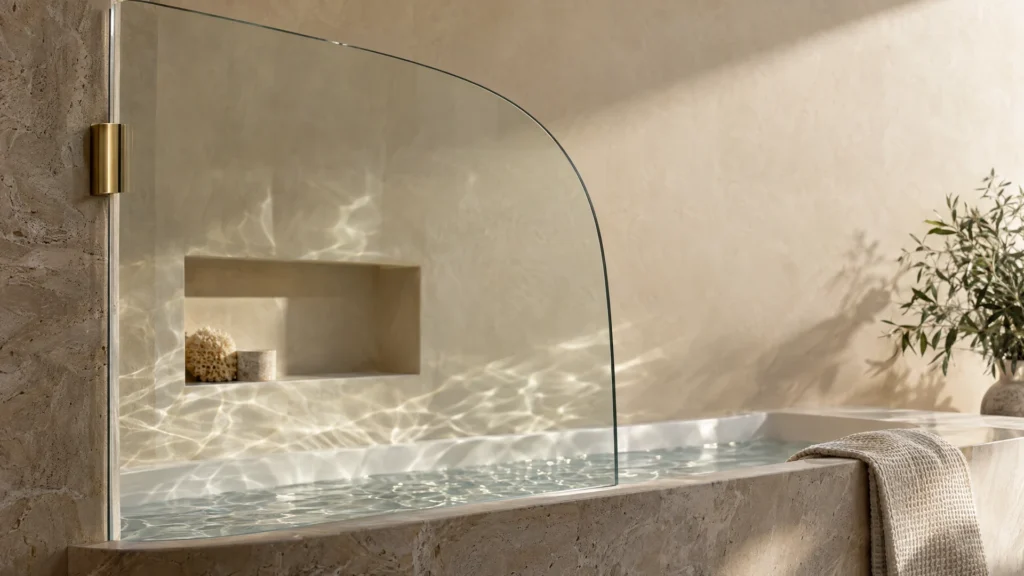
Screens leak in predictable places, and each leak has a predictable cause. At the bottom edge: the transit seal has compressed, shrunk or lifted, and water bridges underneath it — a seal replacement, not a new screen. At the hinge side on a hinged or half door: the vertical seal has hardened or the hinge has dropped a millimetre, which walks the seal out of compression. At the wall junction: a silicone line laid over a damp substrate, which beads rather than bonds and lets go within months. And end of the run: the spray itself, exiting past the glass, which no seal can fix because it is a sizing answer.
Seals are consumables in the same way tyres are: the correct response to a perished sweep or bottom seal is renewal before it flatters itself into a floor problem. Our dedicated guide to bath screen seals sets out the leak map in full, and our repair colleagues handle seal renewals as standard work.
KEEPING BATH GLASS CLEAN
The cleaning answer for bath glass is shorter than the shower-glass answer, because bath glass leads a gentler life: daily squeegee after the last shower — the glass is dry more hours than a walk-in panel, which is why bath screens scale slower. Scale, if it builds, is a water-hardness problem before it is a cleaning problem: Dubai’s municipal supply runs mineral-heavy, and the deposits it leaves on glass are calcium driven off by regular mild acid — household white vinegar on a cloth, kept off seals and metalwork. Commercial lime removers work too; abrasive pads are the one thing we would forbid. Any dried mark on a smooth glass surface is cosmetic — scrubbing is what turns cosmetics into damage.
REPLACING A TIRED OLD SCREEN
Old bath screens reach end of life in familiar ways: the aluminium has pitted, the seals are black with mould that no cleaning shifts, the panel wobbles in a channel that has widened past adjustment. A replacement uses the bath as found — the old screen comes off, the rim is cleaned back to sound surface, fixings re-drilled where profiles have changed, and a new panel fitted: 10mm glass where the old one was typically 6 or 8mm, which reads as quality the first time the door swings. Old screens are also usually the wrong size — fitted for the shower habits of a bathroom two refurbishments ago — so replacement is the moment to resize honestly and resite the head if the spray has been escaping all these years.
SCREEN NOW, OR REMOVE THE BATH?
A different decision some households face: the bath itself. A bath conversion takes the tub out and returns the footprint as a walk-in shower; it costs more than any screen on this page, closes the bathing question forever, and is the right answer for households that have genuinely stopped bathing. A screen answers the opposite households — and in rental properties, the reversible one: glass comes off cleanly and the curtain can return. If the bath is used, keep it and screen it; our screen-versus-curtain comparison and the bath conversion page frame the full decision. The price guide covers bath screens; bath removal is separate building work that the guide does not price.
HOW IT WORKS
WhatsApp first: send us a photo of your bath with the taps visible, the length of the bath, and a shot along the rim at the shower end. Most questions — type, rough coverage, edge problems — resolve at this stage, and we will quote a range against the photo.
Measurement: if the job proceeds, we visit to template the panel — the bath rim’s line and level, the end wall’s plumb, the exact coverage from your shower’s position, and the rim edge read for its fixing. Panels are then cut to size from those dimensions, drilled and notched, with the edges finished, before the glass is toughened.
Fitting day: the panel is offered up, fixed, and sealed, with the swing and seal checks done while you watch. How long the fitting takes depends on the screen type and the bath edge, and we will confirm what to expect when the job is booked. The first-use timing is confirmed in writing at handover and depends on the sealant used.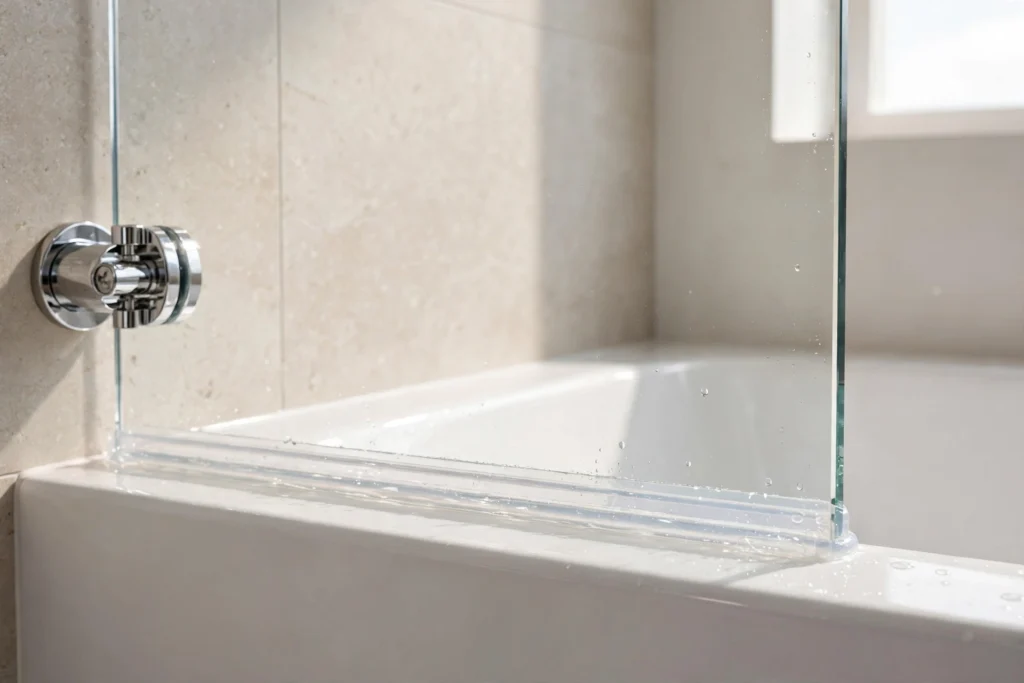
GUIDES & ADVICE
Our bath screen guides, in reading order:
- Fitting a Bath Screen When the Bath Edge Is Narrow, Sloped or Uneven — how edge width, slope and profile decide the fixing and the sealing, and the edges where the honest answer is no screen.
- Fitting Glass on a Bathtub: How Bath Screen Installation Works — how a bath screen is measured, templated, made and fitted, from the first photo to the final seal.
- Fixed vs Hinged Bath Screens — the honest comparison: access, sealing and which bath each type quietly fails, plus the edge requirements nobody mentions.
- Half Glass Door for a Bathtub: Pros, Cons and Splash Reality — how a wider hinged door works over a bath, how its coverage compares with a fixed panel, and when it beats both a panel and a full slider.
- Sliding vs Fixed Screens Over a Bath — tracks versus a single panel: hardware, seals, cleaning geometry and the baths each one actually suits, with our honest verdict.
- Bath Screen Seals: Where Leaks Start and How to Prevent Them — the leak map, seal types and profiles, what your rim profile decides, and what to attempt before booking a seal renewal.
- Bath Screen Sizing: Length, Height and the Splash Zone — sizing from the water backwards: coverage length from the head’s position, height against the spray arc, and how to map your splash zone.
- Frameless Bath Screens: Look, Weight and Hardware — glass carried on hinges or brackets alone: the weight involved, sealing without a frame, exposed edges, and when slim-profile is the smarter build.
- Folding and Pivot Bath Screens — The two moving systems explained — how each moves, where their seal lines run, who they suit, and an honest note on what we fit.
- Bath Screen Replacement: From a Tired Old Screen to New Glass — assessing the old screen and bath edge, when the old fixings can be reused, upgrading type mid-replacement, and what happens to the old glass.
- Converting a Bath Area: Screen on the Bath vs Removing the Bath for a Walk-In — who still needs a bath, disruption and cost drivers compared in factors, and the middle path that decides later.
Can a bathtub have a full glass enclosure?
It can — “enclosure” over a bath usually means more than a single screen: a fixed screen with a return panel at the far end, or a hinged door paired with a fixed panel, closing the showering zone at both ends. Both combinations sit inside the range we fit. Whether your bath and walls suit it is a measurement question — our guide to converting a bath area compares a screen on the bath with taking the bath out for a walk-in.
AREAS WE COVER
We measure, make and fit bathtub glass screens across Dubai, Sharjah, Abu Dhabi and Ras Al Khaimah. If you are in Dubai itself, our local shower screens & fixed walk-in glass page covers the walk-in and enclosure side of the work; see our price guide for what the door systems cost and what moves any quote.