If your shower door is leaking at the bottom, the water on the floor is rarely a mystery — and it is almost never the glass. A leak at the door’s bottom edge is usually caused by one of five things: a worn bottom seal, silicone that has failed, a door that has dropped slightly on its hinges, water being pushed at the door faster than any door line can hold it back, or drainage that lets water pool against the door. This article is a diagnosis guide: how to tell the five apart in about two minutes, and what category of fix each one needs — so you know whether you are looking at a seal renewal, a re-alignment, or a sign of a bigger problem. Choosing and fitting seals and silicone is a separate job, covered in its own guide; here we find the cause.
At a glance
- Most common cause: the bottom sweep seal has hardened, flattened or split, so it no longer touches the floor or threshold.
- Second most common: silicone along a fixed line — panel to wall, frame to floor — has cracked or peeled away.
- The hidden cause: hinges wearing or loosening let the door drop a few millimetres — enough to open a gap at the bottom and break the seal’s contact.
- The quick test: run the shower aimed away from the door for two minutes. Still dry? The seals cope with splash but not with direct water — or the leak only starts once the door has been opened and moved.
- What not to do: do not run a new bead of silicone over the old one. It looks fixed for a few weeks, then peels and traps moisture behind it.
First, find out where the water is actually escaping
Before anything is replaced, the leak has to be located honestly, because “the bottom of the door” is where water arrives, not always where it escapes. Dry the floor and the door line completely. Run the shower with the head aimed at the back wall, away from the door, for two minutes, and check the floor outside. If it stays dry, aim the water at the bottom corner of the door for thirty seconds and check again. Finally, open and close the door a few times — a door that only leaks after it has been opened is usually shedding water that was sitting on the glass and seals, which points to seals and alignment rather than the fixed lines.
Watch the exact point where the first drip appears. Water at the hinge side suggests the door has dropped or the vertical seal has failed. Water at the closing edge points to the meeting seal or the door sitting out of line. Water appearing some distance from the door usually means it is travelling along a failed silicone line inside the enclosure and emerging where the line ends.
Leaking where the door closes
“Leaking where the door closes” is how most people describe this problem, and it is a specific fault, not a general one. When a hinged door shuts, its closing edge should meet the fixed panel or the wall profile evenly, top to bottom, with the magnetic or fin seal compressing slightly along its whole length. If the door has dropped on its hinges — even by two or three millimetres — the closing edge meets at an angle. The top may touch while the bottom stands open, and that bottom gap is exactly where shower water, running down the inside of the glass, escapes onto the floor.
You can check this yourself: close the door slowly and look at the gap along the closing edge against the light. An even gap that narrows as the seal compresses is healthy. A gap that is visibly wider at the bottom than at the top means the door is out of square, and no new seal will fix it for long — the alignment has to be corrected first, then the seal can do its job. This is also why a leaking door often arrives together with a second complaint: the door dragging, catching, or not closing with its usual clean pull.
Cause 1: the bottom seal has worn out
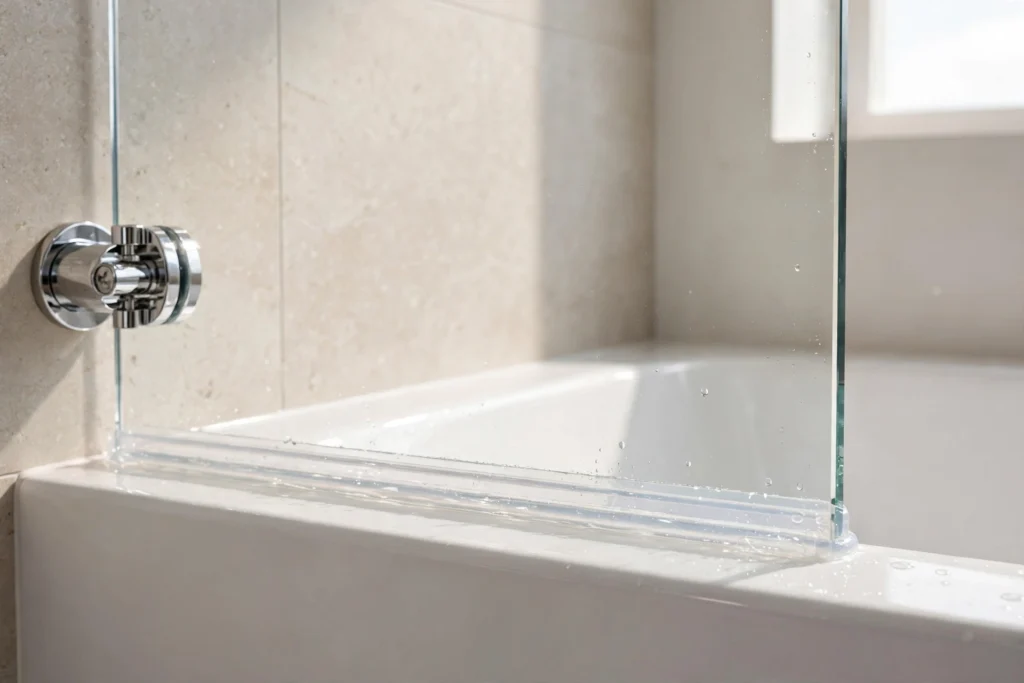
The bottom seal — the flexible sweep along the lower edge of the door — does more work than any other part of the enclosure. It flexes every time the door opens, sits in water and soap residue, and in UAE bathrooms it also deals with hard-water scale that stiffens the flexible fin over time. A healthy seal is soft, springy, and touches the floor or threshold along its full length. A worn one is flattened, yellowed, split at the ends, or has gone hard enough that it holds a curve instead of springing back.
Press the fin gently with a fingertip along its length. If it springs back evenly, it is probably sealing; if it stays flat, cracks, or has shrunk back from either end, it has reached the end of its life. That is the diagnosis. Which replacement profile your door needs, and how it is fitted, depends on your glass thickness and gap size — that selection is covered in our guide to shower seals and silicone, in detail. What matters here is the order: confirm the door is hanging square first (Cause 3), because a new seal on a dropped door wears out at the same corner within months.
Cause 2: the silicone has failed
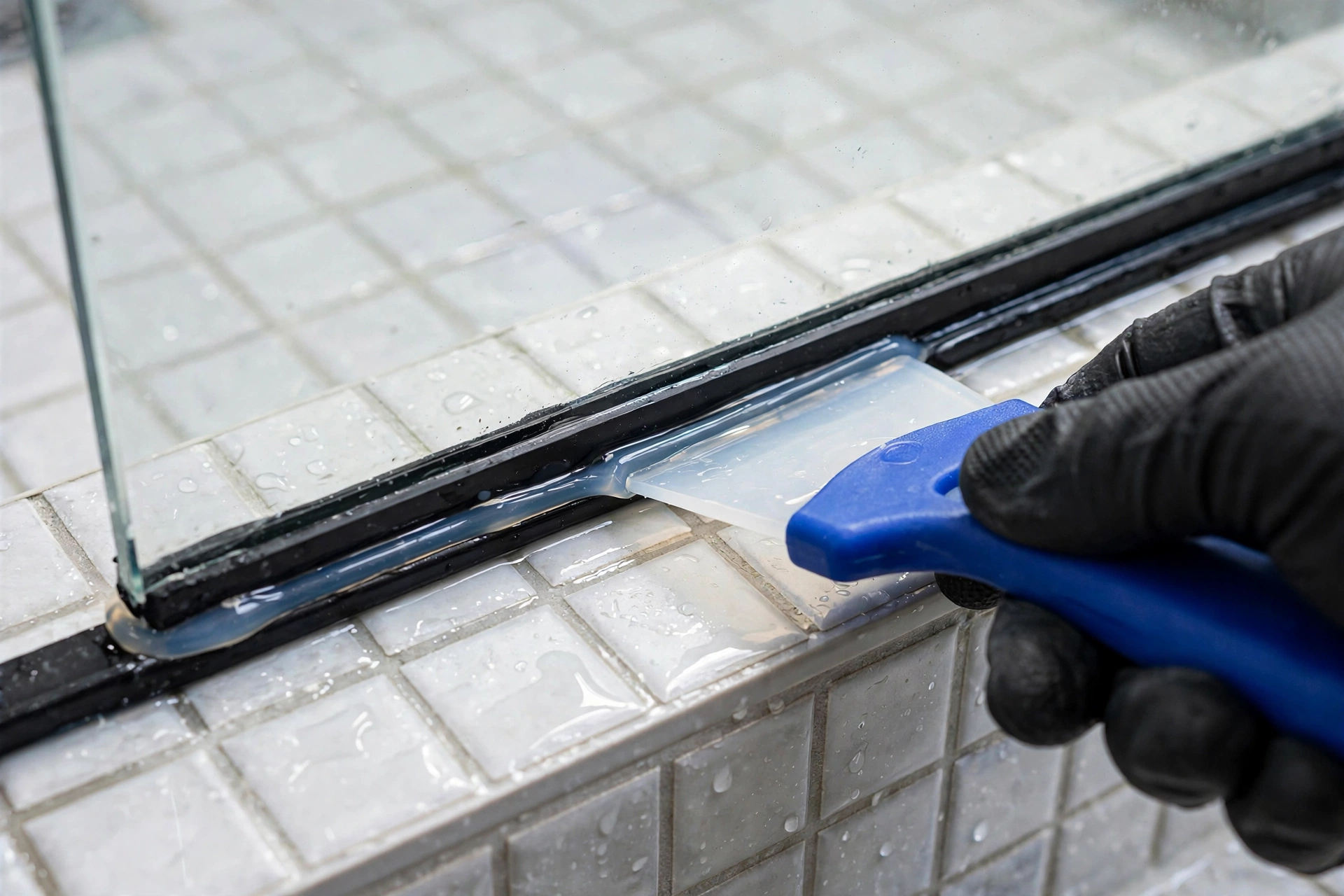
Silicone seals the fixed lines of the enclosure: where a fixed panel meets the wall, where the frame meets the tray or floor, and along channels and profiles. It fails in predictable ways. It shrinks and cracks with age, peels away from one surface, or develops mould within the bead itself — the black spotting that no amount of surface cleaning removes, because it is inside the material, not on it.
Failed silicone lets water travel behind the panel or under the threshold and emerge outside the shower, sometimes a surprising distance from the entry point. Run a fingernail lightly along the bead: if it lifts, gaps, or feels hollow behind, the line has failed. Two cautions belong with this cause. First, a failed silicone line on a fixed joint is a sealant problem; silicone is never the fix for a moving door edge — that is the seals’ job, and adding silicone where a seal belongs restricts the door and fails quickly. Second, if a leak has run for months, water may already have reached tiles, grout or the floor build-up behind the joint. That is no longer a cosmetic sealant issue — it is a waterproofing question, and it needs a proper inspection before anything is re-sealed over the top of it.
Cause 3: the door has dropped on its hinges
Glass shower doors are heavy, and hinges carry that weight every time the door swings. Over years of use, hinge fixings can work slightly loose, or the internal mechanism wears, and the door drops. The drop is small — millimetres — but a bottom seal is only designed to bridge a small, even gap, so a dropped door defeats it at one corner.
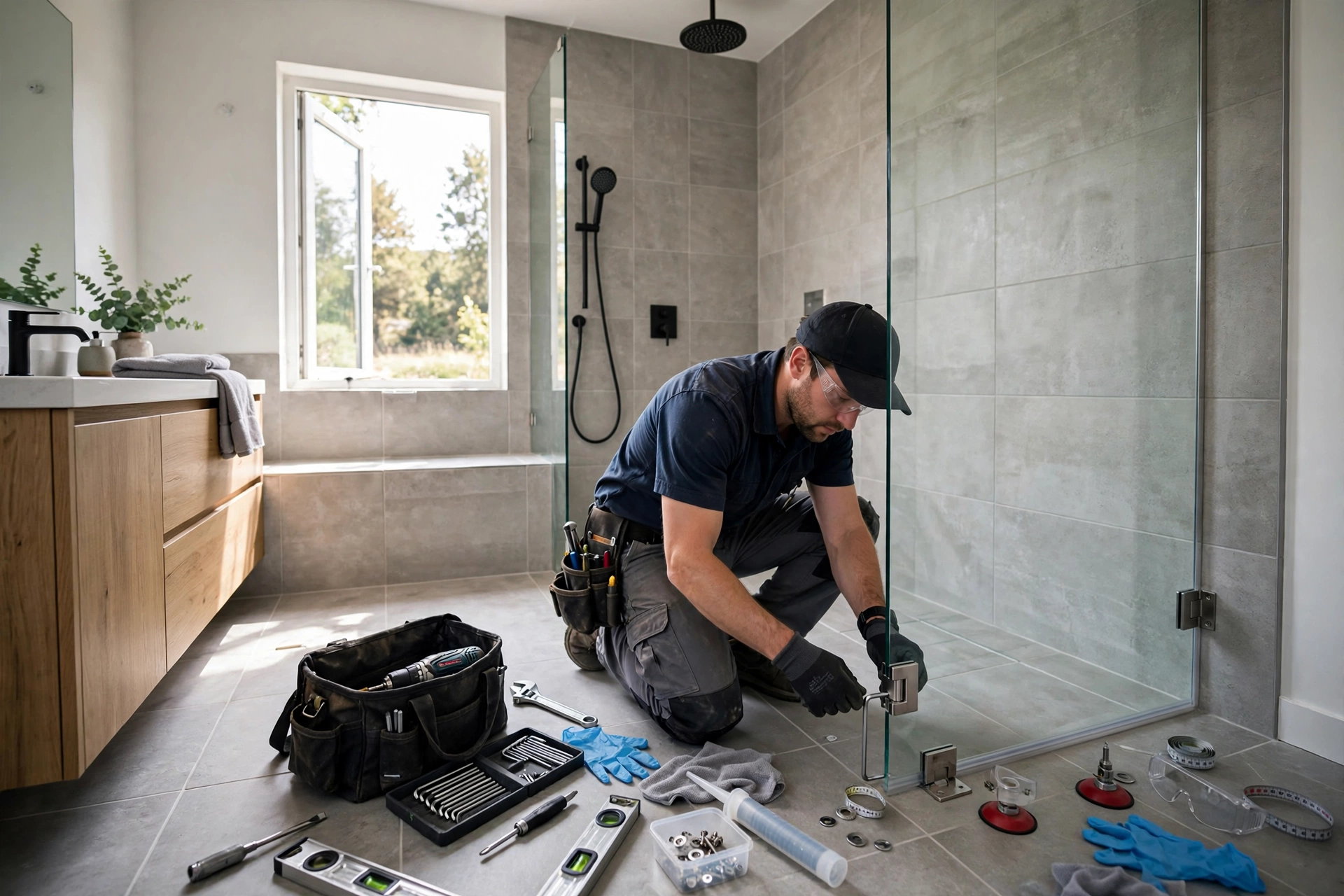
The signs are consistent: the gap under the door is uneven, the door may touch or drag on the floor at the closing corner, the handle sits slightly lower than it used to, and the leak is worst at the lowest corner. The fix is to re-hang and re-align the door — hinges inspected, fixings secured, worn hinges replaced if adjustment alone will not hold the door square — and only then to renew the seals the misalignment has damaged. Replacing seals on a door that is still out of line is paying for the same job twice. One safety note: adjusting or re-hanging a glass door is not a casual DIY job. The panel is heavy, under load, and a mistake can crack it. This is qualified-person work, with the door properly supported throughout. If this is your situation, our guide to a shower door that won’t close properly covers the alignment symptoms in full.
Cause 4: the water itself — spray, slope and thresholds
Sometimes every seal is sound and the door still leaks, because the enclosure is being asked to hold back more water than a door line can handle. A shower head aimed directly at the door joint, a high-flow rain head fitted close to the door, or a floor that slopes towards the door instead of towards the drain will all push water at the weakest line continuously. A fixed panel or door is a splash barrier, not a dam.
This cause is diagnosed by the pattern: leaks only during long showers, or only when the head is on its highest setting, with seals that test fine at lower flow. The honest fixes are adjusting the head angle, correcting a missing or undersized threshold, or — where the layout genuinely overwhelms the door — changing the configuration, for example adding a fixed panel so the door moves out of the direct spray line. How hinged doors keep water in explains what a door line can and cannot hold back, and where its honest limits are.
Cause 5: drainage — water pooling against the door
The fifth cause is the one most often misdiagnosed as a seal failure. If the drain is partially blocked, the waste is slow, or the shower floor’s fall runs towards the door instead of the drain, water pools across the floor during a shower and stands against the bottom of the door. No sweep seal is designed to hold back standing water under pressure — it is a splash seal, and given a deep enough pool it will be breached.
The test is simple: watch the floor while the shower runs. If water visibly gathers and creeps towards the door line instead of clearing to the drain, the door is not the primary fault. Clearing a blocked waste is a plumbing matter; correcting a wrong floor fall is a bigger conversation about the shower build itself. Either way, renewing seals will not cure it, and any diagnosis that skips the drainage check risks selling you the wrong repair.
What a proper repair involves
A proper repair follows the diagnosis, in this order. First, the leak is located and the cause identified — seal, silicone, alignment, water load, or drainage — because the same puddle can come from any of them. Second, any alignment problem is corrected: hinges secured or replaced, the door re-hung square, the closing edge meeting evenly. Third, the seals are renewed to match the door — the correct profiles for your glass thickness and gaps. Fourth, failed silicone is cut out and re-applied to clean surfaces — never layered over the old bead. Finally, the door is water-tested the same way it was diagnosed, aimed at the door line, before the job is called done.
That sequence is the difference between a repair and a patch. If you have already paid for this leak to be fixed once and it has come back, the most likely explanation is that one step was skipped — usually the alignment, or the drainage check. Our shower glass repair page sets out every repair we carry out, and what each one involves.
When repair is not the right answer
Most leaking doors are repaired, not replaced, and anyone who tells you otherwise before inspecting the door is guessing. Replacement becomes the honest recommendation when the glass itself is damaged, when the door has been cut for hardware that is no longer available and the panel is effectively unserviceable, or when the enclosure was wrong for the opening from the start — a door asked to span too wide an opening will sag and leak no matter how often it is adjusted. In those cases the repair money is better put towards a correctly measured replacement, and we will tell you so rather than book a fix we cannot stand behind.
Frequently asked questions
Why is my shower door leaking where the door closes?
Because the closing edge is no longer meeting evenly. Usually the door has dropped slightly on its hinges, so the seal compresses at the top but stands open at the bottom — and water running down the inside of the glass escapes through that gap. The fix is to re-align the door first, then renew any seal the misalignment has damaged.
Can I fix a leaking shower door seal myself?
A push-on bottom seal can be replaced if you can match the exact profile for your glass thickness and gap — an almost-right seal will leak, jam, or fall off. Beyond that, be honest about the limits: silicone work fails quickly when it is layered over old sealant, and hinge adjustment on a heavy glass door is not a safe one-person DIY job — the panel must be supported, and a mistake can crack it. If the leak survives a seal change, the cause is elsewhere and it is time for an inspection.
How long does a shower door seal last?
It depends on use and water hardness, but a bottom sweep in a busy family bathroom in the UAE typically hardens and flattens within a few years. Hard-water scale speeds this up. A seal that has gone stiff, split at the ends, or no longer springs back when pressed has reached the end of its life even if it looks intact.
Will new silicone stop my shower door leaking?
Only if failed silicone is actually the cause — and only on a fixed line. Silicone seals panels to walls and frames to floors; it does not seal a moving door’s bottom edge or closing edge, which are the seals’ job. Adding silicone where a seal belongs restricts the door and fails quickly, which is why the diagnosis comes before any tube is opened.
How do I get a leaking shower door repaired?
Send us two or three photos on WhatsApp — the full door, a close-up of the bottom edge, and the closing edge — along with your area. From the photos we can usually tell whether it is a seal, silicone, or alignment problem; drainage and waterproofing questions need a visit to confirm. We cover Dubai, Sharjah, Abu Dhabi and Ras Al Khaimah, and we will confirm the exact work after seeing the door.
Talk to us about the leak
If your shower door is leaking at the bottom, message us on WhatsApp on 052 443 2655 with a photo of the door and a close-up of where the water escapes. Tell us your area, and we will tell you honestly whether it is a seal, a silicone line, an alignment problem or a drainage issue — and what fixing it involves — before you commit to anything.
Message us on WhatsApp about the leak
This guide is part of our Shower Glass Repair series. Next: Shower Door Dragging or Touching the Floor? Causes and Fixes →