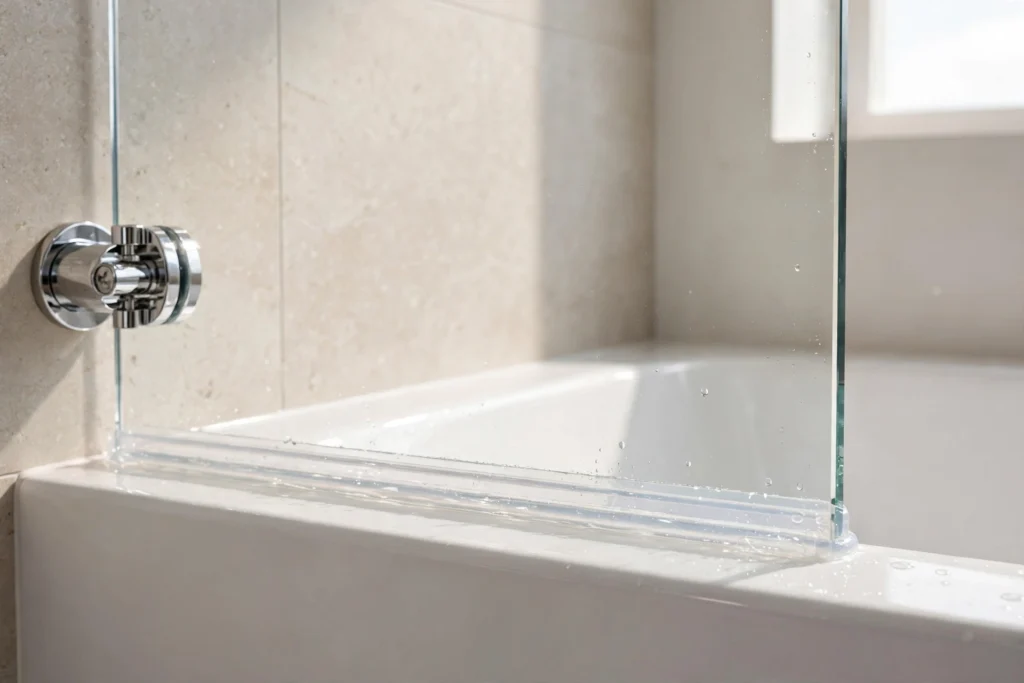
A shower door that drags or touches the floor is a symptom with several possible causes: hinge wear or sag, fixings that have drifted out of alignment, a floor or threshold line that has changed, or a bottom seal dragging on the surface below. What has moved is a genuine question, and it is worth answering before anything is tightened, ordered or replaced. A door can drop because its hinges have worn or slipped, because the fixings holding those hinges have worked loose, because a sliding panel has dropped on its rollers, or because the floor or threshold line it clears has changed. Each fault produces the same scrape at the floor and a different fix, and treating the wrong one is how a straightforward job gets paid for twice. This guide treats dragging as what it is — a symptom — and sets out the signs, a two-minute check you can do yourself, the test for each cause, and what the fix involves for each one.
At a glance
- Dragging is a symptom, not a diagnosis: several different faults make a door meet the floor, and they do not share a fix.
- The contact pattern is the first clue: contact at one corner, contact along the whole bottom edge, and a sliding panel scraping in its track each point a different way.
- The quick test (hinged doors): slide a bank card under the closed door. If it passes at the hinge side and jams at the far corner, the door is out of level.
- Sliding doors drop differently: the panel hangs from rollers, so wear or slip there lowers one end of the panel in its track.
- What not to do: don’t keep forcing it. A dragging door grinds its own bottom edge, tears its seal, and loads the remaining hardware harder every time it is used.
What dragging is telling you
A door that has started to drag announces it gradually, and most people live with the early signs for months. The first is usually sound: a scrape, scratch or shudder at the same point of every swing. Then comes feel — the door develops a tight spot, needs a small lift by the handle to close cleanly, or no longer pulls shut with its usual even resistance. Look underneath and the geometry tells the story: on a hinged door the gap under the door tapers, the closing edge no longer meets its seal evenly from top to bottom, and the magnetic strips don’t line up the way they did — they meet at one end and stand apart at the other.
There is often a mark, too. A fine arc scratched into the shower tray or floor tiles, exactly under the door’s swing, is the signature of a door that has been touching down for a while. And a door that has dropped frequently arrives with a second complaint: water escaping at the lowest corner, because the bottom seal has been crushed, torn, or is simply no longer in line with the floor. The leak and the drag are often the same door seen from two sides — and the leak will not stay fixed while the door is still down.
Timing is evidence as well. Dragging that begins within the first year or so of a door’s life points away from wear and towards the hanging itself — hinges set into an out-of-plumb wall without packing, or a door whose weight was never evenly shared between its hinges. Dragging that arrives after years of good service points to something that has worn, slipped or worked loose since. Dragging that starts the week something else changed — a new floor, a new threshold, a new bottom seal — points at the change, not the door.
A two-minute check you can do yourself
Close the door slowly and look along the gap beneath it against the light, then run these checks. First, the card test from the summary above: a bank card or similar thin gauge should slide under the door with roughly the same resistance from hinge side to closing edge. Second, the lift test: grip the handle and lift the door very slightly. If the door rises a few millimetres and the dragging disappears in that lifted position, the drop is in the hanging — hinges or their fixings — not in the floor. Third, watch where it touches. Contact only at the far closing corner is the classic dropped-door pattern. Contact along the whole bottom edge points elsewhere: a seal that has been replaced with a deeper profile, a raised threshold, or debris and scale built up under the door.
One more observation decides between the two hinge-side causes: watch the hinge itself. Get someone to lift and lower the door gently while you watch each hinge. If the hinge body shifts against the wall or the glass, the fixings are loose. If the hinge body stays put but the door moves within it, the mechanism itself has worn or slipped. That distinction matters, because the two faults have different fixes — and it is exactly what we check first on a visit.
For a sliding door, the equivalent checks are simpler: look along the gap at the top of the panel, which should be even end to end; watch the panel as it travels for a dip or judder at the same point of every run; and check the track and the bottom guide for the build-up of scale and grit that can imitate a drop.

Cause 1: the hinges have worn or slipped
A shower hinge is a working pivot, and pivots wear. The internal bearing surfaces oval out, the self-closing action goes slack, and play develops that no amount of tightening will remove, because the looseness is inside the hinge, not at its fixings. A hinge can also slip — rotating slightly in its clamp or notch under the door’s repeated load — which drops the door even though the pivot itself is sound. The signs are the lift test above: movement within the hinge body, often with clicking or grinding as the door swings, and a door that no longer closes itself in the last part of the swing. Whether a hinge in this state can be adjusted, repaired or replaced is its own decision, covered in our guide to broken or worn shower hinges: adjust, repair or replace.
Cause 2: the fixings have worked loose
Hinges are held by screws into the wall and by clamp bolts that grip the glass. Every swing of the door works those fixings a fraction; add a door that gets slammed, leaned on while someone steadies themselves, or used as an improvised towel rail, and over years the fixings give by millimetres. The door doesn’t fall — it rotates, pivoting down around the loosened hardware, which is why the damage always shows at the corner furthest from the hinges. The test is the hinge-watch above: the hinge body itself moves against the wall or glass when the door is lifted. Caught before the hardware or the glass edge is damaged, this is the most straightforward of the causes to put right.
Sliding doors: rollers and track drop
A sliding panel does not hang on hinges — it hangs from rollers running in a track above it (some designs also run on rollers at the bottom), and it drops when that running gear gives. Rollers wear and flatten, a roller carriage slips in its adjustment slot, or the track itself works out of line; scale and grit packed into the track can also lift, drop or deflect the panel at one point of its run. The pattern differs from a hinged door: the panel sits lower at one end, the gap along the top of the panel is visibly uneven, and the scrape or judder happens at the same point of every slide rather than on a swing arc. Lift the panel gently by its edge: movement at a roller, or one end rising noticeably more than the other, locates the fault. Sliding faults in full — rollers, tracks and alignment — are covered in our guide to a sliding shower door that is not sliding properly; the point here is that a dragging sliding door is a running-gear problem, not a hinge problem, and no hinge fix applies to it.
Cause 3: the floor or threshold line has changed
Sometimes the door has not moved at all — the line it has to clear has come up to meet it. New flooring or a new threshold strip raises the surface the door was measured to clear. A bottom seal replaced with the wrong profile can be deep enough to drag on the floor — the timing is the clue, because the dragging starts the week the seal was changed. A flexing acrylic tray can drop underfoot and meet the door halfway. And scale and grit built up along the door line can imitate a drag convincingly. The test is the contact pattern from the check above: contact along the whole bottom edge, or dragging that began right after floor, threshold or seal work, points here rather than at the hanging. These causes are all fixable — and none of them is fixed by touching the hinges.
Why you should not keep using a dragging door
A dragging door is sometimes treated as a cosmetic annoyance. It isn’t. The bottom edge of the glass is grinding on a hard surface under load, and toughened glass is at its most vulnerable at its edges — chips there matter. The crushed bottom seal tears and starts leaking. On a hinged door, the weight that was meant to be shared transfers onto whichever hinge is still holding, so that hinge wears faster and the drop accelerates; on a sliding door, a dropped panel grinds its guide and track, widening the damage along its run. And a door that binds can twist against its seals and frame as it is forced, stressing everything it touches. None of this means the door is about to fail dramatically; it means a small misalignment becomes a bigger job the longer it is used. Doors are heavy — a 10mm glass shower door is not something to wrestle with daily once it starts fighting back.
What the fix involves, per cause
The fix follows the cause, which is why the diagnosis comes first. Loose fixings: the door’s weight is supported — never left hanging on one hinge while the other is loosened — the fixings are secured into sound material (a fixing turning in a failed wall plug is repaired properly, not tightened hopefully), and the door is lifted back to true: even gap beneath, closing edge meeting its seal along its full length, magnetic strips lining up. Worn or slipped hinges: a slipped hinge can be re-seated and the door re-hung; a worn pivot cannot be adjusted back to life, and whether the hinge should be adjusted, repaired or replaced is the decision our hinge guide works through. Sliding rollers and track: the panel is lifted clear, worn rollers are renewed or the carriage re-set, the track cleaned and re-aligned, and the panel re-hung level in its run. A changed floor line: the line is corrected — the right-profile seal fitted, a raised threshold dealt with, a flexing tray supported, scale cut back — with the door itself left alone.
Only once the door hangs or runs true are the casualties renewed: the bottom seal the dragging has crushed, and any silicone line the movement has cracked. Doing it in the other order — new seal first, alignment later — is how people pay twice. Finally the door is swung or slid repeatedly and the gaps checked again under the card test, because a repair you cannot verify is a guess.
Occasionally the inspection finds more than the symptom suggested: a glass edge already chipped by prolonged contact with the floor, a door cut for hardware that can no longer be matched, or a hinged door simply too wide for its two hinges, which will sag again however carefully it is hung. In those cases our shower glass repair team will say so plainly and explain the options, rather than book a fix we cannot stand behind.
Frequently asked questions
Can I adjust the hinges myself?
Tightening a visible fixing is one thing; re-hanging is another. The door must be supported while fixings are loosened — a 10mm glass door is heavy, awkward, and unforgiving of a slip, and a panel that twists while half-loose can crack. It is genuinely a two-person job with the door’s weight managed throughout, and hinge work on a heavy glass door is not casual DIY. If the card test shows a drop, the safe home contribution is the diagnosis and a photo; the re-hang is ours.
Why has it only started dragging now, after years of being fine?
Because wear is cumulative and the margin is tiny. A bottom seal bridges a gap of millimetres; a door can drop almost imperceptibly for a long time before the last fraction of a millimetre makes contact. A knock, a slammed door, or a new, deeper seal can be the trigger that turns a nearly-touching door into a dragging one — the cause was building long before the symptom.
Will a dragging door damage the glass?
It can. The grinding happens at the glass edge — the part of a toughened panel that tolerates damage least — and the seal and floor finish suffer first and most visibly. Caught at the scraping stage, doors are usually re-hung with no lasting harm. Left for months, edge chips and a torn seal line are the typical result.
The door only drags at one corner. Is that the same problem?
Yes — it is the textbook dropped-door pattern for a hinged door. The corner furthest from the hinges drops the most, so contact starts there while the hinge side still shows a healthy gap. One-corner contact is an early dropped door, not a different fault, and it is the earliest, simplest moment to put it right.
My door slides rather than swings. Does this still apply?
Yes — a sliding panel that scrapes or judders has usually dropped on its rollers or in its track, which is the sliding fault covered above rather than a hinge fault. Check the top gap for evenness and the track for packed scale first; the full sliding diagnosis is in our sliding-door guide.
Can you fix a dragging door in Dubai, Sharjah, Abu Dhabi and Ras Al Khaimah?
Yes — we repair shower glass across the four emirates we cover. Send a photo of the door and a close-up of the bottom corner that touches, and we will tell you before we visit whether it looks like fixings, wear, rollers, or the floor line.
Talk to us about the dragging door
If your shower door is dragging or touching the floor, message us on WhatsApp on 052 443 2655 with a photo of the full door and a close-up of the corner that catches. Tell us your area, and we will tell you honestly whether it looks like loose fixings, worn or slipped hinges, dropped rollers, or a changed floor line — and what putting it right involves.
This guide is part of our Shower Glass Repair series. Next: Broken or Worn Shower Hinges: Adjust, Repair or Replace? →