

The difference between 8mm and 10mm shower glass sounds trivial — two millimetres, barely visible at the edge. At the size of a real shower door, it is not trivial at all. Thickness decides how much the door weighs on its hinges, how rigid the panel feels when it swings and closes, which hardware and seals fit it, and how far a panel can span before it starts to flex. The honest answer to “is 8mm enough?” is: it depends on the size of the door or panel hung in front of you — and this article sets out how that decision is actually made. Our own practice is stated plainly, because it shapes every installation we do: we install 10mm glass as our standard across hinged, sliding, fixed and bathtub glass. Here is why, and here are the cases where 8mm is genuinely fine.
At a glance
- Weight: glass weighs about 2.5kg per square metre per millimetre. A typical door is roughly 28kg in 8mm and 35kg in 10mm — the hinges carry the difference on every swing.
- Rigidity: the thicker panel flexes noticeably less, so seals sit more evenly and the door feels solid rather than springy.
- Hardware: hinges, clamps and seal profiles are made for a specific thickness. The glass and its hardware are chosen as a set, never separately.
- Hinged doors are the deciding case: all the weight hangs off one edge, so door width and height drive the thickness decision more than anything else.
- 8mm is genuinely fine for small panels and narrow doors well inside their limits. It struggles when it is asked to do a 10mm job at a large span.
What two millimetres actually change
Start with weight, because everything else follows from it. Glass weighs about 2.5 kilograms per square metre for every millimetre of thickness, so a square metre of 8mm weighs about 20kg and a square metre of 10mm about 25kg. Take a common door size — 700mm wide by 2,000mm tall, which is 1.4 square metres. In 8mm that door weighs roughly 28kg. In 10mm, roughly 35kg. Seven extra kilograms does not sound dramatic until you remember where it goes: on a hinged door, all of it is carried by two hinges on one edge, and it is lifted, swung and caught by those hinges thousands of times over the door’s life.
The second change is rigidity. An 8mm panel flexes more than a 10mm panel of the same size — press the free edge of a wide 8mm door and it moves; the door can feel springy, and over a tall panel the flex is visible as a slight bow. Flex is not just a feel problem. A door that flexes works its seals unevenly, loads its hinges unevenly, and closes with a less positive action. A 10mm panel of the same size stays flatter, keeps its seals seated along their full length, and closes with the firm, damped feel people describe as quality — which is really just stiffness.
The third change is hardware load and fit. Hinges, clamps, handles and seal profiles are manufactured for a stated glass thickness: the hinge’s glass clamp, the channel a panel sits in, and the seal that grips the door’s edge are all sized to the millimetre. A seal profile made for 8mm will not grip a 10mm door; hardware rated around a lighter door is the wrong partner for a heavier one. This is why thickness is never a last-minute substitution on an order — it is decided when the door is designed, together with the hardware that will carry it.
None of this makes 8mm poor glass. Both thicknesses are toughened safety glass, and both do the job when the size is right. The question is never “which thickness is better?” in the abstract — it is “which thickness is right for this door, at this width and height, on these hinges?”
Door size and hinge limits
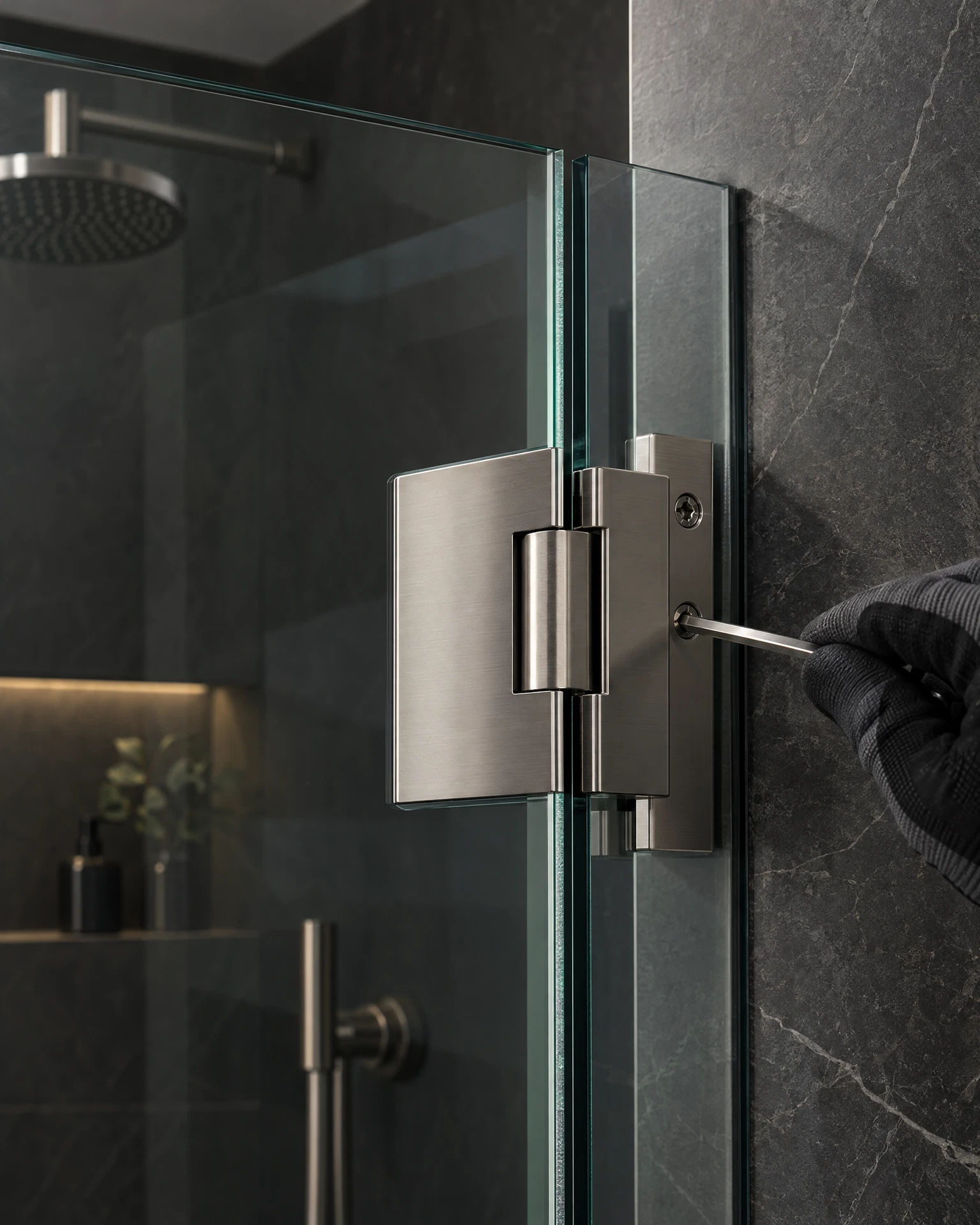
Of everything in a shower enclosure, the hinged door is where thickness is decided, because a hinged door is the only panel whose full weight hangs off one edge. Two forces act on the hinges. The first is the straightforward weight of the leaf. The second is leverage: the wider the door, the further its centre of weight sits from the hinge line, and the harder the top hinge is pulled. Width therefore punishes hinges faster than height does — a door that grows 100mm wider loads its hinges far more than a door that grows 100mm taller.
This creates a practical envelope for any hinged door, in either thickness. A narrow door on a compact opening sits comfortably inside it: 8mm carries it without flex or strain, and the door will feel fine. As the door gets wider and taller, two different limits approach. In 8mm, the limit that arrives first is rigidity — the leaf starts to flex at the handle edge, and the bigger the door, the more it moves. In 10mm, the leaf stays rigid, and the limit becomes the hinges themselves: the answer is heavier-duty hinges, a third hinge, or splitting the opening into a fixed panel plus a narrower door rather than asking one leaf to span it all. That last option is a layout decision, and it is often the right one — a very wide single door is awkward to use even when it is engineered safely.
The worked example from earlier shows the arithmetic installers actually do. Your opening is measured, the door leaf size is calculated from it, the weight follows from the area and thickness, and the hinge set is chosen to carry that weight with margin. A door specified the other way round — thickness picked from a brochure, hinges hoping for the best — is how doors come to sag, drag and leak within a few years. And a note that belongs in every thickness conversation: checking, adjusting or re-hanging a glass door of either thickness is qualified-person work. A 28–35kg panel under hinge load is not a casual DIY lift; the door has to be supported throughout, and a mistake can crack it.
Panel span and fixing limits
Fixed panels play by different rules, because nothing hangs and nothing swings: the panel is held along one or more edges — in a floor or wall channel, or on clamps — and the question is span. The longer the unsupported span, particularly along a free top edge or an unbraced end, the more a panel can deflect, and the sooner a thinner panel starts to feel and behave flexibly. The principle is simple: as spans grow, the case for 10mm strengthens, because stiffness is what keeps a long panel calm when it is knocked, leaned on or caught by a draught of shower spray.
Fixed panels appear throughout our shower glass installation work — as the fixed half of a door set, as walk-in screens, and as splash panels — and we hold them at the same 10mm standard for the same reason: at the spans real bathrooms ask for, the rigidity is doing quiet work every day. How far a walk-in or fixed panel can span in each fixing arrangement is a subject of its own, covered in its own guide; what matters for the thickness decision is the direction of travel — bigger span, thicker glass.
Why we install 10mm as standard
Our standard is 10mm, across hinged doors, sliding doors, fixed panels and bathtub glass, and the reasons are the three from the first section applied at real bathroom sizes. The doors and panels in Dubai, Sharjah, Abu Dhabi and Ras Al Khaimah homes are rarely small: openings are wide, ceilings are high, and doors are tall. At those sizes, 10mm keeps a hinged door rigid on its hinges, keeps a long fixed panel stiff, and gives sliding panels the flatness to run true in their tracks. The hardware ecosystem follows the same logic — the heavy-duty hinges, clamps, rollers and seal profiles we fit are made around 10mm glass, so glass and hardware are matched as a set rather than adapted to each other.
There is also a consistency argument that matters more than it sounds. An enclosure built from one thickness throughout — door, fixed panel, return — has edges that align, seals specified from one family, and hardware chosen once, correctly. Mixing thicknesses inside one enclosure creates a visible step at every meeting edge, different seal profiles on adjacent panels, and hardware compromises somewhere. One thickness, chosen at the level the largest panel needs, is simply the cleaner build.
To be clear about what this standard is not: it is not a claim that 8mm glass is unsafe or that an existing 8mm enclosure needs replacing. It is a specification decision for new work, made at the sizes we are asked to build — and the next section is the honest other half of it.
When 8mm is genuinely fine
There are real cases where 8mm is the right specification, and pretending otherwise would be sales talk rather than advice.
Small fixed panels. A short splash panel with a modest span, well supported along its fixed edges, asks little of its glass. At small sizes the flex difference between 8mm and 10mm is negligible, and the panel will sit calm and rigid for its whole life.
Narrow hinged doors. A compact door on a small en-suite opening — well inside the hinge envelope, with weight in the low twenties of kilograms — is carried comfortably in 8mm. The door stays flat because there is not enough leaf to flex, and the hinges are nowhere near their working limit.
Short over-bath screens. A small screen over a bath edge has a short span and is typically supported along the bath line, so the loads are modest. The thickness question there is dominated by other things — the shape of the bath edge and how the screen is fixed — rather than by rigidity.
The pattern in all three cases is the same: 8mm is fine when the panel is small enough that neither flex nor hinge load is being tested. The failures appear when 8mm is specified by habit or by headline saving on a door or span that needed 10mm — and even there, be aware the saving is usually smaller than expected, because measuring, hardware and fitting do not change with thickness. If your opening sits anywhere near the boundary — a wide door, a tall panel, a long span — that is exactly the case to have measured and specified rather than guessed.
Frequently asked questions
Is 10mm glass safer than 8mm?
Both thicknesses are toughened safety glass, and both behave the same way if broken. Thickness is not really a safety choice at these sizes — it is a rigidity and hardware-load choice. The safer enclosure is the one where the glass, hinges and fixings are correctly matched to the door’s size and weight, whichever thickness that turns out to be.
How thick is the glass in a typical shower door?
Doors vary with size, but the doors we install are 10mm, because typical UAE bathroom openings produce doors large enough that 10mm rigidity and hinge capacity are the right specification. Smaller doors elsewhere are commonly 8mm and perform perfectly well at their size.
Can I mix 8mm and 10mm glass in one enclosure?
It can be done, but we advise against it. The meeting edges step visibly where the two thicknesses meet, the seal profiles differ from panel to panel, and the hardware has to be specified in two families. One thickness throughout — set by the largest panel’s needs — gives the cleaner, more consistent enclosure.
Does thicker glass keep water in better?
Only indirectly. Sealing is done by the seals and the door’s alignment, not by the glass itself. But a rigid 10mm door holds its seals seated evenly along their whole length, where a flexing thinner door works its seals unevenly — so at larger door sizes, thickness supports the sealing rather than providing it.
My existing shower door is 8mm. Is that a problem?
Almost certainly not. If the door hangs true, closes cleanly and its seals are sound, its thickness was right for its size and there is nothing to fix. Thickness becomes a question when a door is being replaced, an opening is being changed, or a door is flexing, sagging or overloading its hinges — at which point the replacement should be specified from the measured opening, not copied from the old panel by habit.
How do I know which thickness my opening needs?
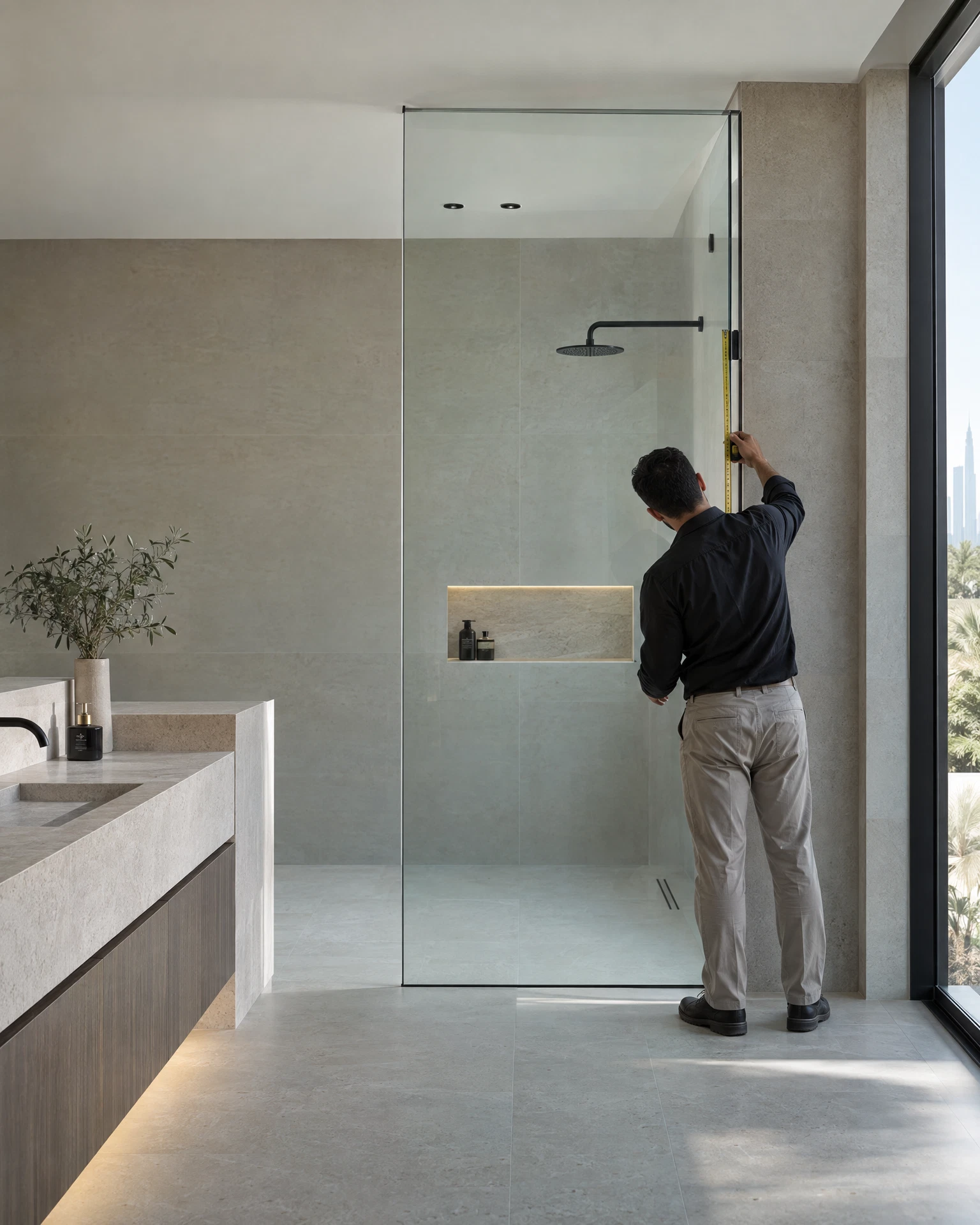
Send us the rough opening width and height — and a photo of the space — on WhatsApp, and we will tell you which thickness the door or panel size calls for and why. The final specification is always confirmed at the measuring visit, because the door leaf is calculated from the real opening, including how square the walls are.
Talk to us about your glass thickness
If you are choosing glass for a new shower and the 8mm-versus-10mm question is open, message us on WhatsApp on 052 443 2655 with your opening size and a photo. We will tell you honestly which thickness your door or panel needs — including when 8mm is genuinely enough — before you commit to anything.
This guide is part of our Shower Glass Installation series. Next: Preparing Your Bathroom for a Measurement Visit: What to Clear, Check and Decide →
