

“Magnetic strips don’t line up” is one of the most common ways owners describe this fault to us — and it is a precise observation, because a shower door closes properly only when several things happen at once. The door has to swing free, arrive square, meet its seals evenly along its full height, and then be held there by magnetic strips that meet face to face and take hold. When any one of those fails, the door stands slightly open, pops back after you push it, latches at the top and gaps at the bottom — and usually starts letting water through at the same corner. This guide decodes the closing symptoms into three checks: the gap, the magnetic strips and seals, and the hinges and fixings. Then it sets out what adjustment involves, and the point at which a closing problem stops being an adjustment and becomes a replacement.
At a glance
- Closing properly is a chain: free swing → square arrival → even seal contact → magnets meeting and holding. The symptom tells you which link broke.
- Check 1, the gap: the space between the door edge and what it closes against should be even, top to bottom. A tapered gap means the door has moved.
- Check 2, the magnets: strips that meet at one end only are an alignment fault; strips that meet fully but won’t hold are a magnet or seal fault.
- Check 3, the hinges: play or slip at the hinges shows up at the closing edge, furthest from them.
- A door that won’t close usually leaks too — the gap that lets the door stand open is the gap that lets water out.
What “closing properly” actually requires
On a well-set door the last part of the swing does the work: the door travels freely, the closing edge meets its seal or strike profile evenly, and the magnetic strips — one set in the door’s edge profile, one in the profile it closes against — come together along their full length and pull the door the final few millimetres into place. You feel it as a soft, definite take-up: no push needed, no bounce back.
That gives you the symptom map. A door that needs a lift or a push to latch has usually moved — it is arriving low or out of square. A door that latches at one end and stands off at the other has a taper in it: the strips are meeting where the gap is right and standing apart where it isn’t. A door that closes flush but drifts or pops open is meeting correctly and failing at the hold — the magnets or their profiles. A door that closes and holds but leaks at the closing edge has seal contact failing somewhere along the height, which is the same family of faults read from the water’s side: our guide to a shower door leaking at the bottom works through the leak-diagnosis side of it. Each symptom sends you to a different check below.
Check 1: the gap, top to bottom
Close the door gently, without forcing the latch, and look at the gap between the door’s closing edge and the frame, fixed panel or wall profile it closes against — from top to bottom, against the light. On a true door that gap is a constant, slim, even line. Three departures matter. A gap that tapers — tight at the top, wide at the bottom, or the reverse — means the door is out of square: it has dropped or shifted on its hinges, and no magnet will fix geometry. A gap that is even but too wide overall means the door is closing in the wrong place — shifted across, or seals that have compressed and thinned with age, so the strips never quite reach each other. And a gap that is right along most of its length but wrong at one point points at something local: a distorted seal, debris, or a profile that has taken a knock.
Note too whether the door still swings cleanly into that gap. If it has started catching or scraping on the way in, the closing fault has a floor-level twin: the full diagnosis for that is the dragging one, covered in our guide to a shower door dragging or touching the floor. Closing faults and dragging faults are frequently the same movement seen at different edges of the same door.
Check 2: magnetic strips and seals
With the door closed as far as it will go, run a fingertip slowly down the closing edge and feel where the magnetic strips meet and where they stand apart. The pattern is the diagnosis. Meeting at one end only — gripping at the top, say, and adrift at the bottom — is the tapered gap from Check 1: the strips are fine, the door’s alignment is not, and replacing the strips would change nothing. Meeting along the full length but holding weakly, so the door drifts open under its own seals’ spring, is a strip or seal fault: magnetic strips lose their pull with age and heat, the flexible seal blades behind them harden and push the door off instead of compressing, and the strip itself can slip or twist inside its profile so it presents edge-on rather than face-to-face. Meeting nowhere, with an even gap, points back to position — the door is closing short of where the strips can reach.
While you are there, look at the strips themselves: cracking, perished or flattened seal fins, scale build-up on the strip faces (heavy in hard-water areas, and enough to hold two strips a fraction apart along their whole length), and any length where the seal has pulled out of its channel. Scale and displaced seals are clean-and-reseat work; a hardened, perished seal set is renewal work — the same seal family covered in our wider repair work, and renewing seals on a door that is also out of square is wasted money until the alignment is corrected. Order matters: geometry first, then the soft parts.
Check 3: hinges and fixings
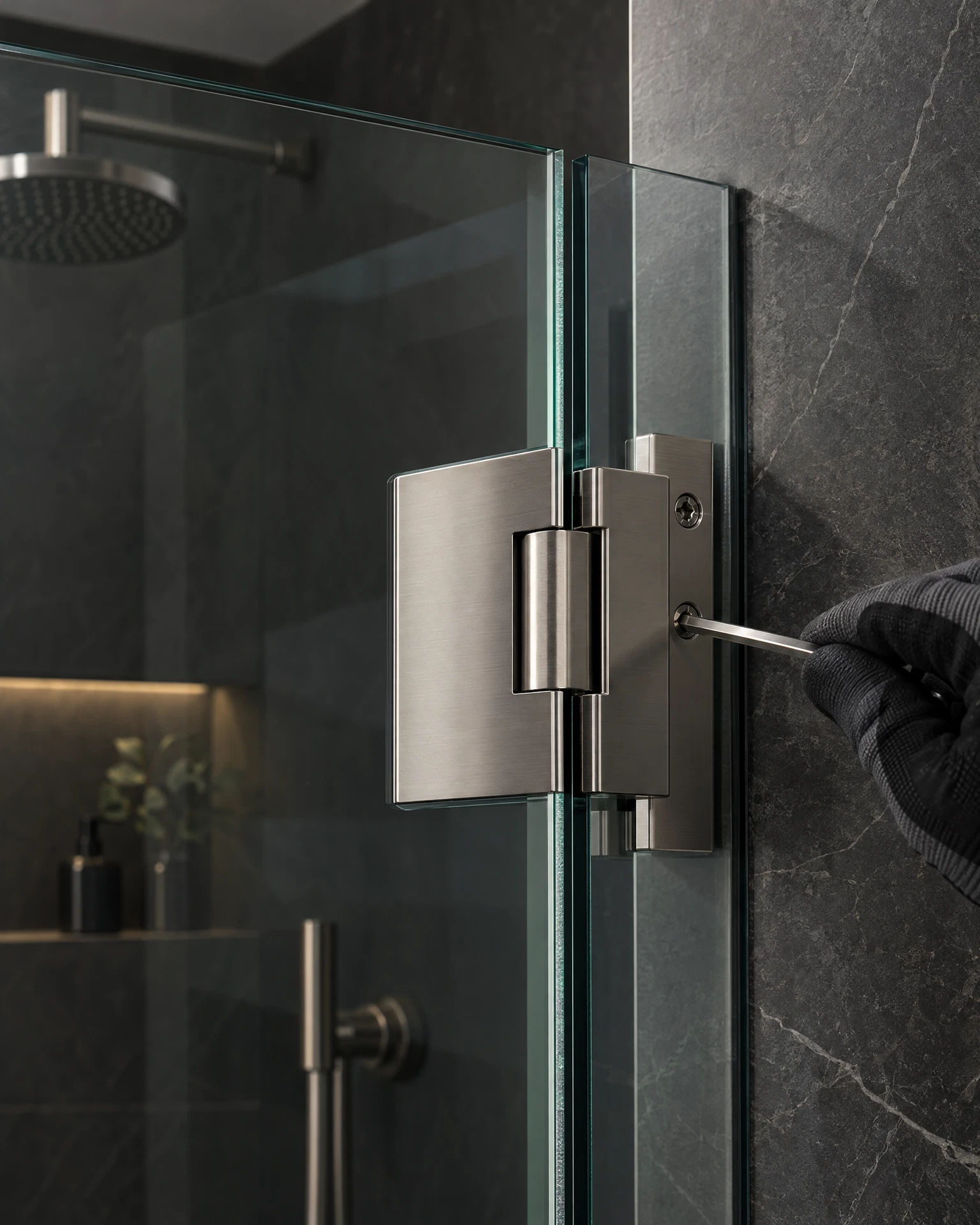
Everything in Checks 1 and 2 can be produced by movement at the hinges, because the closing edge is the far end of a lever: a millimetre of play at the hinge becomes several at the handle side. Watch the door as it closes the last part of its swing — does the whole door shift or settle as it arrives? Grip the handle and test for play: a slight lift-and-drop movement in the door, or a hinge body that moves against the wall or the glass when the door is lifted gently, tells you the fault lives at the hardware — fixings that have worked loose, or hinge mechanisms that have worn and developed play inside.
Distinguish the two if you can, because they lead to different work: movement of the hinge body is fixings; movement within a hinge that stays put is wear. But the verdict on the hinge itself — whether it can be adjusted back to truth, repaired, or should be replaced — is its own decision with its own tests, and it is covered in full in our guide to broken or worn shower hinges: adjust, repair or replace. For a closing fault, what Check 3 establishes is simply where the movement lives.
What adjustment involves
Adjustment means restoring the geometry the door was fitted with, in the right order. The door’s weight is supported first — a 10mm glass door is heavy, is never left hanging on one hinge while the other is loosened, and this is two-person work, not a solo wrestle with an Allen key. Then the source of movement is dealt with: fixings secured into sound material, a slipped hinge re-seated, the door brought back to square — even gap at the closing edge, even gap beneath, arriving flush along its full height. Only when the door hangs true are the soft parts judged: strips cleaned and re-seated, seals renewed if they have hardened or perished, and the magnetic take-up tested along the whole edge, top, middle and bottom. The verification is the close itself, repeated: the door should pull itself in from the last few centimetres, hold without drifting, and show an even seal line against the light. If a door has been standing open against a seal for a long time, that seal may have taken a set in the wrong shape — another reason the seals are judged after alignment, not before.
When closing problems mean replacement
Adjustment has a range, and some doors are beyond it. A hinge whose internal wear has eaten the adjustment out of it cannot hold a door square however carefully it is set — that is a hinge replacement, and occasionally the honest verdict on the hardware as a set. A door that was cut or hung wrong from the start — closing edge out of parallel with its frame in a way no hinge movement can correct — was never adjustable into truth; the fault is in the original fitting, and putting it right means re-hanging or replacing the panel, not endless adjustment. Damaged profiles and channels — a strike profile bent by impact, a magnetic channel torn out of its edge — can end the discussion about strips. And glass damage settles everything: a door whose edge has been chipped by closing against something it shouldn’t, or whose hinge notches are damaged, is a replacement panel, not a repair. In each case we will show you the evidence — the taper, the play, the damage — and explain whether the replacement is a part, a hinge set, or the panel, before any work is booked.
Frequently asked questions
Why do the magnetic strips only meet at the top?
Because the gap tapers. The strips meet where the door arrives at the right distance and stand apart where it doesn’t — and a door that grips at the top and gaps at the bottom has almost always dropped or shifted slightly on its hinges, so the bottom of the closing edge arrives short. It is an alignment fault wearing a magnet costume; new strips fitted to an out-of-square door will “only meet at the top” in exactly the same way.
The door closes, then pops open again a moment later. What is that?
The door is arriving but not being held. Either the seals have hardened and their spring pushes the door back off faster than the magnets can hold it, or the strips are meeting weakly — aged magnets, strips twisted in their profiles, or scale holding the faces a fraction apart. If it closes flush and then drifts, geometry is usually innocent and the strips and seals are the fault.
Can I replace the magnetic strip myself?
If it is a simple push-in profile and the door is hanging true, a like-for-like strip is one of the more approachable parts — but diagnose first. Most “strip” complaints are alignment or hardened-seal faults, and a new strip on a tapered gap changes nothing except the bill. Check the gap pattern in Check 1 before ordering anything; if the gap tapers, the strip is not your problem.
Will a door that won’t close properly leak?
Usually, yes — at the closing edge, and worst at whichever end stands off. The strips and seals that hold the door are also what seal it, so a closing fault and a leak at the door’s edge are most often one fault with two symptoms. If the leak is your main complaint, our leak guide works through the causes from that side.
My sliding door doesn’t close flush either. Does this apply?
Partly. A sliding panel that closes unevenly is usually out of line on its rollers or guides rather than its magnets; the checks on gap evenness still tell you a lot, but the hardware side of a sliding fault — rollers, tracks, alignment — is a different diagnosis from a hinged door’s.
Can you fix a shower door that won’t close in Dubai, Sharjah, Abu Dhabi and Ras Al Khaimah?
Yes — we repair shower glass across the four emirates we cover. Send a photo of the closed door showing the gap at the closing edge, top and bottom, and tell us which pattern from the checks above matches. We will tell you before we visit whether it looks like alignment, strips and seals, or hinges.
Talk to us about the door that won’t close
If your shower door won’t close properly — standing open, popping back, or with magnetic strips that don’t line up — message us on WhatsApp on +971 52 443 2655 with a photo of the door closed, showing the gap at the top and bottom of the closing edge. Tell us your area, and we will tell you honestly whether it points to alignment, the strips and seals, or the hinges — and what putting it right involves.
This guide is part of our Shower Glass Repair series. Next: Paid for a Shower Before — and It Still Leaks: Fixing Bad Installations →
