A cracked shower panel, or a shower door that has shattered, is one of the few bathroom problems where the first job is not diagnosis — it is keeping everyone away from the broken glass. Everything else in this guide comes after that. Toughened shower glass is strong in service, but once it is cracked its strength is unpredictable, and a shattered panel leaves fragments that stay sharp however small they look. Below are the make-safe steps for the first hour, why toughened glass behaves the way it does when it fails, what not to do, and then — once the bathroom is safe — how replacement actually works: how the new panel is measured, matched to your existing hardware, and refitted.
Make it safe: the first hour
Do these things first, before photographs, before phone calls, before tidying anything.
- Keep people and pets out of the bathroom. Close the door on the room if you can do so without walking through glass. A cracked panel can let go without warning, and a shattered one spreads fragments further than you’d expect — into grout lines, the tray, the bath mat.
- Do not touch, push, lean on or try to move the damaged panel. A cracked panel is held together by its own stressed surface, not by strength. Handling it, or swinging a cracked door “just to check”, is how panels come down.
- Do not use the shower. Water, steam and temperature change all work on damaged glass, and you would be standing in the fall zone.
- If the glass has shattered, keep shoes on anywhere near the room and keep children and pets away until the area has been professionally cleared. Fragments of toughened glass are small but genuinely sharp, and they travel.
- Do not attempt to remove the damaged panel or its remains yourself. Shower panels in 10mm glass are heavy, a damaged one is unstable as well as heavy, and its fixings are under unpredictable stress. Making safe and removing damaged glass is professional work, with the panel supported and controlled throughout.
- Then take photographs from the doorway — the whole shower, the damage, the hinges or channels, and any hardware — without stepping up to the panel. Those photos are what a replacement starts from, and they can be taken from a safe distance.
At a glance
- Safety first, always: people and pets out, hands off the panel, shower out of use, damaged glass left for professionals to make safe and remove.
- A cracked toughened panel cannot be patched, filled or glued back to strength — damaged panels are replaced whole.
- Toughened glass shatters into many small fragments rather than long shards — that is it working as designed, not a sign of poor glass.
- Replacement is measured, matched and made: the new panel is measured from the opening and the surviving hardware, matched for thickness and hardware positions, then toughened to order.
- Existing hardware is often reusable — if it is sound and wasn’t part of the cause.
Why toughened glass behaves the way it does
Shower glass is toughened (tempered) safety glass: it is heat-treated so its surfaces are in compression and its core in tension, which is what gives it its strength in everyday knocks and temperature swings. That internal stress pattern explains both failure modes in this article. A crack that reaches into the stressed core can run across the panel with little provocation. And when a toughened panel does fail completely, the stored energy releases through the whole sheet at once, breaking it into the familiar spread of small, relatively blunt fragments — far safer than the long blades ordinary glass produces, but still sharp, and still not something to walk through or pick through by hand.
It also explains why breakage can seem to come from nowhere. Edge damage is the common starting point — a chip at the panel’s edge or corner, where toughened glass is most vulnerable, sometimes done long before the panel finally lets go. Stress concentrated at a fixing, a hard knock from a handle or a metal bottle, or a flaw inside the glass itself can each be the trigger. The practical point is not which one it was — often that can only be judged from the remains and the hardware — but that a cracked panel is a panel whose stress pattern is already broken. It is not “mostly intact glass with a line in it”, and it should not be treated until it gets worse.
What not to do
- Don’t tape it up and keep showering. Tape does not restore any strength, and a panel held by tape is still a cracked panel — over a person, in steam, being swung on its hinges.
- Don’t try crack repair. Resins and fillers marketed for windscreens and mirrors do not apply to toughened shower glass: the panel’s strength is in its heat-treated stress pattern, not in its surface, and no surface product rebuilds that.
- Don’t order a replacement panel by measuring the broken one yourself and guessing the rest. A replacement must match the opening, the thickness and the exact hardware positions — and measuring around damaged glass is neither safe nor accurate. That measurement is part of the replacement job (below).
- Don’t reuse a damaged panel’s “good half”, and don’t let anyone talk you into a smaller panel in the same fixings. Partial fixes on damaged glass are how the second failure happens.
- Don’t sweep fragments into the bath or shower drain, and don’t pick through the remains looking for the cause with bare hands. Leave the forensic curiosity for after the area is safe.
How replacement works: measure, match, refit
Once the bathroom is safe, replacement follows the same discipline as any made-to-measure glass — with the damaged panel made safe and removed professionally as the first step of the job, not by you beforehand.
Measure. The new panel is specified from the opening: true widths and heights, the squareness of the walls and tray or bath edge, and the positions the hardware dictates. Where the damaged panel survives in one piece it can corroborate sizes, but the specification is the opening itself — panels fitted “to the old glass” inherit every error the old fitting had.
Match. The replacement is matched to what stays: the glass thickness of the original installation (our standard work is 10mm; the new panel matches the system it joins), the finish, and — precisely — the hardware positions. A hinged door panel is drilled and notched for its hinges and handle before toughening, and those positions are fixed at manufacture; they cannot be adjusted afterwards, which is why they are taken from the existing hardware layout before the glass is made. Toughened glass also cannot be cut down after toughening, so the panel is made to size from the start.
Refit. The new panel is fitted to the existing (or renewed) hardware, aligned — even gaps, closing edge meeting its seals, door latching squarely — then sealed and water-tested. A replacement door that drags or won’t close has not been finished, and the alignment checks from our wider repair work apply to it exactly as they do to a repair. The full service — what we replace and how the job runs — is set out on our shower glass replacement page.
Reusing existing hardware: when it is sensible
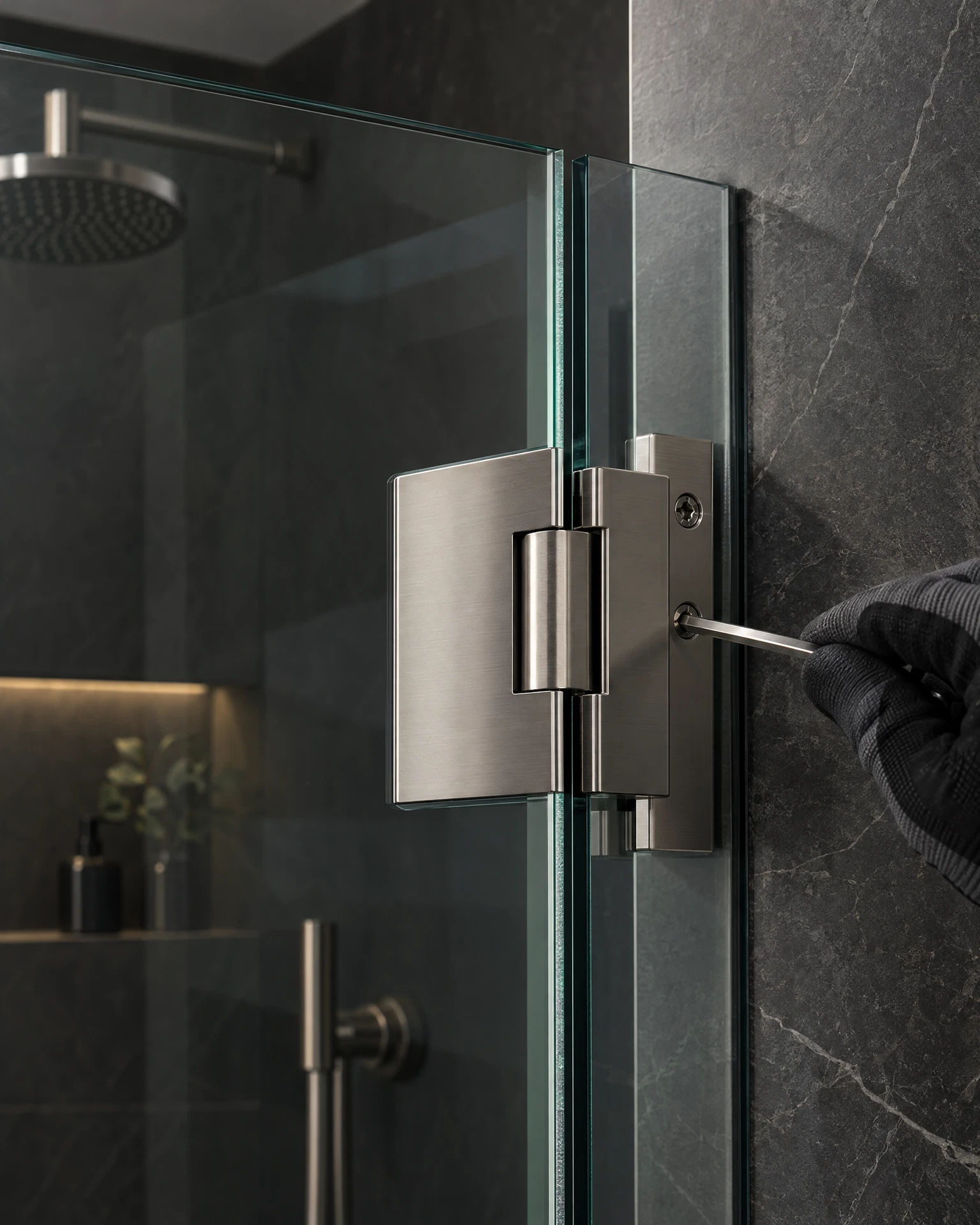
Often, yes — and it is one of the things that keeps a replacement straightforward. Hinges, handles, channels and sliding gear that are sound, uncorroded and undamaged can stay, and the new panel is made to fit them. There are three exceptions, and they are judged on inspection, not assumed from photographs alone. Hardware that is damaged or worn out is not reused — a hinge with play in it will load the new panel unevenly from day one. Hardware implicated in the failure — a fixing that was over-stressed, a fitting that chipped the edge it gripped — is renewed, or the same stress is rebuilt into the new panel. And hardware whose finish or type can no longer be matched matters on multi-panel enclosures, where one odd hinge shows. If your hardware falls into any of those, we will show you why from the inspection, and the replacement panel is specified around the new fittings instead.
Frequently asked questions
The panel is cracked but still in place. Is it safe to leave for a few days?
Leave it alone, keep the bathroom out of use, and treat “a few days” as the outside limit, not a plan. A cracked toughened panel can fail at any point — a door closing elsewhere in the house, a temperature change, nothing at all. Keep people away from it and get the replacement started; the photos for a quote take two minutes from the doorway.
Can a cracked shower panel be repaired instead of replaced?
No. Toughened glass cannot be patched back to strength — its strength is a heat-treated stress pattern through the whole panel, and once that is broken no filler, resin or tape restores it. Damaged panels are replaced whole; that is not a sales position, it is how the material works.
Why did it shatter on its own? Nobody touched it.
It happens with toughened glass, and it usually isn’t truly causeless: edge damage from an earlier knock, stress at a fixing, or a rare flaw within the glass can sit quietly until the panel lets go — sometimes months later, sometimes under a temperature change. What matters practically is that the replacement inspection looks at the hardware and fixings, so a cause that lives in the fitting is not rebuilt into the new panel.
How is the new panel matched if I don’t know who installed the original?
From the opening and the hardware, not from paperwork. The measurement takes the opening’s true sizes, the thickness is read from the installation itself, and hinge and handle positions are taken from the existing layout before the panel is made. An unknown installer is the normal case, not a problem.
What should I send on WhatsApp for a replacement quote?
Photos taken from a safe distance: the whole shower or enclosure, the damaged panel, close-ups of the hinges or channels and any handle, and the rough width and height of the panel if you can read them from the doorway side. Tell us your area and whether the glass is cracked or fully shattered — and do not step closer to get a better photo.
Can you replace cracked shower glass in Dubai, Sharjah, Abu Dhabi and Ras Al Khaimah?
Yes — we install and repair shower glass across the four emirates we cover, and damaged-panel replacement is part of that repair work. Making the area safe comes first; message us the photos and we will tell you the sequence for your case before any visit is arranged.
My shower glass is broken but still in place — what do I do?
Treat it as failed even if it is holding together. Toughened glass that has cracked can give way without warning, so stop using the door, keep children and pets away from it, and do not tape it up and carry on. Take photos from a safe distance and send them to us on WhatsApp — we will tell you how to make the area safe and arrange the replacement. Broken glass cannot be repaired in place; the panel is replaced.
Talk to us about the damaged glass
If your shower glass has cracked or shattered, keep everyone clear of it and message us on WhatsApp on +971 52 443 2655 with photos taken from the doorway — the whole shower, the damage, and the hinges or channels. Tell us your area and whether the panel is cracked or has shattered, and we will talk you through making it safe and how the replacement will be measured, matched and fitted.
This guide is part of our Shower Glass Repair series. Next: Shower Door Won’t Close Properly? Alignment, Magnets and Gaps →