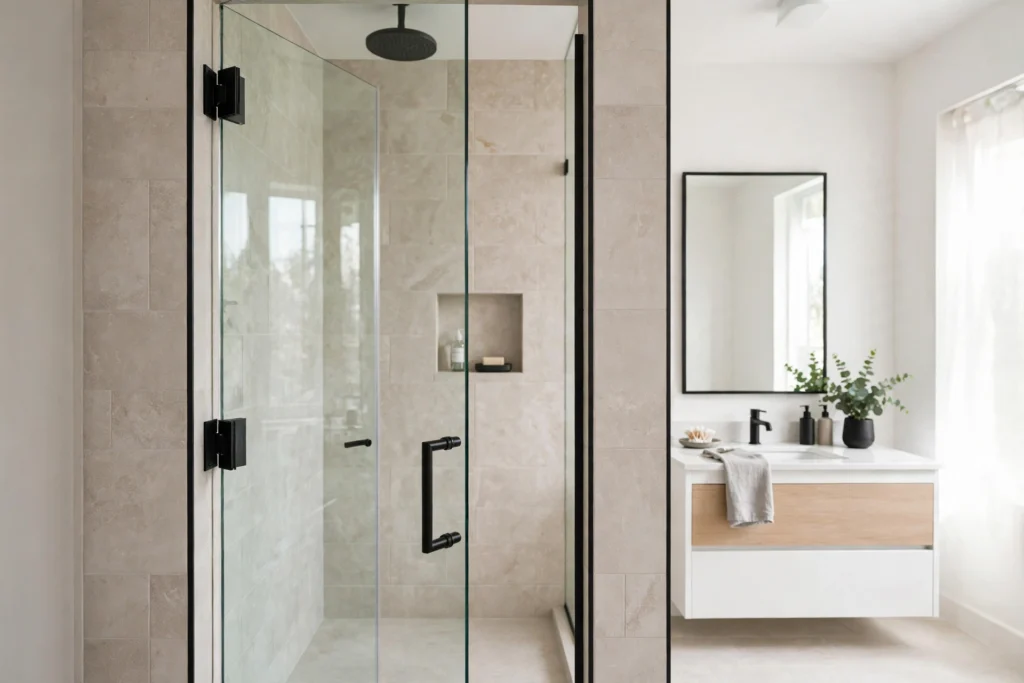
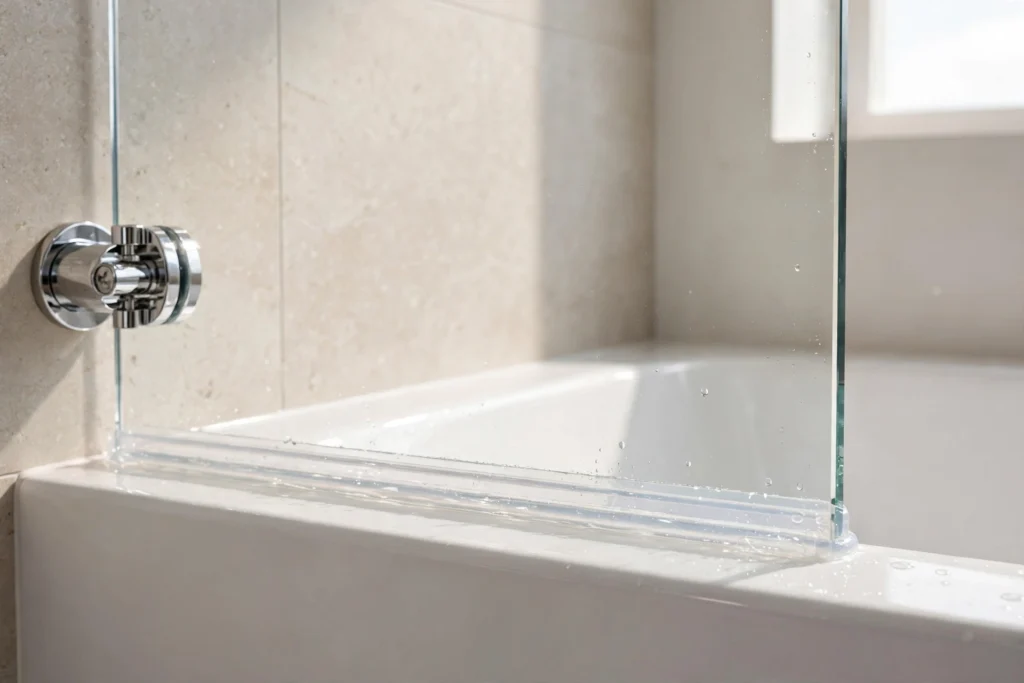
Over a shower tray, the sliding-versus-fixed question is mostly about space: a slider needs no swing room, a fixed panel needs no door. Over a bath, that familiar comparison quietly stops applying, because the bath changes the terms. The screen stands on the bath’s edge rather than on a flat tray, you climb over that edge to get in, the taps sit at one end of the run, and the bath’s length — not the room’s width — is the territory being guarded. A sliding screen over a bath is a genuinely different product from a sliding shower door, and a fixed bath screen is equally different from a walk-in panel. This article compares the two over-bath options on the things that actually differ: access along the bath, sealing and the track at bath level, the cleaning reality, and which baths each one suits. (Sliding doors over shower trays are a separate question — that is the Sliding pillar’s ground, and containing water with them is covered by its own guide.)
At a glance
- A fixed screen is one sealed panel and an opening: no moving parts, one bath-edge seal line, and permanent open access along the rest of the bath.
- A sliding screen covers the full length but only ever opens part of it: the panels overlap, so the usable opening is a fraction of the run — and it can be moved along the bath.
- The track is the slider’s price of admission: it sits at bath-edge level, collects water, soap and scale, and needs cleaning a fixed panel never asks for.
- Sealing differs in kind: fixed = one static seal line; sliding = a channel, overlapping joints and moving seals — more leak points, each manageable, none imaginary.
- The bath decides: a long, straight, flat, wide rim can carry a slider well; a curved, narrow or uneven edge points firmly to fixed.
Why the bath changes the sliding question
Three facts of bath geometry drive everything that follows. First, the threshold is the bath edge itself — a rim you step over, of a width and flatness the bath manufacturer chose, not the installer. A sliding system’s track has to live on or above that rim, and not every rim offers it a home. Second, access runs along the bath, not into an open floor area: you enter over the edge at whichever point the opening allows, and everything you do in the bath — reaching the taps, bathing a child, cleaning the far end — happens along that same line. Third, the water’s behaviour differs: a shower over a bath throws its spray along the bath’s length, so coverage is a question of how much of the length is guarded, not how wide a doorway is. Judge both screens against those three facts and the comparison almost makes itself.
Access along the bath
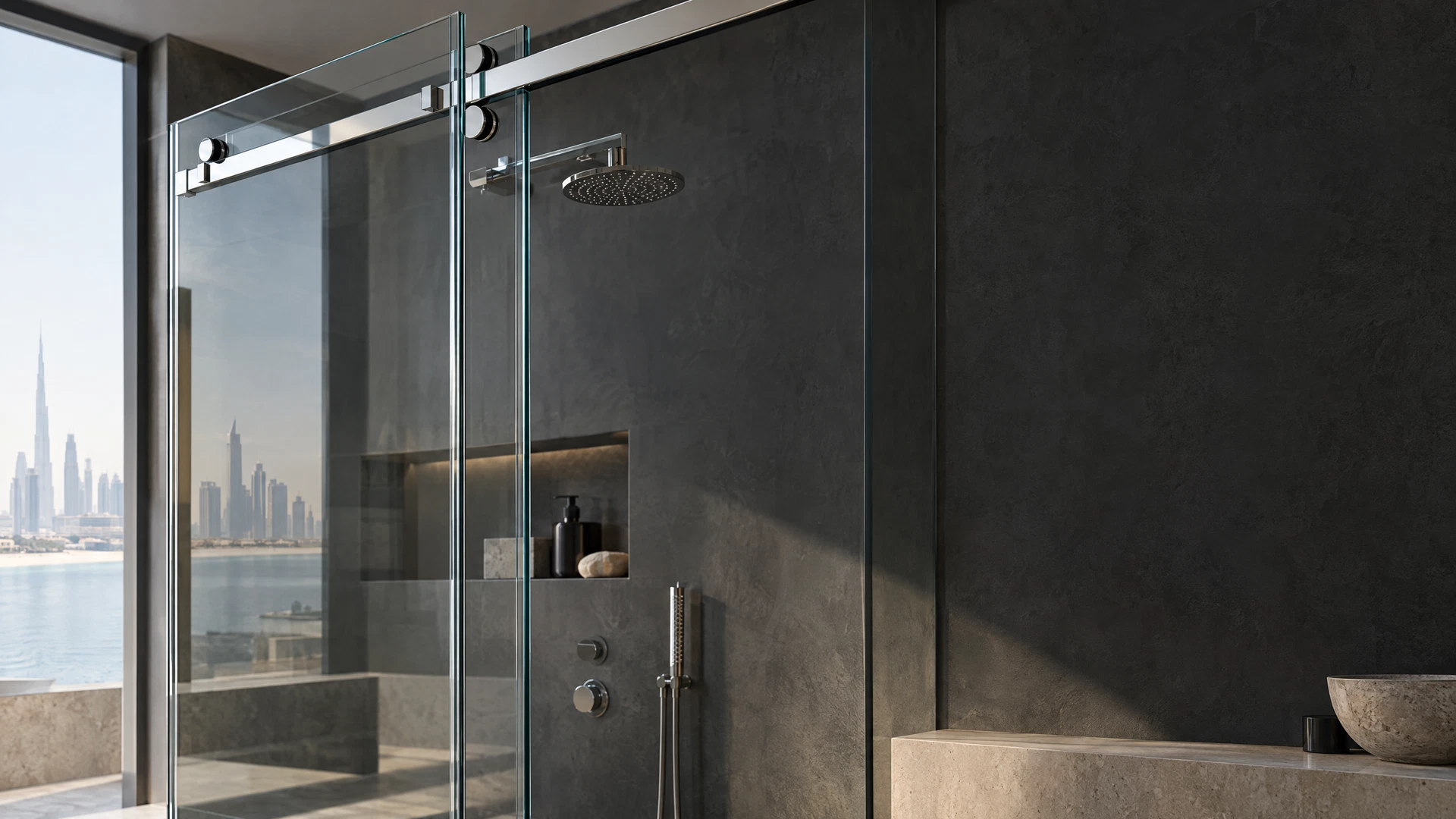
A fixed screen guards its section and leaves the rest of the bath permanently open. That openness is its access story: step in anywhere along the unguarded length, reach the taps without moving anything, lean in to clean the whole tub. The opening never changes size or position — which is a virtue for routine and a limitation only if the guarded section stands where you wanted to climb in.
A sliding screen plays the opposite hand. Closed, it can guard the bath’s full length — the only over-bath system that can. But open, it never gives you the full length: the panels stack over each other, so the clear opening is the run minus the overlap, and on a short bath that opening can become genuinely awkward — wide enough to climb through, narrow enough to make bathing a child or cleaning the far end an exercise in reaching through a gap. What the slider returns for that compromise is flexibility: the opening can be positioned along the bath — at the tap end for filling and cleaning, at the middle for climbing in — by sliding the panels to it. Households feel this difference daily and imagine it beforehand least, so picture the actual movements: the fixed screen asks nothing and offers a fixed gap; the slider offers a movable gap and asks a small negotiation every time.
Sealing and the track at bath level
A fixed screen’s sealing is almost boring, which is its strength: one continuous bath-edge seal under the panel, one vertical seal at the wall, both static, both inspectable at a glance. Where those seals sit, how they age and how they are renewed is its own subject — where bath screens leak at their seals — but the fixed screen has the shortest leak map of any bath screen: two lines and the corner where they meet.
A sliding screen replaces that simplicity with a small system. The bottom track is a channel sitting at bath level, and a channel at bath level collects what bath level produces: standing water, soap, shampoo and scale. Good systems drain the channel back into the bath; all systems need it cleared out periodically, because a silted track holds water against the seals and slows the panels. The panels’ overlap joints shed most spray by geometry — water running down one panel meets the next panel behind it — but they are moving joints, not sealed ones, and direct spray fired straight at an overlap will find some of it through. The rollers and guides carry the panels above that channel, and they live in the dampest, soapiest zone of the whole installation. None of this makes a bath slider leaky by nature; it makes it a system with more, smaller sealing behaviours to keep on top of, where the fixed screen has two.
The cleaning reality
Be honest about maintenance, because it is where sliders lose their shine — literally. The fixed panel is two flat faces of glass and an edge seal: the same wipe-down as any screen, with hard-water scale the main enemy in our water. The sliding system adds the channel: a narrow track that collects a paste of soap and scale, reachable with a brush rather than a cloth, plus the overlap zone where two panels pass and neither face can be wiped without sliding the other out of the way. The panels themselves also meet the bath edge along a moving seal that drags through whatever the edge has collected. None of it is heavy work, but it is recurring work, and it belongs to the household, not the installer. If the honest self-assessment is that the track will never be cleaned, the fixed screen is the better recommendation — a neglected track is the start of most bath-slider complaints: stiff panels, standing water, smells that seem to come from nowhere.
Which baths suit a slider
A slider earns its place on a bath with a long, straight run — enough length that the stacked opening stays generous — and a rim that gives the track a proper home: wide enough, flat enough, and level enough along its run for the channel to sit and drain as designed. It suits households whose over-bath shower is the main shower and who want full-length coverage without a door swinging into the room, and who will give the track its occasional clean. A fixed screen wins on short baths (where the slider’s opening shrinks twice — once to the stack, once to the run), on curved or sculpted rims and narrow edges that cannot carry a channel honestly, in households that bathe more than they shower over the tub and want the access permanently open, and anywhere the cleaning will not happen. Curved and uneven edges are their own fitting problem beyond this comparison — they are measured and judged case by case, and sometimes they rule out more than the slider.
Between the two sits the option this comparison deliberately leaves out: the hinged screen, fixed’s sibling, which trades the fixed panel’s simplicity for a door’s access — that choice is worked through in our fixed vs hinged bath screens comparison, and the full range is on our bathtub glass screens page.
Frequently asked questions
Does a sliding bath screen leak more than a fixed one?
It has more places water can misbehave — the track channel, the overlap joints, the moving bottom seals — against the fixed screen’s two static seal lines. Fitted on a suitable rim and kept reasonably clean, a slider contains a shower well; neglected or fitted on an edge that never suited it, it leaks at the track first. The fixed screen’s advantage is not magic sealing, it is having so little to go wrong.
Is the track difficult to clean?
Not difficult, but it is a real, recurring job: a brush along the channel, the drainage slots cleared, the overlaps wiped by sliding each panel across. In hard-water areas the scale builds steadily. If that sounds like a chore that will be skipped, choose the fixed screen — its whole maintenance is a wipe and an occasional seal check.
Can I still get into the bath easily with a sliding screen?
You climb in through the opening the stacked panels leave, positioned where you slide it. On a long bath that opening is comfortable; on a short bath it can feel like posting yourself through a gap, and reaching the far taps for a child’s bath means sliding panels back and forth. Try the movement in your head against your actual routine before choosing — it is the difference owners mention most after fitting.
My bath has a curved or very narrow edge. Can I have a slider?
Probably not honestly. The track needs a flat, level seat of adequate width along its run; a curved or narrow rim gives it neither, and forcing a channel onto one builds the leak in at fitting. A fixed screen, which asks the edge for one seal line rather than a channel, is usually the answer on such baths — and some edges need their own solution entirely, which a measurement settles.
I have a fixed screen now. Can it be converted to a slider?
Not by conversion — the two are different systems with different hardware, and the fixed panel’s glass is not drilled or sized for a track. It would be a replacement: old screen off, edge made good, new system measured and fitted. That is sometimes the right call, but go into it as a replacement decision, not an adjustment.
Talk to us about your bath
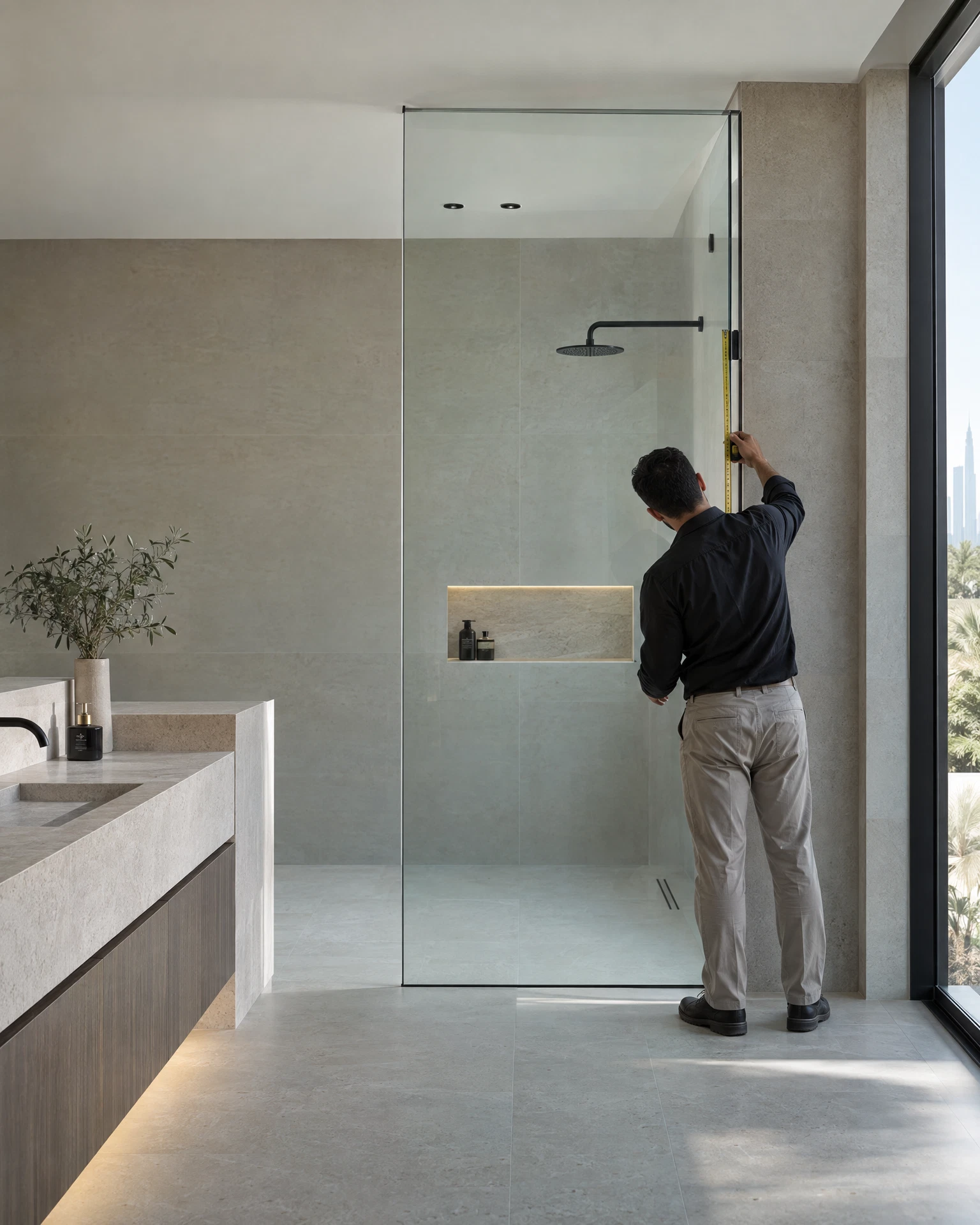
If you are choosing between a sliding and a fixed screen, message us on WhatsApp on +971 52 443 2655 with a photo along your bath’s edge and one wide shot of the bathroom. The rim’s width and run are usually visible in the photos, and we will tell you which system your bath honestly suits — before either is measured for a quote through the shower glass price guide.
This guide is part of our Bathtub Glass Screens series. Next: Bath Screen Seals: Where Bath Screens Leak and How It’s Prevented →