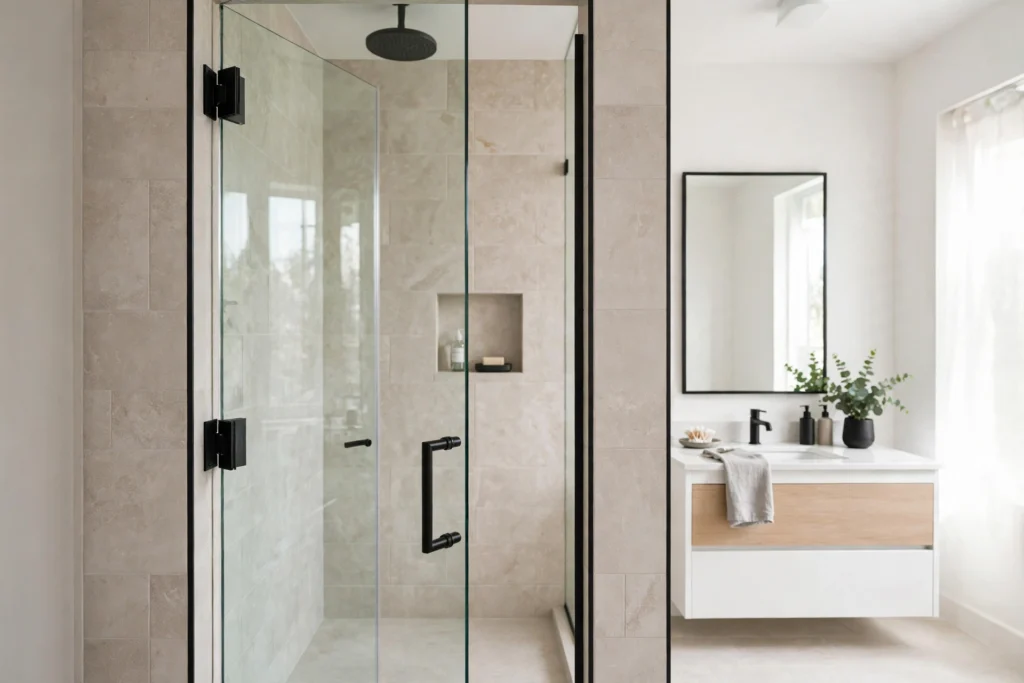
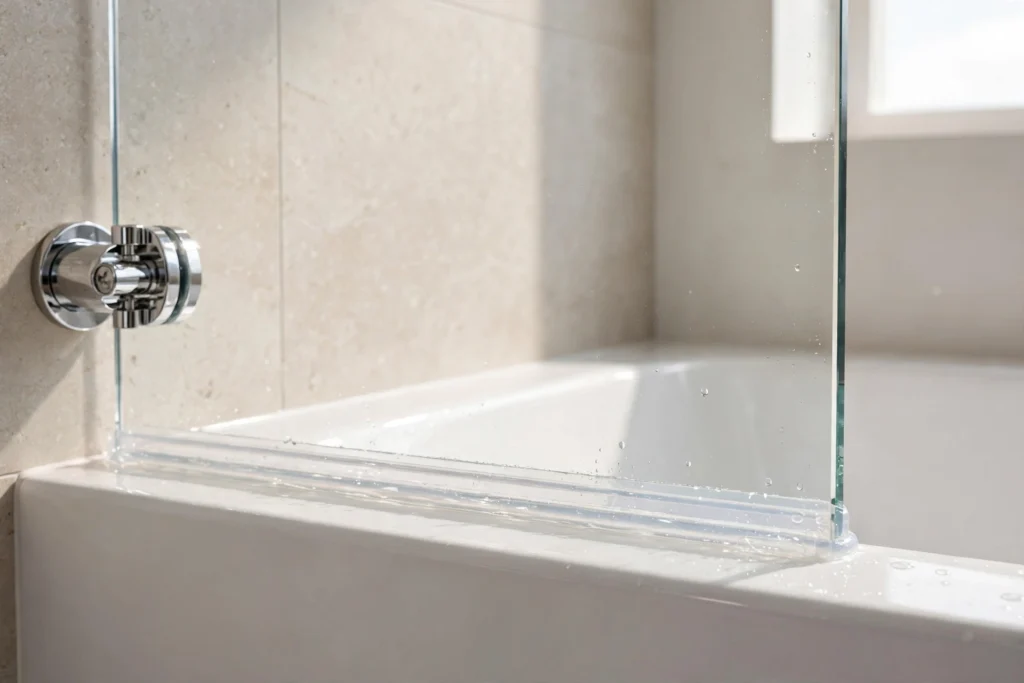
The half glass door is the bath screen people ask about most hopefully. It promises the clean line of glass without giving up the open bath: a door that covers the shower end of the bath, hinges open when you want the tub, and leaves the rest of the bath — and the room — feeling unboxed. The question underneath every enquiry is the same one, and it deserves a straight answer: is half a door enough, or will the bathroom floor pay for the openness? The honest answer is that a half door is a coverage compromise with a predictable pattern — it holds back the water that lands where it stands, and it does nothing about the water that lands beyond it. Whether that is a good bargain depends almost entirely on where your shower head sits, how you shower, and how long your bath is. This article works through the coverage first, then the genuine pros, then the splash reality, so you can judge it for your own bathroom rather than from a brochure.
At a glance
- A half door covers roughly the shower end of the bath — the length beyond the door is open by design, and splash that reaches it escapes.
- Shower head position decides more than door size: a head above the covered end, aimed down the bath’s length, is the forgiving setup; a head near the open end defeats any half door.
- The pros are real: full open access for bathing and cleaning, no track, nothing to swing into the room’s space beyond its arc, and the lightest visual footprint of any bath screen.
- The cons are equally real: it is a splash reducer, not a seal. Energetic showering, children, and a hand shower waved around will all put water past it.
- It suits adults showering at the covered end of a longer bath, in households that also bathe and want the access — and it does not suit anyone expecting enclosure-level dryness.
What a half door actually is
Start with what the thing is, because the name invites a misunderstanding. A half glass door is a single hinged glass door, made to measure, fitted at one end of the bath — almost always the end where the shower is — covering a portion of the bath’s length rather than all of it. “Half” is approximate: the coverage is set by the bath, the shower position and the swing, not by a fraction. It differs from a fixed half panel in the one way that matters: it moves. It hinges open — for climbing in, for bathing children, for cleaning the bath — and closes to stand guard while you shower. It differs from a full-length hinged screen in the other way that matters: where the full screen guards the whole edge, the half door guards its section and stops. Everything else about the choice follows from those two facts. If you are still weighing the full-length options, our comparison of fixed vs hinged bath screens covers that decision; this article is only about the partial door.
Coverage: where the water actually goes
Water leaves a shower over a bath by three routes, and a half door deals with them very differently. The first is direct spray: water from the head, and water bouncing off your body, travelling in the direction it is aimed. Within the door’s length, that water meets glass and runs down into the bath — handled. Beyond the door’s end, the same spray meets open air and lands on the bath edge, the floor, or the wall at the far end — not handled, and no half door of any quality changes that. The second route is runoff: water sheeting along the bath edge itself, which the door’s bath-edge seal interrupts only along the door’s own length. The third is the casual splash — the elbow, the dropped shower gel, the child — which obeys no geometry at all.
So the coverage question is really a question about your spray pattern. Stand in the bath and look at where the water actually lands when you shower: the wetted zone on the far wall and the bath edge marks the territory a screen has to guard. If that zone sits comfortably inside the door’s length, a half door covers your shower. If it extends past where a door can reasonably reach, the shortfall will be on your floor — every time, in roughly the same place, which is why half-door regret has such a consistent shape: not a flooded bathroom, but a permanently damp patch at the open end that its owner did not expect.
The shower head position decides
More than any other factor, the head’s position and type settle whether a half door works. The forgiving setup is a fixed head mounted above — or just inside — the covered end, angled so its spray falls down the bath’s length and lands within the guarded zone; the door then intercepts both the direct spray and most of the bounce. A rainfall head centred over the covered section is similarly workable: its water falls in a column the door mostly stands inside. The unforgiving setups are a head mounted towards the open end of the bath (the door is then guarding the wrong territory entirely), a hand shower on a riser that gets aimed along and out of the bath, and any arrangement where the bather stands at the open end to be under the water. Bath length helps or hurts: on a long bath, the covered fraction can guard the whole wetted zone while still leaving generous open length; on a short bath, the same door covers the same absolute length but the spray has far less bath to land in before it reaches the open section. This is why the half-door conversation always starts with a photo of your bath and its shower position — the answer is visible in it before anything is measured.
Pros: access and openness
The case for the half door is not hard to make, because its advantages are the ones you feel daily. Access is the headline: the door swings open, so getting into the bath, lifting a child in and out, and cleaning the full length of the tub are all unobstructed — where a full fixed panel leaves you leaning over glass to reach the far taps, and a full screen with a gap makes you plan around it. The room stays open: with no glass along most of the bath, the bathroom keeps its sense of space, light moves freely, and the bath still reads as a bath. There is nothing to maintain along the edge: no track to clean, no second panel, one bath-edge seal and one hinge line — the simplest hardware set of any moving bath screen. And when it is open, it is genuinely out of the way in a way a curtain never manages: no fabric clinging, no rail, just glass folded back and a clear bath. For households where the bath is used as a bath most of the week and showered over carefully by adults, these are not small things — they are the difference between a screen that suits the household and one it resents.
Cons: the splash reality
And here is the other side, stated as plainly. A half door will not keep all the water in. It reduces splash at the guarded end — substantially, for a well-placed head and a settled showering style — but the open length is open, and water will find it: spray that carries, bounce off shoulders, the rinse that aims the hand shower the wrong way for a second. Expect a mat at the open end and a floor that tolerates one. It is the wrong choice for enthusiastic showering — long rinses, moving around under the water, children treating the bath as a water park — because all of it pushes the wetted zone past any partial coverage. It cannot be upgraded by quality: a better-made half door seals its own edges better, but no hinge, seal or glass thickness extends its length; the limitation is geometry, not manufacture. And it asks something of the bather: a moment’s awareness of where the water is aimed, which some households are happy to give and others will simply never do — and both are legitimate positions. What we will not do is fit one while promising enclosure dryness; the households that love their half doors are the ones who chose them with the splash reality in view.
Who it works for
Put together, the half door’s household looks like this: the bath is a bath first — used for soaking, for children, for the dog — and showered over second, by adults whose shower head sits at the covered end and whose style is reasonably contained. The bath is long enough that the guarded zone covers the spray. The floor at the open end is tile or stone that shrugs off a damp mat’s worth of water. Against that, it does not work where the over-bath shower is the household’s main shower used hard every morning, where the head sits at the wrong end, where the bath is short, or where a dry floor is non-negotiable — for those, the full-length options on our bathtub glass screens page are the honest route, and we will say so from your photos before you spend anything.
Frequently asked questions
Will a half door keep my bathroom floor dry?
At the guarded end, yes — direct spray there is caught and returned to the bath. At the open end, no: splash that travels past the door lands where it lands. Most half-door households run a mat at the open end and find that a fair trade for the access; if you need the whole floor dry after every shower, you need full-length coverage.
Can a half door be made longer than half?
Yes — coverage is made to measure, and a door can guard more of the length. But follow the logic through: as the door approaches the full length, you are really choosing a full-length hinged screen, which is a different article’s decision (our fixed vs hinged comparison) with its own swing and access behaviour. The half door earns its place while a meaningful length stays open.
Does a half door seal properly where it closes?
Along its own edges, it is sealed like any hinged screen: a bath-edge seal beneath it and a closing edge that meets its stop. Those seals govern the door’s own footprint. They do nothing about the open length — which is the distinction that matters, and why “sealing” is never the fix for a half door that lets water past its end.
Half door or shower curtain — is the glass worth it?
For the length it covers, glass holds water back far better than a curtain, stands clear of the bather, and does not cling, billow or mildew at the hem. The curtain’s one advantage is that it can be drawn along the whole bath — full-length, flexible coverage. Households that shower gently and hate curtains choose the door; households that need every centimetre covered cheaply keep the curtain until they are ready for a full screen.
What do you need from me to advise on a half door?
One photo along the bath showing the shower head’s position, and one from the doorway showing the whole bath and its length. From those we can see the wetted zone your shower makes and tell you honestly whether a half door covers it — or whether your setup is one of the ones that defeats it.
Talk to us about your bath
If a half door sounds like your bathroom, message us on WhatsApp on +971 52 443 2655 with a photo along the bath showing the shower position and one wide shot of the whole bath. We will tell you plainly whether it will work in your setup — and if the splash reality says otherwise, we will tell you that instead, and what would work. For figures, the shower glass price guide sets out how bath screens are priced; the exact number follows measurement, as always.
This guide is part of our Bathtub Glass Screens series. Next: Fixed vs Hinged Bath Screens →