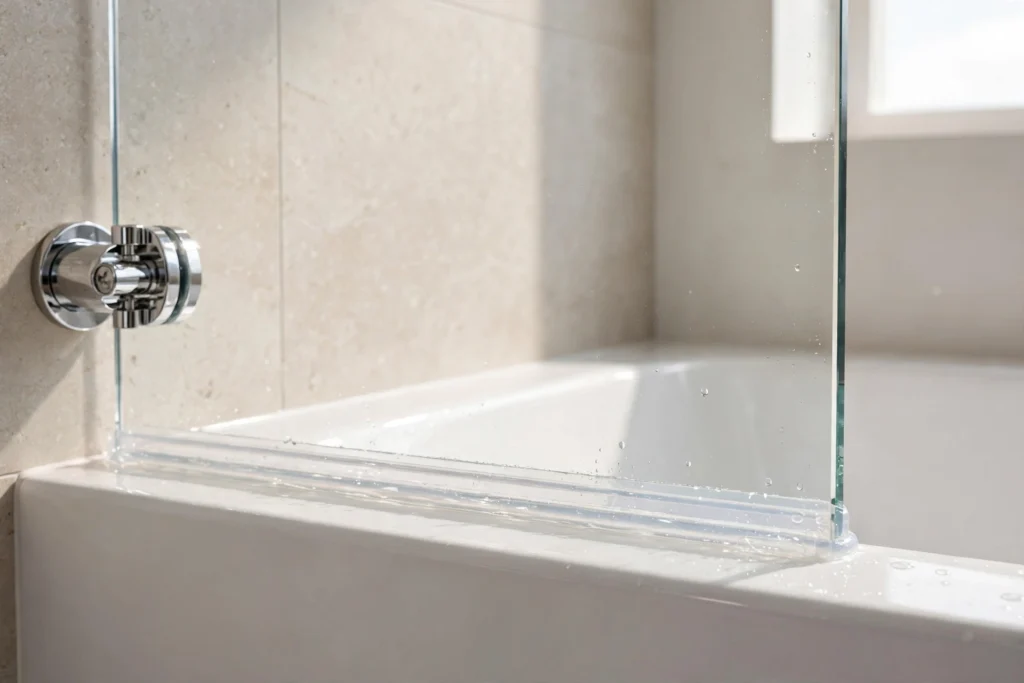
A bath screen has far fewer places to leak than a shower enclosure — and it leaks at them with great predictability. Strip the subject down and there are three: the seal where the screen meets the bath edge, the seal where it meets the wall, and, on a hinged screen, the gap at the hinge line. Nearly every “my bath screen leaks” conversation resolves to one of the three, or to the small corner where two of them meet. That is good news twice over: each point can be prevented properly at fitting, and each has a recognisable ageing pattern, so a leak that appears years later can usually be read like a label — where the water shows up tells you which seal has finished. This article walks the three points in order of importance, what prevention actually consists of at installation, and how aged seals are renewed when their time comes. It covers bath screens only; the equivalent map for shower door seals and silicone in depth is its own guide, linked below.
At a glance
- Three leak points: the bath-edge seal (the critical one), the vertical wall seal, and the hinge-line gap on hinged screens — plus the corner where the first two meet.
- The bath-edge seal does the heavy work: it turns back the full sheet of water running down the glass, along the whole length of the screen, every shower.
- Prevention happens at fitting: a rim checked for level and curve, the correct seal profile in full contact, the wall profile bedded against a checked wall — none of it visible afterwards, all of it decisive.
- Hinge-line gaps are managed, not eliminated: a moving joint cannot be sealed shut; it is kept out of the direct spray line and fitted with deflecting seals.
- Seals are consumables: when one hardens, splits or lifts, renewal with the correct profile — not a bead of silicone over the top — is the fix.
The three leak points on a bath screen
Picture the screen standing on the bath. Water running down its face reaches the bottom edge and meets the bath-edge seal, the flexible profile the screen sits in or behind, compressed against the rim. At the wall end, the vertical seal closes the line between the screen’s edge — usually held in a wall profile — and the tiles, from the bath rim up to the screen’s top. And on a hinged screen, the hinge line is the vertical joint where door meets fixed section or wall bracket: a working pivot that must stay free to move. Leaks present accordingly: water pooling on the rim and escaping at the bath’s outer edge is the bath-edge seal; a damp patch on the wall or floor at the screen’s end is the vertical seal or the corner; spray appearing on the floor beside the hinge, usually only while the shower runs, is the hinge line. The corner — the few centimetres where bath-edge seal meets wall profile — deserves its reputation as the honorary fourth point: it is where two seals and a sealant line all terminate, and a small failure there borrows the symptoms of both its neighbours.
The bath-edge seal: the critical one
This seal carries the whole job. Every litre that hits the glass runs down it and arrives at the bath edge, and the seal’s task is to turn that sheet of water back into the bath rather than let it continue under the screen and off the rim’s outer face. Three things decide whether it succeeds. Contact: the profile must touch the rim continuously along the full length — a seal that bridges a dip in the rim seals the high spots and leaks at the low one, which is why the rim’s run is checked at measurement, and why a curved or stepped edge is a fitting problem in its own right, judged case by case. Profile: the seal must suit the glass thickness and the gap it closes; a profile too slight stands off the rim, and one too deep drags, folds and wears. Compression: the screen’s weight and fixings hold the seal in gentle, even compression — a screen that has worked loose on its fixings unloads the seal at one end, and the leak appears there first.
At fitting, prevention is therefore mostly measurement and patience: rim level and curve recorded, the correct profile supplied with the screen rather than improvised on the day, the seal run unbroken from wall to the screen’s end with the corner finished deliberately. In service, the bath-edge seal ages by hardening — the flexible fin that once sprang against the rim goes stiff, then cracks along its bend, then starts to lift at the ends. The early sign is a rim that stays wet long after the shower and a faint tide line escaping at one spot; the late sign is water on the floor that has clearly come under the screen rather than over it.
Wall profile and vertical seals
The wall end fails more quietly. The screen’s edge typically sits in an aluminium wall profile, and the seal that matters is the one between that profile and the wall — a line that has to cope with the wall as it is, not as it was drawn. Walls that lean or bow leave the profile touching at top and bottom and standing off in the middle; a profile forced flat against a bowed wall twists, and the screen in it sits under stress. Prevention at fitting is checking the wall’s plumb before the profile is fixed, packing or bedding the profile so its seal line is continuous, and sealing the profile’s ends — top, and especially the bottom where it lands on the bath rim, which is that troublesome corner again. The vertical flexible seal between glass and profile ages the same way the bath-edge seal does — hardening, shrinking slightly, losing its spring — and its symptom is specific: damp appearing on the wall outside the shower area, or water tracking down the outside of the bath at the wall end, worst when the shower head aims towards that end. Because this seal line stands vertical, it rarely floods; it seeps, chronically and quietly, which is why it is so often the last suspect and the first thing we check.

Hinge-line gaps on hinged screens
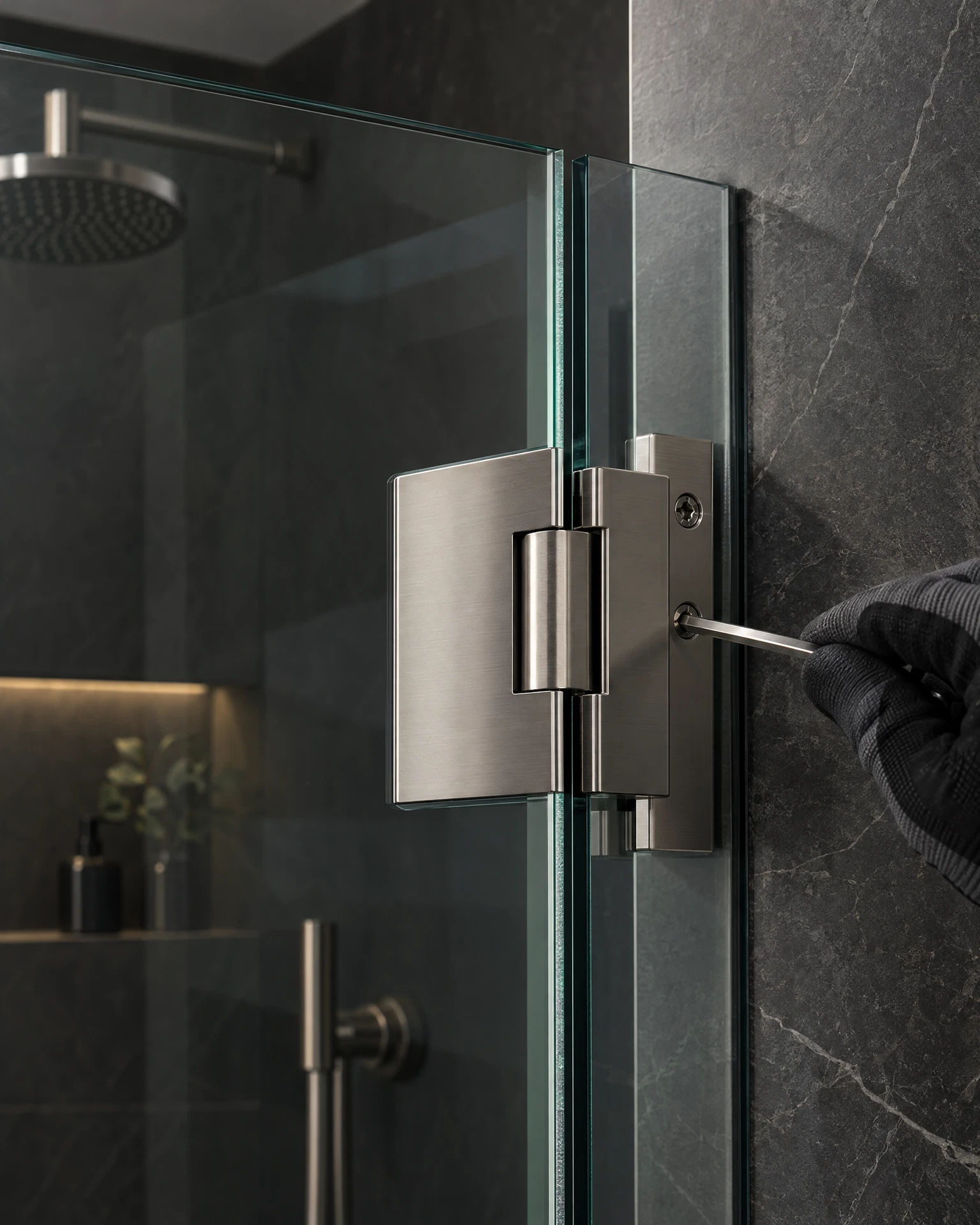
The hinge line is the point owners most often accuse of being a defect, so it is worth being precise: a hinged screen’s pivot gap cannot be sealed shut, because the door has to swing. What design and fitting do instead is manage it. The hinge itself carries seals and deflectors that turn most water back; the gap is kept as even and as small as the hardware allows; and at the planning stage the screen is positioned so the hinge line does not stand in the shower head’s direct firing line — spray aimed point-blank at any moving joint will push a fine mist through it, on any screen, from any maker. In service, the hinge line’s share of leaks grows as its seals age and as hinges wear and let the door drop a fraction, opening the gap unevenly — wider at the top or bottom. A hinge-line leak that appears on an older screen is therefore read as a symptom: of perished hinge seals, of hinge wear, or of both, and renewing the seals on a door that has dropped treats the smaller half of it. What never fixes it is packing the gap with sealant — the first swing tears it out and the leak returns with interest, a pattern the door-seal guide describes in its silicone sections; the principle is identical over a bath.
Renewing aged bath seals
Renewal is the happy ending most bath-screen leaks are entitled to, because seals are consumables fitted to be replaced. The work is specific rather than dramatic: the screen’s seals are identified by point — bath-edge, vertical, hinge — the aged profiles are removed completely (a new seal laid over the compressed remains of the old one inherits its gaps), the correct profile for the glass thickness and the measured gap is fitted, and the corner is remade as one deliberate junction rather than three endings. The screen’s fixings are checked while access is easy, because a loose screen will eat its new seals the way it ate the old ones. Two cautions belong here. First, renewal restores seals, not geometry: if the bath rim itself has dropped or the screen was fitted against an edge it never suited, new seals buy time rather than a cure, and we will say so. Second, silicone is a finishing material, not a substitute seal — where it belongs in this work, and where it is a red flag, is covered properly in our guide to shower seals and silicone: when to replace. Done right, a resealed screen is watertight on its original glass and hardware, which is why this is among the most satisfying jobs on a bath: the screen you have, keeping water the way it did when it was new. The full range of screens and how they are fitted is on our bathtub glass screens page.
Bath screens use the same family of parts described for shower doors: a bottom seal along the bath edge does most of the waterproofing, with side seals at the wall and closing edges. When a bath screen seal hardens or splits, it is replaced — the new seal must match the profile and glass thickness, and the screen must sit true on the bath edge, or the new seal leaks exactly where the old one did.
Frequently asked questions
Why does my bath screen leak at the bottom corner, by the wall?
Because that corner is where the bath-edge seal, the wall profile and its sealant line all terminate together — three endings in a few centimetres. It is the most common bath-screen leak point there is. The fix is to remake the corner as one junction and renew whichever of the seals meeting there has aged, not to add more silicone on top of the old.
Can I stop the leak by running a bead of silicone along the bath edge?
Almost never for long. If the flexible seal beneath has hardened or lifted, silicone over it bridges a moving, failing joint — it skins, splits and peels, and the leak returns. Silicone has a proper finishing role in screen work, but the seal itself is a profile that has to be renewed. The door-seal guide sets out the same principle in full.
How do I know if it’s the seal or something worse?
Read the water. Water arriving under the screen along the rim points to the bath-edge seal; damp at the wall end points to the vertical seal or corner; spray beside the hinge only while the shower runs points to the hinge line. Something worse — a loose screen, a dropped door, a rim problem — usually announces itself by movement: the screen rocks slightly, the gaps are visibly uneven, or the leak survives a seal renewal. Send us a photo of where the water appears and we will read it with you.
How long should bath screen seals last?
There is no honest calendar figure — life depends on water hardness, cleaning chemicals, how often the shower runs and whether the screen moves. Judge by condition, not age: a seal that has gone hard, yellowed, split along its bend or lifted at its ends has finished, whatever its birthday. Caught at that stage, renewal is a small job on a sound screen.
My screen only leaks when the shower points straight at it. Is that a fault?
Partly design, partly aim. Any screen — and a hinge line especially — will pass a fine spray under a direct, close-range jet; that is physics, not failure. If it has started doing it under normal showering where it never used to, the seals have aged into it, and renewal is the answer. Adjusting the head’s angle away from the hinge line helps any hinged screen, new or old.
Talk to us about your bath screen
If your bath screen is leaking, message us on WhatsApp on +971 52 443 2655 with a photo of the screen and a close-up of where the water escapes — the bath edge, the wall end or the hinge line. We will tell you which seal it is and what renewing it involves, before anything is booked.
This guide is part of our Bathtub Glass Screens series. Next: Bath Screen Sizing: Length, Height and the Splash Zone →