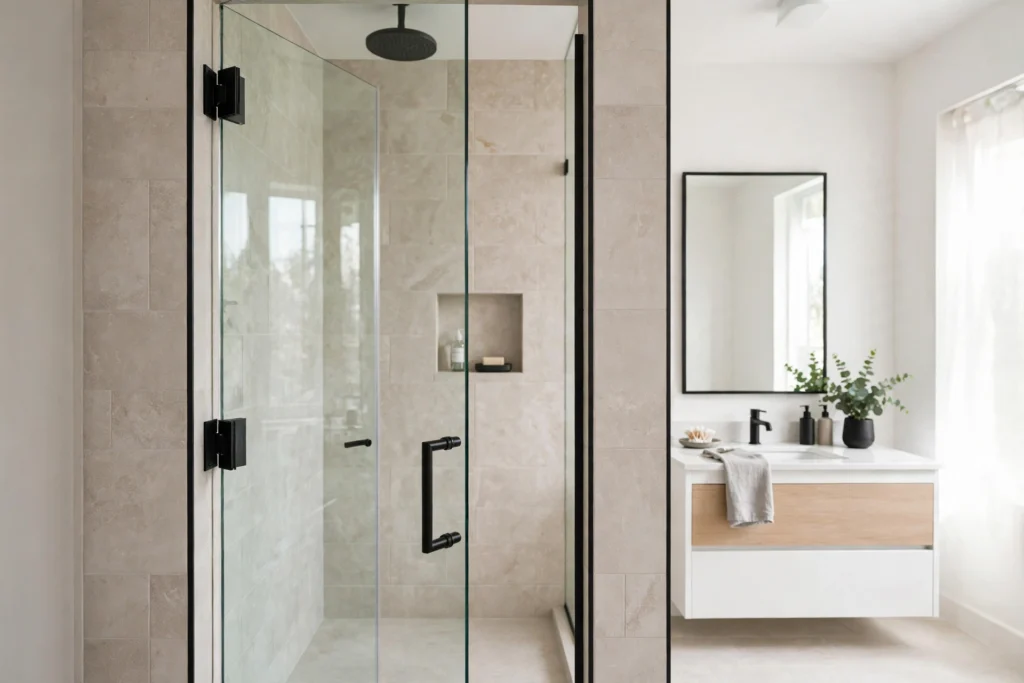
“Frameless” is the word people bring to us when they want the glass to disappear — and over a bath, it can come closer to disappearing than anywhere else in the bathroom, because a bath screen is a single panel with nowhere for a frame to hide anyway. But frameless is a construction, not a style filter, and over a bath it has specific consequences that a framed or slim-profile screen does not. With no frame, the glass carries itself: every gram of its weight hangs on hinges or brackets, every edge is exposed, and every seal is a strip fitted to the glass rather than a channel built into a profile. None of that is a reason against it — frameless bath screens are honest, durable builds when the hardware and the bath edge are up to the job. It is a reason to choose it knowing what the hardware has to do. This article explains what frameless actually means over a bath, the weight the hinges or brackets carry, how a frameless panel is sealed, what its exposed edges ask of you, and the cases where a slim profile is quietly the smarter build.
At a glance
- Frameless means no perimeter frame at all: the panel is held by hinges or brackets and clamps alone, and its edges are exposed, polished glass.
- The hardware is the structure: a frameless bath screen in 10mm glass typically weighs in the region of 20–35 kg, and all of it hangs on the hinge or bracket line — there is no frame sharing the load.
- Sealing is fitted, not built in: with no channels, water is managed by a bath-edge seal, a wall seal and accurate gaps — the same seal family as any bath screen, with no frame to forgive a poor one.
- Exposed edges are the care item: polished and safe in normal use, but the edge is where toughened glass is most vulnerable to a hard knock.
- Slim-profile is smarter where the wall or bath edge is out of true, or where a fixing channel would do real work — frameless asks the room to be accurate.
What frameless means here
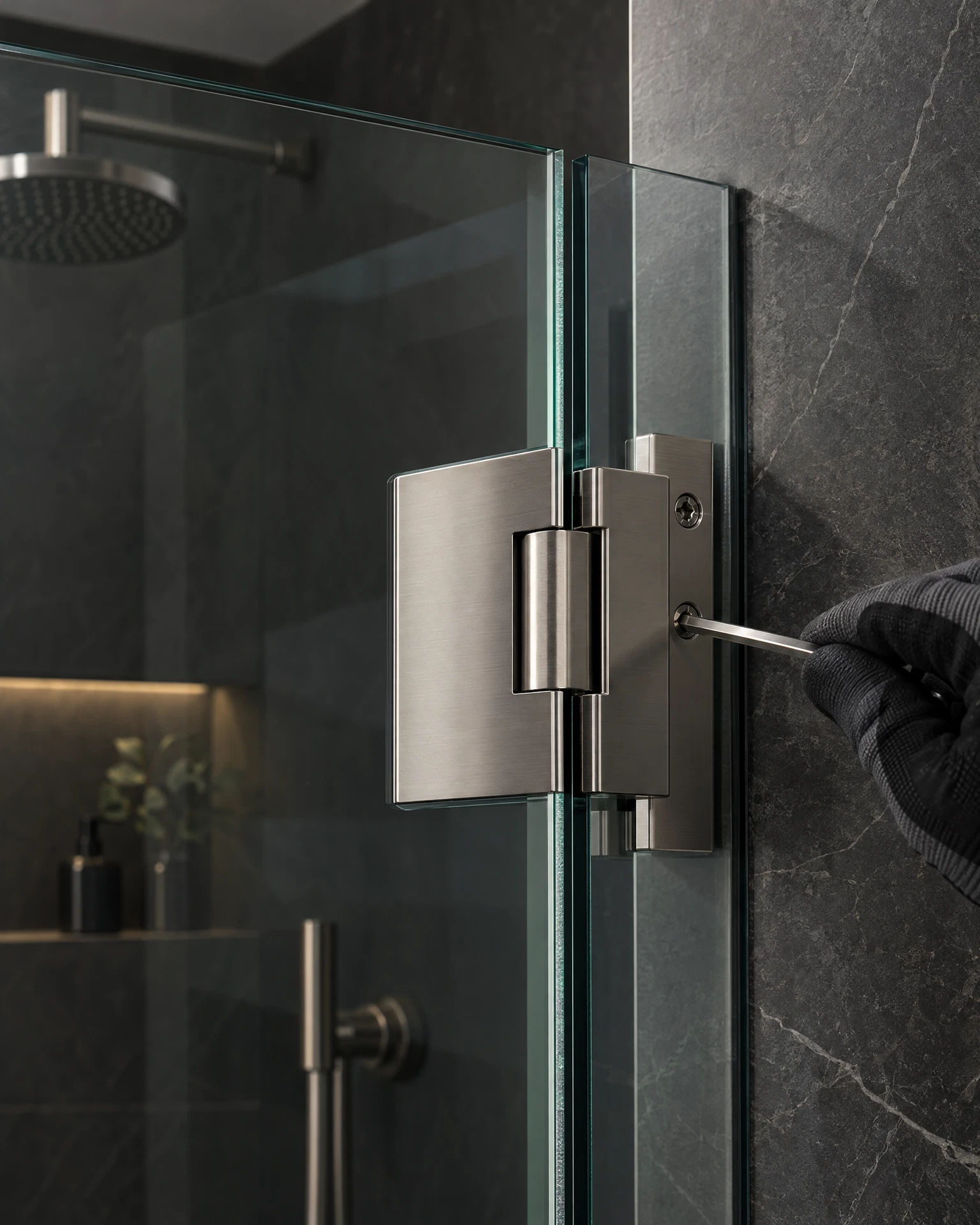
Over a bath, a frameless screen is a single panel of toughened glass — fixed, or hinged so it can swing — held by hardware only. A fixed frameless panel stands on brackets or clamps fixed to the wall and the bath edge. A hinged frameless screen hangs on two hinges, wall-to-glass or on a fixed return, and those hinges carry the panel’s full weight every time it moves. There is no aluminium section around the glass, no channel along the bath edge, no profile up the wall. Compare the neighbours: a framed screen carries its glass inside a full perimeter frame that does the structural work, and a slim-profile screen splits the difference — a narrow channel at the wall and bath edge shares the load and gives the panel something to sit in, while the rest of the panel reads as bare glass.
One clarification, because the two get confused: frameless is about how the glass is held, not about how the glass looks. A frameless screen can be clear, or carry a privacy finish — frosted or satin-etched effects, tints, fluted or reeded textures all exist as glass finishes, each trading light and privacy differently: frosting blurs fully but shows water marks more readily, tint keeps the view and darkens it, fluting distorts rather than blocks. Which finish suits a household is its own comparison, covered in our privacy glass guide; what matters here is that the finish changes nothing about the construction — a frosted frameless panel hangs on its hinges exactly as a clear one does.
Privacy finishes work on bath screens exactly as they do on showers. A frosted glass bath screen keeps the light but blurs the outline — useful in a family bathroom or an en-suite with a clear door — and fluted glass does the same job with a ribbed texture. Frosting is part of the glass, not a film, so it cannot peel; it does show limescale a little differently and wipes clean the same way. The full run-through of clear, frosted, fluted and tinted options is our privacy glass decision guide.
Weight and the hinge/bracket question
This is the part of frameless that brochures skip. Glass is heavy, and frameless glass is specified thick because the panel’s own stiffness is part of the structure: our standard work is 10mm, and 10mm toughened glass runs to roughly 25 kg per square metre. A typical over-bath panel — somewhere around a metre to a metre and a half wide and a metre and a half tall — therefore typically lands in the region of 20–35 kg. On a framed screen, that weight is carried by the frame and spread along its channels. On a frameless screen, it is carried by two hinges, or by a line of brackets, and by the fixings behind them.
Three consequences follow. First, the hardware has to be genuinely rated for the panel — hinges and brackets on a frameless screen are not trim; they are the structure, and undersized hardware shows itself in a panel that creeps, drops or works its fixings loose. Second, the fixing substrate matters more: hinge screws and bracket fixings go into the tiled wall and the bath edge, and they hold only as well as what is behind them — sound tile on solid backing holds; hollow or crumbling substrate does not, and no hinge quality compensates for it. Third, the bath edge itself is part of the structure: a fixed frameless panel’s brackets and seal sit on the edge, so the edge needs to be flat, level and wide enough to take them — a narrow, rounded or sloping bath edge is a genuine obstacle to a frameless fixed build, where a channelled profile can sometimes bridge what brackets cannot. This is why a frameless enquiry starts with photos of the bath edge and the wall, not with a glass size: the panel is the easy part.
Sealing without a frame
A frame does quiet waterproofing work that only becomes visible when it is absent: its channels catch water running down the glass and return it to the bath, and its gaskets give the glass a forgiving seat. A frameless screen has none of that, so its sealing is done entirely by fitted seals — a flexible bath-edge seal under the panel that closes the line where glass meets bath, and a vertical seal where the panel meets the wall. Those seals work well — they are the same seal family every bath screen depends on — but they work by accuracy: the gap they bridge has to be the gap they were sized for, even along its length. On a true wall and a level bath edge, a frameless panel’s gaps are even and the seals sit as intended. On a wall that leans or an edge that dips, the gap tapers, and the seal is asked to bridge a wide space at one end and is crushed at the other — the classic starting point of a leak that no amount of silicone should be asked to fix.
What frameless does not change is splash behaviour. Coverage is coverage: a frameless panel guards the length it stands over, exactly as a framed panel of the same size does — the fixed-versus-hinged and coverage decisions are set out in our comparison of fixed vs hinged bath screens, and they apply here unchanged. Frameless changes how the panel is held and sealed, not how much water it turns back.
Exposed edges and care
Every edge of a frameless panel is out in the room: polished smooth at manufacture, and part of the look. In daily use those edges ask for two things. The first is a little respect for what an edge is. Toughened glass is immensely strong across its face and genuinely vulnerable at its edges and corners — a hard knock from a metal bottle, a hand shower head swung against the edge, or a heavy object dropped against the corner is the realistic damage route for any frameless panel, over a bath as in a shower. It is not fragility; it is knowing where the material’s one soft spot is, and not storing the metal bath rack where it swings against the glass.
The second is cleaning, and here frameless gives something back. With no channels or frame sections, there is nowhere for soap and scale to lodge: the panel is one flat surface, and in hard-water homes a squeegee pass after showering keeps it clear with a fraction of the effort a framed screen’s channels demand. The seals remain consumables, as on every screen — when a bath-edge or wall seal hardens, splits or lifts, it is renewed, and the renewal is the same work whatever the construction. Care, in short, is lighter on the glass and identical on the seals, with the edge-awareness as the only new habit.
When framed or slim-profile is smarter
Frameless is the right build for a true room and a sound bath edge. There are honest cases for the alternatives. Choose slim-profile where the room is slightly out of true: the wall channel absorbs small errors and gives the panel a seat, so the seals are not asked to bridge tapered gaps — the profile earns its thin line of metal. Choose slim-profile or framed where the bath edge is awkward: a narrow or curved edge that brackets cannot sit on may still take a channel. Choose framed where the screen will take hard daily knocks — a busy family bathroom where the frame, not the glass edge, meets the accidents — or where containment outranks appearance and the channels’ water management is worth having at every use. And choose frameless, without apology, where the walls are true, the edge is flat and the household will give the edges ordinary care: it is the cleanest-reading build of the three, and on the right bath it is also the simplest thing to live with. If you are unsure which construction your bath suits, you will find the full range on our bathtub glass screens page — and a photo of your bath edge usually settles it faster than any description.
Frequently asked questions
Is a frameless bath screen safe? All that weight on two hinges?
Yes, when the hardware is rated for the panel and the fixings go into sound material — which is the whole point of the construction. Hinges and brackets for frameless work are engineered to carry the panel’s weight with margin; the failures happen when undersized hardware is used or fixings go into weak substrate. That is an installation quality question, not a frameless question.
Does frameless leak more than framed?
Not by construction. Sealing on a frameless screen depends on fitted seals and accurate gaps; on a framed screen, on gaskets and channels. A frameless screen on true walls seals as well as anything; a framed screen with perished gaskets leaks through its own channels. What frameless cannot do is forgive an out-of-true wall — the gap has to be right because nothing hides it.
Can any bath take a frameless screen?
Most can, but the bath edge decides. A fixed frameless panel needs an edge flat, level and wide enough for its brackets and seal; a hinged one needs a wall (or return panel) that can carry the hinges beside the bath. Narrow, steeply rounded or sloping edges can rule the frameless fixed build out — send a photo along the edge and we will tell you straight whether yours takes it.
Does a frameless screen cost more?
The honest driver is hardware: with no frame, the hinges or brackets are the structure and are specified accordingly, and the glass is made and polished to be seen from every side. How that lands against a slim-profile build for your bath is a figures question — the shower glass price guide sets out how bath screens are priced, and the exact number follows measurement of your bath.
Can a frameless screen be frosted for privacy?
Privacy finishes — frosted or satin effects, tints, fluted textures — are glass finishes, and they are available on frameless panels as on other constructions, each with its own trade-offs in light, privacy and how readily it shows water marks. Tell us the privacy problem you are solving — an overlooked window, a shared family bathroom — and we will advise which finish family fits it.
Talk to us about a frameless bath screen
If frameless is the look you want over your bath, message us on WhatsApp on +971 52 443 2655 with a photo along the bath edge and one of the wall the screen will fix to. The edge and the wall decide whether frameless is your build — we will tell you honestly if they say yes, and if they say slim-profile, we will tell you that instead and why. For figures, the shower glass price guide sets out how bath screens are priced; the exact number follows measurement, as always.
WhatsApp us about a frameless bath screen
This guide is part of our Bathtub Glass Screens series. Next: Folding and Pivot Bath Screens →