
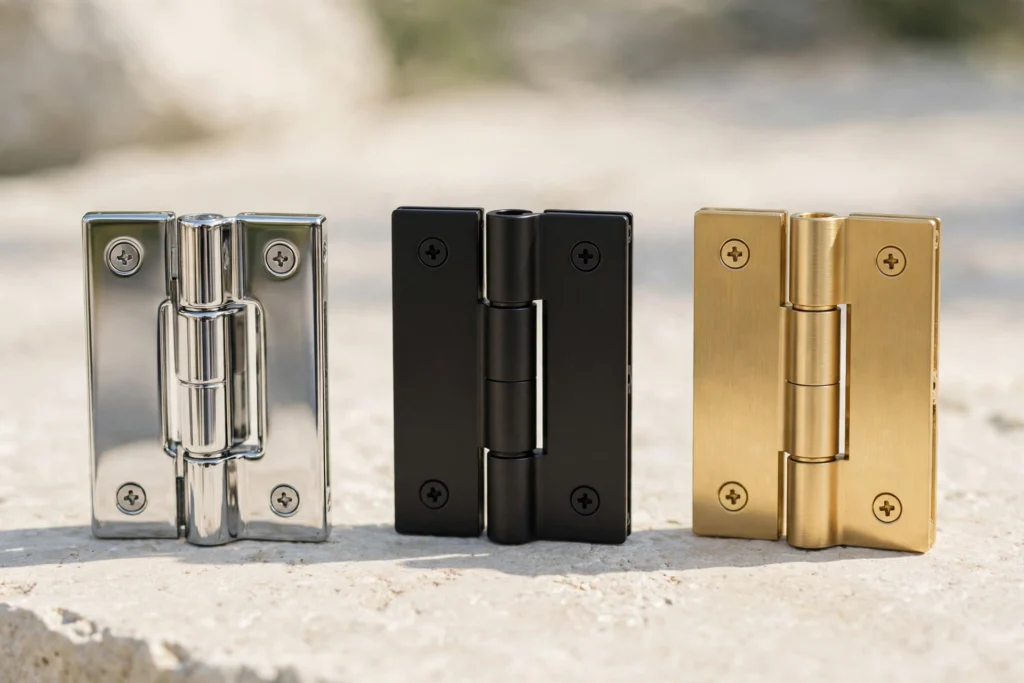
Ask what a finish costs and the honest answer is a direction, not a number. In the ranges we fit, chrome is the baseline and black and gold sit above it, and the exact difference exists only inside an itemised quote for a specific hardware set. This page explains why that direction exists — because it is not arbitrary, and it is not a markup on a colour. A hardware finish is a manufacturing process applied to the base metal part, and the three finishes on offer are produced in different volumes, by different routes, in different widths of range. Each of those facts lands in the price of every hinge, handle, clamp and channel on your shower. What this page will not give you is a percentage, because we do not publish a finish delta and any site quoting you a tidy “black costs this much more” is inventing a precision the supply chain does not have. The figures that do exist — for whole systems, not finishes — are tabled in our shower glass price guide; this page is the finish line only.
At a glance
- Finish is a process, not a paint colour: each finish is produced differently on the same base part, and the process is where the price difference is made.
- Chrome is the baseline: the longest-established finish, produced in the largest volumes, in the widest ranges — the finish quotes default to.
- Black costs more for structural reasons: an additional coating process over the base part, smaller production runs, and narrower ranges.
- Gold and brushed finishes are the premium end: the smallest runs, the most finishing labour, the least forgiving ranges to match across a full set.
- The set is the unit: finish money is spent per part but judged as a whole — every visible component must match, which is why partial upgrades and mixed finishes rarely save what they promise.
- No amount or percentage is published here — the real difference for your hardware set belongs in your itemised quote after measurement.
Why finishes differ in price at all
Start with what a finish is. A hinge leaves its factory as a metal part — brass or stainless — and the finish is the surface system applied to it: the layer you see, touch and clean. Different finishes are different industrial processes applied to that part, run as separate production batches, stocked as separate inventory, and sold as separate ranges. A hardware maker does not produce one hinge and colour it three ways at the till; it produces three product lines that happen to share a shape.
Three consequences follow, and together they are the whole answer to this page’s question. Process cost: some finishes are a single established plating route; others add coating stages, curing and inspection on top. Volume: a finish produced in large runs spreads its setup costs thin; a finish produced in small runs cannot. Range width: a finish offered across every part type — every hinge pattern, handle, clamp, channel, roller housing — costs more to sustain than one offered in a few popular parts, and the buyer feels that as both price and availability. Chrome wins on all three counts, which is why it is the baseline. Black and gold lose on at least two of the three, which is why, in the ranges we fit, they sit above it. Everything below is those three facts, finish by finish.
Chrome: the baseline
Chrome is the finish the shower hardware industry is tooled for. Electroplated chrome has been the standard surface for bathroom brassware for generations: the plating route is mature, the production volumes are the largest in the industry, and virtually every hardware part in every pattern is available in it. That combination — established process, high volume, total range width — makes chrome the cheapest finish to produce and the easiest to source, and so it is the finish a quote assumes unless you say otherwise.
Chrome’s baseline position has a second, quieter financial benefit: matching over time. Hardware outlives finishes’ fashion cycles, and when a hinge or handle needs replacing years later, chrome is the finish most likely to still exist in the same range. Choosing the baseline is not choosing the cheap-looking option; on price it is choosing the finish with the lowest production cost and the lowest long-term matching risk — which is precisely why it anchors the scale the other two are measured against.
Black: coating and range effects
Black hardware is the same base part with an additional coating process applied over it — powder coating and vapour-deposition coatings are the kinds of routes used — and that extra stage is the first reason it prices above chrome: more process, more handling, more inspection, on smaller production runs that spread those costs less thinly. The second reason is range. Black is a younger finish in shower hardware, and its ranges are narrower: not every part exists in black, and a full set — hinges, handle, clamps, channels, and on a sliding door the roller gear and track furniture — has to be assembled from what the black range actually contains. Where a part is missing from the range, the set is completed another way, and that sourcing work is part of what the finish costs.
Notice what is not in this explanation: durability rankings and which finish you should prefer. A black finish is not priced above chrome because it is better; it is priced above chrome because it costs more to make and to range. Choosing between them is a separate question, and price is only this page’s half of it.
Gold and brushed finishes: the premium end
Gold-toned finishes — and their brushed variants — sit at the premium end of the scale for the same three reasons, pushed further. The production runs are the smallest of the three families, the finishing is the most labour-involved (brushed surfaces are worked to a grain, not simply coated), and the ranges are the narrowest: the full-set problem that appears with black is at its sharpest here, because a gold set that cannot be completed in matching parts is not a set at all. A clarification worth making, since the name invites it: a gold finish is a gold-toned surface finish applied to the base metal part, as chrome and black are — the premium buys the process, the run size and the look, not precious metal.
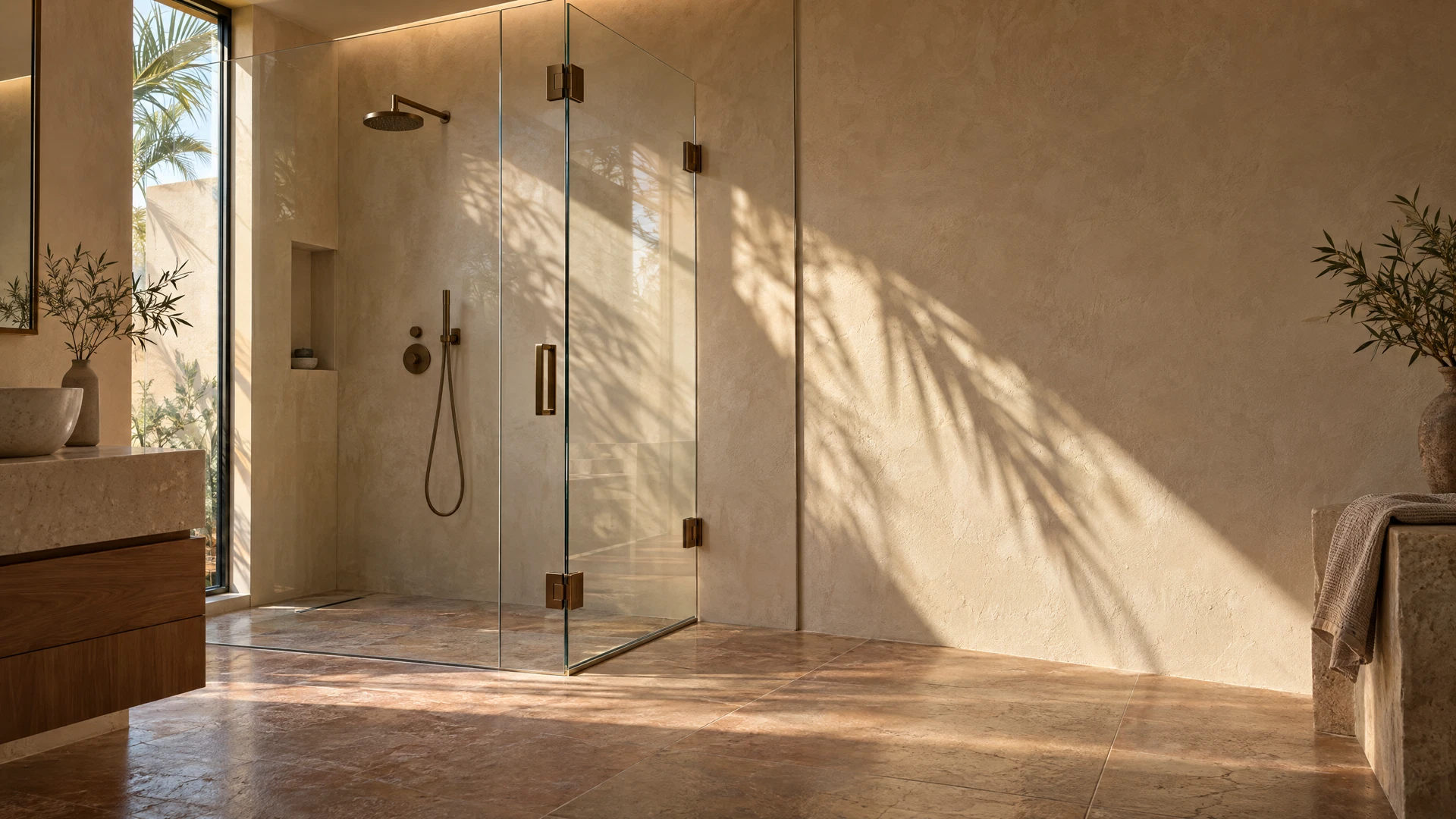
The premium also concentrates where the hardware set is fullest. On a fixed panel held by a channel, the finish touches few parts; on hinged shower glass doors, the hinges, handle and clamps are all visible and all finished — so the finish choice moves more money on a hinged enclosure than on any other configuration, and the same is true in proportion for sliding gear with its track and rollers.
Where finish money is worth it — and isn’t
Since the difference is real but bounded — finish moves the hardware portion of a quote, not the glass or the fitting — the useful question is where it earns. Worth it: a complete, matched set in your chosen finish on the parts you see and touch daily. Hinges and a handle carry a room’s whole hardware impression; bought as a matched set in one finish, they read as a decision. Not worth it: paying premium-finish prices for parts nobody sees — channel buried in a fixing line, internal fixings — where ranges sometimes allow a plainer specification underneath a finished exterior. And actively wasteful: mixing finishes to save money — chrome hinges under a black handle, say. A mixed set saves the smallest part of the difference and reads as a mistake rather than a compromise, because the eye compares parts that stand inches apart. If the budget is tight, the honest economy is chrome throughout: one finish, every part, no apologies. A uniform baseline set looks intentional in a way a mixed set never does, and it keeps the easiest matching path open for any future replacement part.
The last point is about timing. Finish is chosen once, at specification, and is effectively permanent — re-finishing fitted hardware is not a service, it is a replacement. So the finish line is worth its moment in the quote conversation: not because it is the biggest number in the document — it is nowhere near — but because it is the one you will look at every day, and the one whose price difference, whatever it is for your set, is paid exactly once.
Frequently asked questions
How much more does black cost than chrome, exactly?
There is no published figure — no amount and no percentage — because the difference genuinely varies by part and by range: a black hinge set and a black handle do not carry the same difference, and one maker’s black is not another’s. What can be said is the direction and the reason: black is produced by an additional coating process in smaller runs, and in the ranges we fit it sits above chrome. The exact difference for your hardware set appears in your itemised quote, where it can be checked part by part.
Is gold hardware real gold?
No — and it is not priced as if it were. Gold hardware carries a gold-toned surface finish applied to a base metal part, produced by the same family of coating and plating processes as the other finishes. Its premium position comes from small production runs, finishing labour and narrow ranges, not from precious metal content.
Can I mix finishes to keep the cost down?
You can, and this page advises against it on cost grounds alone: the saving is small, because finish only moves the hardware portion of the quote, while the visual cost is large and permanent — mis-matched parts sit next to each other and are compared every day. A complete chrome set costs less than a mixed set containing premium parts and looks more deliberate than either.
Does the finish change the price of the glass or the fitting?
No. Finish prices attach to the hardware parts only. The glass is specified by size, thickness and treatment, and the fitting labour by the job’s shape — a door is hung and aligned the same way in any finish. If a quote shows the finish apparently moving the glass line, that is a document worth questioning line by line.
Which finish is cheapest to match if a part needs replacing later?
Chrome, for the reasons it is the baseline: the widest ranges and the largest production volumes mean a matching hinge or handle is most likely to still be available years on. That is a whole-life cost point rather than a purchase-price one, and it is the strongest financial argument the baseline finish has.
Where can I see what each finish looks like and how it wears?
That is the choosing question, and it has its own guide — finishes compared for appearance, care and durability. This page deliberately covers only the money. If you are at quote stage, tell us the finish you are leaning towards and we will price the complete matched set in it, itemised, so the difference is a number you can see rather than a percentage you have to trust.
Talk to us about finish options for your quote
If you are deciding between chrome, black and gold for a real quote, message us on WhatsApp on +971 52 443 2655 with a photo of your shower and the finish you are leaning towards. We will price the complete matched hardware set in that finish — itemised after measurement, so you can see exactly what the finish adds, part by part.
This guide is part of our Shower Glass Prices series. Next: Comparing Shower Glass Quotes: Inclusions, Glass Specification and Warranty Terms →


