

Everyone’s first question about a shower glass repair is “how much?” — and it is the one question that cannot be answered properly from the symptom alone. A leaking door might need a seal, a hinge, a re-hang, or some combination of the three, and those are different jobs with different bills hiding behind the same puddle. So this article does not do what you may have hoped and list prices — no repair figure is stated here. Send us photos of the fault and we can give you a preliminary steer, but the confirmed repair price follows inspection, because the cause of the fault decides the work. What this article does instead is more useful: it sets out the five things that actually decide what a repair costs, so that when a real number does arrive — after the fault has been identified — you can see exactly what you are paying for. The price framework for new glass lives in our shower glass price guide; this page is about repairs only.
At a glance
- There is no standard repair price: the same symptom (a leak, a drag, a rattle) can come from parts with completely different costs and labour attached.
- The biggest driver is which part has failed — a consumable seal and a matched hinge set are different universes of job.
- Whether glass is involved changes the scale: hardware-only repairs on sound glass are one thing; a job that needs a new made-to-measure panel is another.
- Whether the door has to come down decides much of the labour: a seal swapped with the door hanging is quick; a supported re-hang is not.
- Photos earn a preliminary steer: the confirmed repair price follows inspection, because the cause of the fault — not the symptom — decides the work.
Why repairs are quoted after diagnosis
A new shower can be priced from a system and a size, because the parts are known before anyone visits. A repair cannot, because the parts are the question. Until someone has established whether the leak is a perished seal, a dropped door or a cracked silicone line, “the repair” does not exist as a single thing — there are three or four candidate repairs, each with its own parts and time. An early figure can only ever be a preliminary steer, because it has to assume which candidate is the real one. The confirmed price follows inspection, once the cause of the fault is known — and it is the cause that decides the work, the parts and the bill.
That is why our sequence is photos first. A wide shot of the enclosure and a close-up of the fault — the hinge, the seal, the roller, the leak point — usually identifies the failed part and the shape of the job, which earns you that preliminary steer; the confirmed figure is then a price for the diagnosed work, agreed after inspection. Where the photos cannot settle it, we say so and the diagnosis finishes in person, before any figure is agreed. The rest of this article is the anatomy of that figure: the drivers, in the order they usually matter.
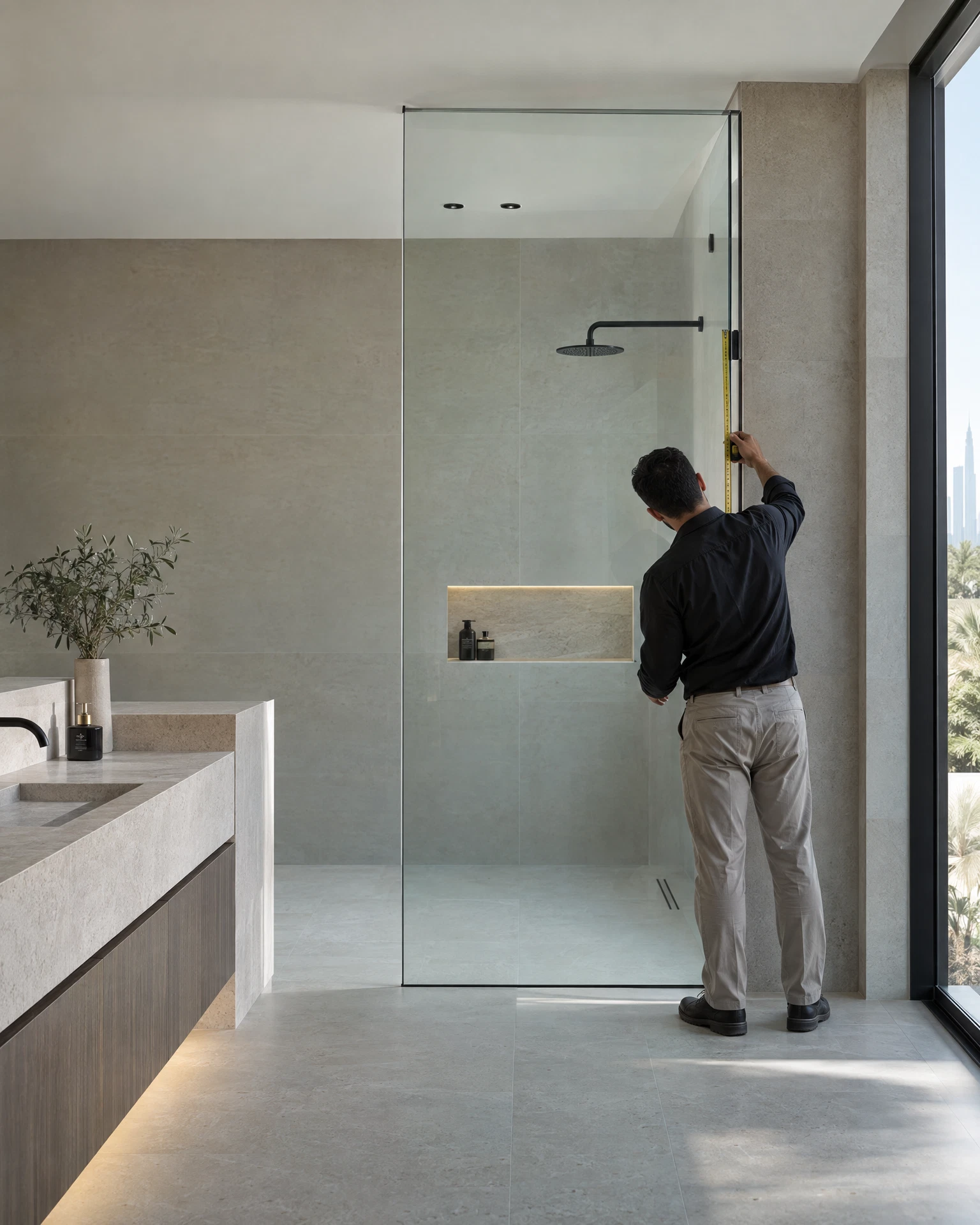
Driver 1: which part has failed
Repairs divide first by part, because the parts themselves are not comparable. Seals and silicone are the consumables of a shower enclosure: the flexible profiles that meet the floor, the wall and the closing edge, and the sealant lines behind them. Renewing them is mostly skilled labour — the old material has to come out completely and the new profile has to be the right one for the gap — but the parts themselves are the modest end of any repair. Hinges are engineered hardware: they carry the full weight of a glass door, they must match the door’s existing cut-outs and thickness, and they are replaced as a working set, not singly, because a new hinge beside a worn one shares the load unevenly. Rollers on a sliding door are smaller parts but just as specific — the carriage has to suit the track system the panel already runs in. Handles and magnetic strips sit between the two: simple parts, but again matched to what is already drilled and fitted.
The point is not that one part is “cheap” and another “dear” in the abstract. It is that a quote for “fixing the leak” means nothing until it says which of these it is actually replacing — and a seal renewal and a hinge replacement should never arrive at the same number.

Driver 2: whether glass is involved
The single biggest step-change in a repair bill is the moment the glass itself joins the job. A hardware fault on a sound panel — the hinge has gone, the seal has perished, the roller has worn — leaves the expensive component, the toughened made-to-measure panel, exactly where it is. A cracked panel, a shattered door, or a panel so badly fitted it cannot be sealed is a different category: the replacement is cut, toughened and finished to the measured opening, which is manufacturing, not just fitting. If your repair conversation is drifting towards new glass, the honest comparison is no longer repair-versus-repair — it is repair versus replacement, and that decision has its own framework in our guide to whether to repair or replace your shower enclosure.
Driver 3: whether the door or panel has to come down
Labour in a repair is mostly door handling. Some jobs are done with everything in place: a bottom seal drawn out and renewed, a silicone line cut back and re-run, a roller adjustment, a handle swapped. Others require the door to be lifted off its hinges and supported — a full re-hang to correct a drop, a hinge replacement, any work where the fixings have to be reached properly. A 10mm glass door is heavy, awkward and unforgiving, so a re-hang is a two-person job with the panel’s weight managed from the first loosened bolt to the last. That difference — in place versus off and supported — is why two repairs replacing the “same” part can carry noticeably different bills, and why a proper quote says which one it is.
Driver 4: matching the hardware you already have
A repair is not built from a catalogue page; it is built to marry parts that are already hanging in your bathroom. Hinges must match the existing glass cut-outs, the door’s thickness and the finish — chrome, black or gold — of everything else on the enclosure. Seal profiles must match the gap they close, which varies by system and by age. Where the original hardware is a current range, matching is a sourcing exercise. Where it has been discontinued, the job grows: either a compatible part is tracked down, or the repair becomes a small conversion — new hinges with new fixings, resealed and realigned — and the quote should say that plainly rather than bury it. This is also where age tells: an enclosure whose parts can no longer be matched is one of the signs the repair-versus-replacement line is approaching.
Driver 5: access, and what surrounds the fault
The last driver is the bathroom itself. A fault reached standing in an open ensuite is quicker work than the same fault in a compact apartment bathroom where the door’s swing is blocked by the basin and everything is done at arm’s length. The state of what surrounds the fault matters too: fixings turning in failed wall plugs have to be made good properly, perished silicone has to be cut out of every joint it has spread to, and scale-cemented tracks have to be cleaned before a roller can be judged. None of this is padding — it is the difference between the repair lasting and the same symptom returning within the year.
The two-visit pattern — and when one visit is enough
Owners sometimes read a second visit as inefficiency. For repairs it is usually the opposite: it is what a made-to-measure trade looks like. The pattern runs diagnosis first — photos, then measurement if the job needs it — then parts or glass are ordered or made for your specific door, then the fitting visit does the work in one clean pass. Repairs that resolve in a single visit are the ones whose parts are standard and whose diagnosis is certain from the photos: seal and silicone renewal, adjustments, like-for-like hardware where the range is current. Repairs that cannot honestly be done in one visit are those waiting on something manufactured or matched — a replacement panel above all. That sequencing is why the confirmed price follows the diagnosis rather than preceding it.
When repair stops being economical
There is a point where the drivers stack up — glass involved, door down, hardware unmatchable — and the repair bill approaches the territory of replacement while still leaving you with an old enclosure around the new part. The signs are recognisable: the same fault returning after a correct repair, several systems failing at once (hinges, seals and rollers together is an enclosure ageing as a whole, not three coincidences), a panel already damaged, or hardware that can no longer be matched at all. Past that point the honest advice changes from “here is the repair” to “here is the comparison” — which is worked through properly in our repair-or-replace guide. What we will not do is keep selling repairs into an enclosure that has finished; the factors above are exactly what we weigh, and we will show you the weighing.
Frequently asked questions
Why won’t you just give me a price over the phone?
Because the price is a property of the diagnosed fault, not of the symptom — and on the phone, all we have is the symptom. Send photos instead: a wide shot and a close-up of the problem area are usually enough for us to name the likely failed part and give you a preliminary steer. The confirmed price follows inspection, because the cause of the fault decides the work. If the photos genuinely cannot settle it, we will say so rather than guess.
Two companies quoted me very different amounts for the same repair. Why?
Usually because they are quoting different jobs. One may be pricing a seal renewal and the other a hinge replacement and re-hang — or one has inspected the fault and the other has priced from the symptom alone. Ask each of them the questions this article is built on: which part are you replacing, does the door come down, are the parts matched to my existing hardware, and is it one visit or two? The answers make the numbers comparable.
My hinge is broken. Is that an expensive repair?
It sits in the middle of the range of repair types: the parts are engineered hardware that must match your door, and the door normally comes down and is re-hung to fit them — so it is more than a seal renewal and far less than anything involving new glass. The exact figure follows the diagnosis of which hinge set your door needs, which is a photos-first answer.
Is a cheap instant quote a bargain?
Not necessarily — but treat it for what it is: a preliminary steer. An early figure is priced from the symptom, before the cause of the fault is known, so it can move once the fault has been inspected. What matters is that it is understood as preliminary and confirmed after inspection. A quote that names the part, the visits and the matching work is the one that tends to stay the same size.
The repair figure is close to a new door. What should I do?
Compare like with like: what the repair leaves you with (an older enclosure with one renewed system) against what replacement leaves you with, and how the drivers in this article stack up on your enclosure — glass condition, hardware matching, how much else is ageing. Our repair-or-replace guide works through that comparison in full.
Talk to us about the repair
If something on your shower has failed — a hinge, a seal, a roller, a door that no longer closes true — message us on WhatsApp on +971 52 443 2655 with a wide photo of the enclosure and a close-up of the fault. We will tell you which part has failed, what shape the job is, and the figure for that diagnosed work — before anything is booked.
This guide is part of our Shower Glass Prices series. Next: What Does It Cost to Replace a Shower Glass Door or Screen? →

