
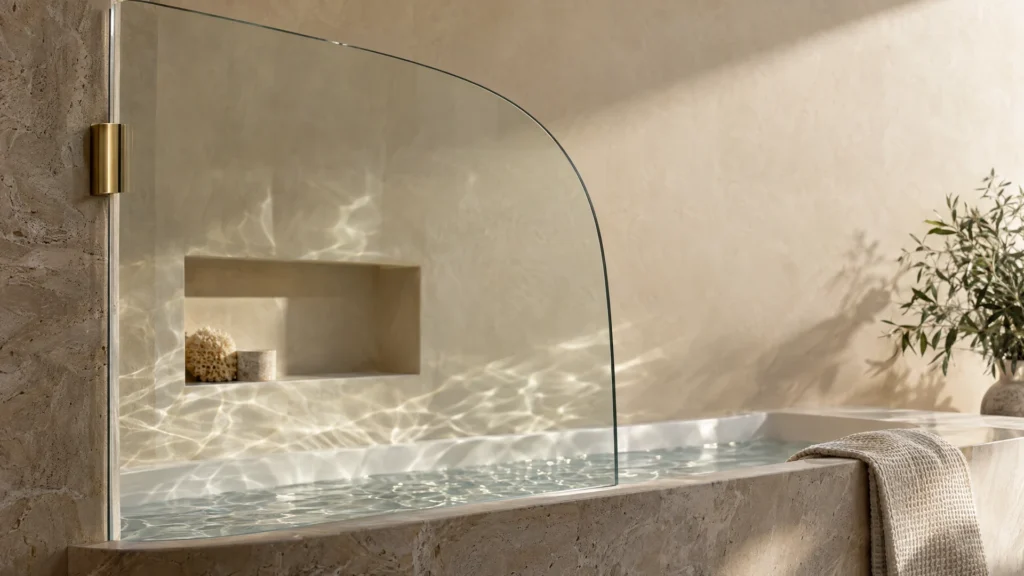
Two bath screens can look near-identical in a photograph and arrive at noticeably different quotes — and the difference is rarely mysterious once you know where bath-screen money actually sits. It is not in the idea of a screen; it is in the construction (a panel that stands still versus one that swings), in the panel itself (a standard rectangle versus a shaped sheet made for one particular bath), in the unglamorous line where glass meets bath edge, and in the hardware finish. This page works through those four drivers and then sets them against the one guide figure that exists for bath screens — fixed bath glass from AED 1,500 in 10mm — so you can see what the “from” in that figure is honestly made of. The full table for every system lives in our shower glass price guide; this page is bath screens only.
At a glance
- Construction is the first driver: a fixed panel is one sheet of glass, held and sealed. A hinged screen adds hinges, a swinging seal line and alignment work — more parts, more fitting, a different number. No separate figure is published for hinged bath screens, and this page invents none.
- Size and shape move the panel cost: a standard rectangle is the baseline; taller, wider or shaped glass — curved, angled, notched around fittings — is made-to-order work.
- The bath edge decides the sealing work: the screen seals against the bath’s rim, so the rim’s width, level and condition are part of the quote, not a detail.
- Hardware finish is a real but smaller driver: chrome, black or gold changes the hardware portion of the quote, in relative terms only.
- The published starting figure: fixed bath glass from AED 1,500 (10mm) — a starting point for the simplest version of the job, with the exact quote confirmed after measurement.
Fixed vs hinged: the construction gap
A fixed bath screen is the simplest object in this trade: a single panel of toughened glass, clamped or channelled at the wall, sealed along the bath edge, finished. It has no moving parts, nothing to align beyond its own plumb, and nothing that wears except its seals. When you see a guide figure for bath glass, this is the construction it belongs to — a fixed panel, in 10mm, at a standard size.
A hinged screen is a different build. The panel hangs on hinges and swings, which means the glass is drilled and notched for the hardware before toughening, the hinges themselves are engineered parts that carry the panel’s weight every time it moves, the closing edge needs a seal that works against a moving panel rather than a static line, and the fitting includes hanging and aligning the door so it swings clear of the bath rim and closes true. A folding screen multiplies the same logic: more panels, more hinges, more seal lines. None of that makes a hinged screen a worse buy — for baths that are also the household’s shower and bath, the swing is often the point. It makes it a more expensive construction, for itemisable reasons: more hardware, more machining of the glass, more fitting time.
What this page will not do is attach a number to that difference, because we do not publish a figure for a hinged bath screen — anyone quoting you a tidy premium for “the hinged version” from a price list is working from theirs, not from your bath. Which construction suits your bath in the first place — splash behaviour, access, who uses it — is a separate question with its own guide: our comparison of fixed vs hinged bath screens. Here, the point is narrower: when two bath-screen quotes differ, check the construction line first, because a fixed quote and a hinged quote are not two prices for one thing.
Panel size and shape
Glass is made to order, so the panel’s dimensions are a cost input, not a catalogue choice. A standard-height rectangular screen over a straight bath is the baseline every “from” figure quietly assumes. Move away from it and the quote follows: a taller or wider panel is more glass, more weight to handle and hang, and sometimes a second pair of hands the standard job does not need. Shape moves it further. Baths are not all rectangles — a curved bath wants a curved or faceted screen, a bath set against a sloping ceiling wants an angled top, a shower-over-bath with fittings in awkward places wants notches and cut-outs placed to the millimetre. Each of those is drawn, cut and toughened for one bath only, and shaped work is priced like the bespoke work it is.
There is a subtler size factor owners miss: the screen only has to be as long as the splash zone it protects, and a well-judged standard-length screen fitted exactly often beats an over-long panel bought “to be safe”. Size is a driver, but it is a driver you partly choose — which is why the measurement conversation matters more than the price list.
Sealing at the bath edge
Every bath screen meets the world at one critical line: the bottom edge, where the glass sits on the bath rim and the water tries to leave. That line is sealed with a profile fitted to the glass and sealed to the rim, and the work in it depends on the rim itself — its width (a narrow rim gives the seal less to sit on), its level (a rim that falls away asks the seal to bridge a taper), and its condition (old sealant, damaged enamel or a rim that has been re-sealed badly all have to be dealt with before the new line goes down). A screen quoted without anyone looking at that edge is a screen quoted without its most failure-prone part.
This is also the part of a bath screen that ages. Seals are consumables: they harden, split and lift, and a screen that was watertight for years starts weeping at the edge for reasons that have nothing to do with the glass. When you compare quotes, the sealing line is worth reading — what profile, fitted how, and what happens at the wall junction where screen, bath and tiles all meet. Cheap sealing is the most expensive line in a cheap quote, because it is the line that brings everyone back.
Where seals fail and how leaks are prevented is covered in depth in our bath screen seals guide.
Hardware finish
The screen’s hardware — its wall fixings or hinges, and any handle — is offered in chrome, black and gold, and the finish moves the hardware portion of the quote. Chrome is the industry baseline: the widest ranges, produced in the largest volumes. Black and gold finishes are applied coatings over the base part, produced in smaller runs and narrower ranges, and they are generally priced above chrome as a result. On a bath screen the hardware set is small, so this is one of the smaller drivers on this page — it will not double anything — but it is a real line, and on a hinged screen with a fuller hardware set it counts for more than on a fixed panel held by a channel. It is explained in relative terms here because relative terms are what honestly exist: no per-finish figure is published, and the exact difference for your screen belongs in your itemised quote, not on a web page.
Why the finishes are priced differently at all is explained in our guide to how hardware finish affects price.
The published guide figure — and its caveat
Here is the figure, in full: fixed bath glass from AED 1,500, in 10mm glass — with the exact quote confirmed after measurement. Every word of that carries weight. Fixed: the figure belongs to the fixed construction described above — it does not price a hinged or folding screen, and it should not be read across to one. From: it is the floor for the simplest version of the job — a standard-size rectangular panel, a sound straight bath edge, standard hardware. The drivers on this page are exactly the things that move a real quote upward from it. 10mm: the thickness is part of the figure, not a footnote. And after measurement: the confirmed number is built from your bath — its true sizes, its edge, its level — because a screen is made for one bath, and the quote is only honest once that bath has been measured.
One warning, because the confusion is common: the price guide’s table lists a figure for an openable shower — a hinged enclosure standing on a tray or floor. That is a different, larger job from a hinged screen standing on a bath rim, and its figure does not price your bath screen in either direction. Figures on this site belong to the system they name; the bath line is the bath line. For the full table and the other systems’ figures, see our shower glass price guide — and for what a screen costs over your bath, the route is the same as for everything made to measure: photos first for a preliminary view, then measurement for the confirmed quote, as our preliminary estimate vs confirmed quote guide explains.
Frequently asked questions
Why did my bath screen quote come in above the from-figure?
Because the from-figure prices the simplest version of the job, and your bath moved it: a hinged rather than fixed construction, a panel larger or more shaped than standard, a bath edge that needed work before it could be sealed, or a black or gold hardware set. Ask for the quote itemised by those lines — a proper quote can show you exactly which driver did it, and each one is checkable against your bathroom.
Is a hinged bath screen a lot more expensive than a fixed one?
It is the more expensive construction — hinges, machined glass, a moving seal line and alignment work against a fixed panel’s static simplicity — but no figure for the difference is published, and this page will not invent one. What can be said honestly is that the gap is made of real parts and real labour, and that your confirmed quote after measurement will price your bath, your swing clearance and your hardware as one itemised job.
Does a shaped or curved bath always cost more?
Generally, yes — shaped glass is drawn and made for a single bath, where a standard rectangle follows a simpler path, and curved work is the furthest point from standard. How much more is a measurement answer, not a list answer: the shape, the size and the edge it seals against are all read on the visit.
Can I get an exact bath screen price from a photo?
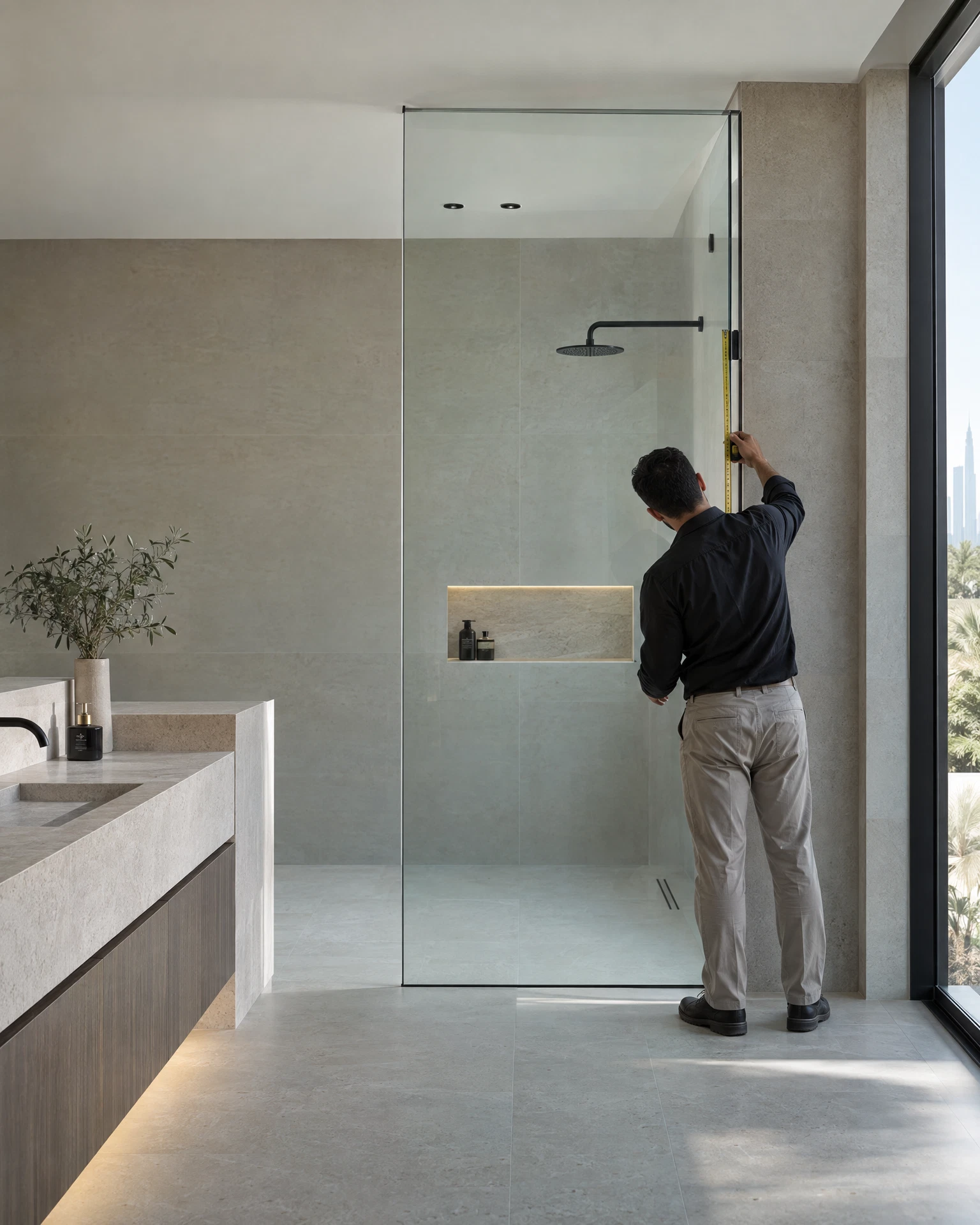
A photo gets you a preliminary estimate — usually enough to confirm the construction, spot edge problems and place the job sensibly against the guide figure. It cannot confirm the exact quote, because the confirmed number rests on true sizes and the bath edge’s level and condition, which are measurement facts. Send the photos anyway: they are how the conversation starts.
What should I send for a bath screen quote?
A photo of the whole bath and shower area, a close-up of the bath edge where the screen will sit, the rough length and height you have in mind, and whether you are thinking fixed or hinged. Tell us your area too. From that we can give you a preliminary view, and arrange the measurement that turns it into a confirmed quote.
Talk to us about your bath screen
If you are pricing a screen for your bath, message us on WhatsApp on +971 52 443 2655 with a photo of the bath, a close-up of its edge, and whether you are thinking fixed or hinged. We will give you a preliminary view against the published guide figure — and the measurement that confirms the exact quote for your bath.
WhatsApp us about your bath screen
This guide is part of our Shower Glass Prices series. Next: Fixed Panel and Walk-In Shower Prices: Glass, Fixings and Waterproofing →


