
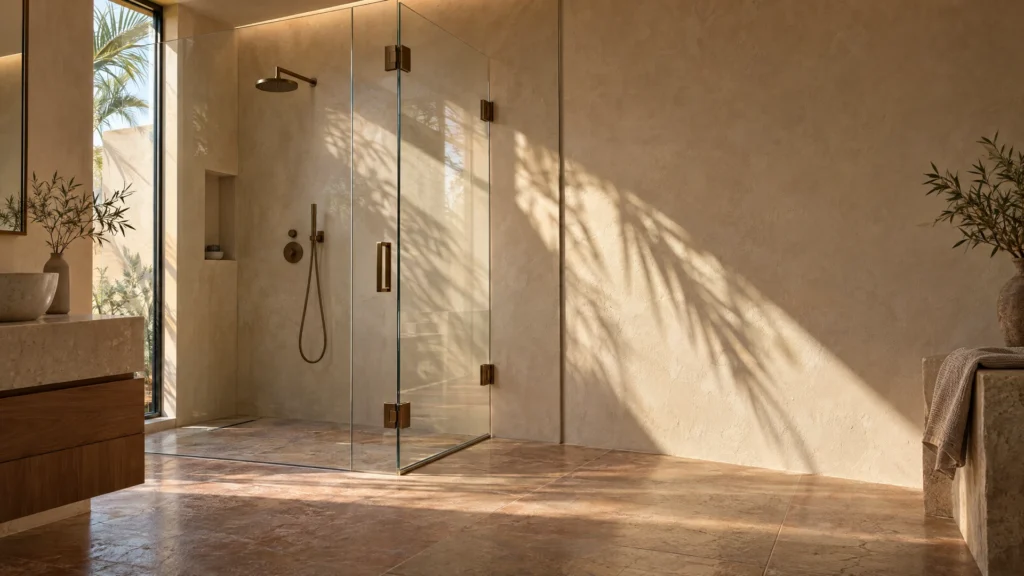
A hinged shower door does not just occupy its opening. Every time it opens, it sweeps a quarter-disc of floor in front of the shower — and anything inside that sweep is something the door will eventually meet. Most hinged-door disappointments are not about the glass at all; they are about a swing that was never checked against the basin, the WC or the towel rail until the door was already made. The check itself takes five minutes, one measurement and a roll of masking tape, and it needs nothing you do not already own. This article explains the arc, lists what it has to clear, shows you how to mark yours out, covers inward versus outward swing, and sets out the alternatives when the arc fails. It is deliberately only about clearance — the wider question of whether a hinged door suits your bathroom at all is covered on our hinged shower glass doors page.
At a glance
- The swing radius is the door’s own width: a 700mm door sweeps a 700mm arc from its hinge line. There is no separate clearance figure to look up — the door brings it with it.
- The arc must be clear at every height, not just on the floor: the handle travels the widest path of all.
- You stand in the arc too. A swing that clears every fixture but leaves you pressed against the basin to open it has still failed.
- Check before you commit: tape on the floor settles it in minutes, before any glass is cut.
- If the arc fails, the layout usually doesn’t: a narrower door with a fixed panel, hanging the door from the other side, a sliding door or a fixed screen all change the geometry.
The swing arc, explained simply
A hinged door rotates around its hinge line. Every point on the glass traces a circle centred on the hinges, and the closing edge — the edge furthest from the hinges, where the handle sits — traces the largest circle. Its radius is simply the width of the door. So a door 700mm wide, opening to about a right angle (typical for shower hinges; some ranges open a little beyond, which only enlarges the area to keep clear), sweeps a quarter-disc of floor roughly 700mm deep in front of the opening, from the closed position to fully open.
Two refinements matter. First, the handle projects out from the face of the glass, so the handle’s arc is slightly wider than the glass’s — a fixture that clears the glass by a whisker may still meet the handle. Second, the arc is not a floor marking only: it exists at every height the door occupies, from the floor to the top of the glass. A basin rim, a rail or a shelf is in the swing if it sits inside that radius at its own height, even if the floor beneath it looks empty. Working room matters as well as bare clearance: a door that passes a fixture with a millimetre to spare will, in real life, be opened a thousand times by people who are wet, hurried or half asleep — a little space beyond the strict arc is typical practice, and the exact margins are confirmed when the door is measured.
What the door must clear
The basin and vanity are the classic collision. Measure to the nearest point of the basin itself, not the edge of the vanity unit below it — basins overhang. Contact here is not a cosmetic issue: a strike lands on the edge of the glass, which is the part of a toughened panel that tolerates damage least, and a daily gentle knock is still a knock.
The WC, checked in both of its states. A raised seat and lid lean back towards the shower in many compact bathrooms, and a swing that clears the closed WC can clip the open one.
Towel rails and heated rails mounted on the wall the door opens towards. The door, or its handle, meets the end of the rail — check the arc at rail height, not just at the floor.
The bath edge, where the shower sits beside or above a bath, and the glass passes over or alongside it.
The bathroom door itself. Two doors in one small room means two arcs, and arcs can cross. If the room door and the shower door can both be open at once — one swung in by someone entering, one swung out by someone showering — check that they cannot meet handle-to-glass.
The small movable fixtures — toilet-roll holders, bidet sprays, bins, stools, scales. They are easy to overlook because they can be moved, but if they live inside the arc they will be struck daily, and the bin will always drift back.
And finally, you. The person opening the door stands in front of it and steps through the opening as it swings. In a tight room the tape test can pass for the door and fail for the person using it. If opening the door fully means flattening yourself against the basin, treat the layout as failed and go to the alternatives below.
Measuring your arc before you commit
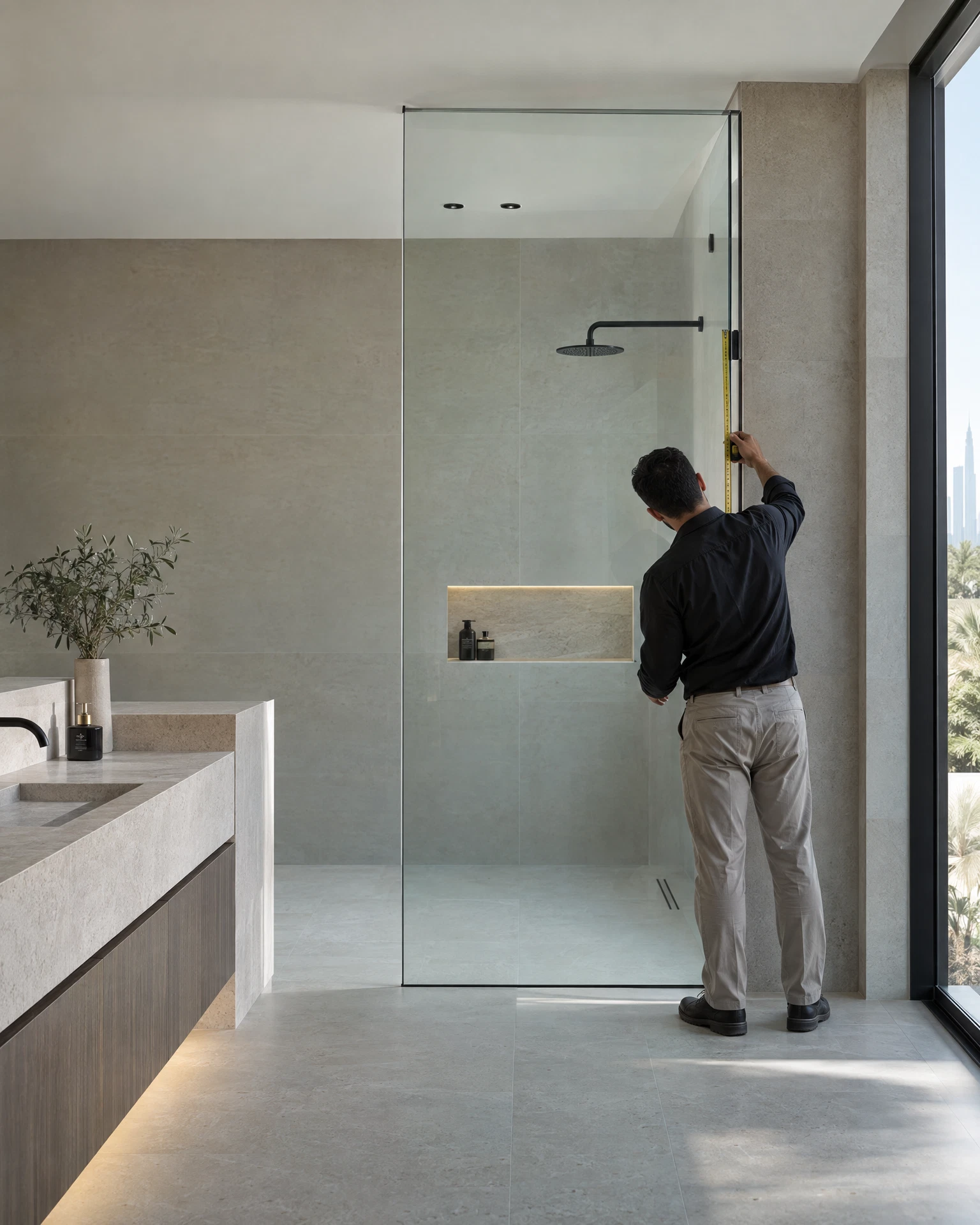
- Estimate the door width. Measure the opening the glass will close. If the layout is a door alone between walls, the door is roughly the full opening width. If a fixed panel sits beside the door, the door is the remaining width. These are estimates for the check — the exact door width is set at the real measurement.
- Swing the radius. Anchor a tape measure, or a length of string, at the point where the hinges would sit, stretched to your estimated door width, and swing it slowly through the arc the door would travel.
- Tape the arc on the floor. Mark the swept curve and the fully-open position with masking tape. Now look at what falls inside the tape: fixtures, and the spot where you would stand.
- Repeat at handle height. Hold the tape at the height the handle will sit and check it against the basin rim and any rails — the handle’s path is the widest of all.
- Check the other hinge side too, if the door could hang from either end of the opening. The arc mirrors, and a failed swing on one side is often a clean swing on the other.
If you want a second opinion before committing, photograph the bathroom with the tape arc in place, note the rough opening width, and send both to us on WhatsApp — the arc reads clearly in a photo, and we can sanity-check it before anyone visits.
Inward vs outward swing
Most hinged shower doors open outward, into the bathroom, and there are two practical reasons it is the typical arrangement. The first is access: an outward-opening door can always be opened from outside, while an inward-opening door can be blocked by someone who has slipped inside the shower. The second is space — the inside of a shower is usually spoken for. An inward swing needs its own arc inside the enclosure, clear of the shower fittings and of the person standing under the water, and in a modest enclosure that space rarely exists.
The outward swing has one honest trade-off: drips. A door opened after a shower carries water off its face, and an outward door sheds that water onto the bathroom floor, where an inward door sheds it into the tray. In practice most people accept the drips and keep the access and the space. Inward swing remains a real option in larger enclosures where the internal arc is genuinely free — but it is a decision taken at measurement, once both arcs are known, not a default.
When the arc fails: the alternatives
A failed arc is a geometry problem, and geometry problems usually have more than one answer.
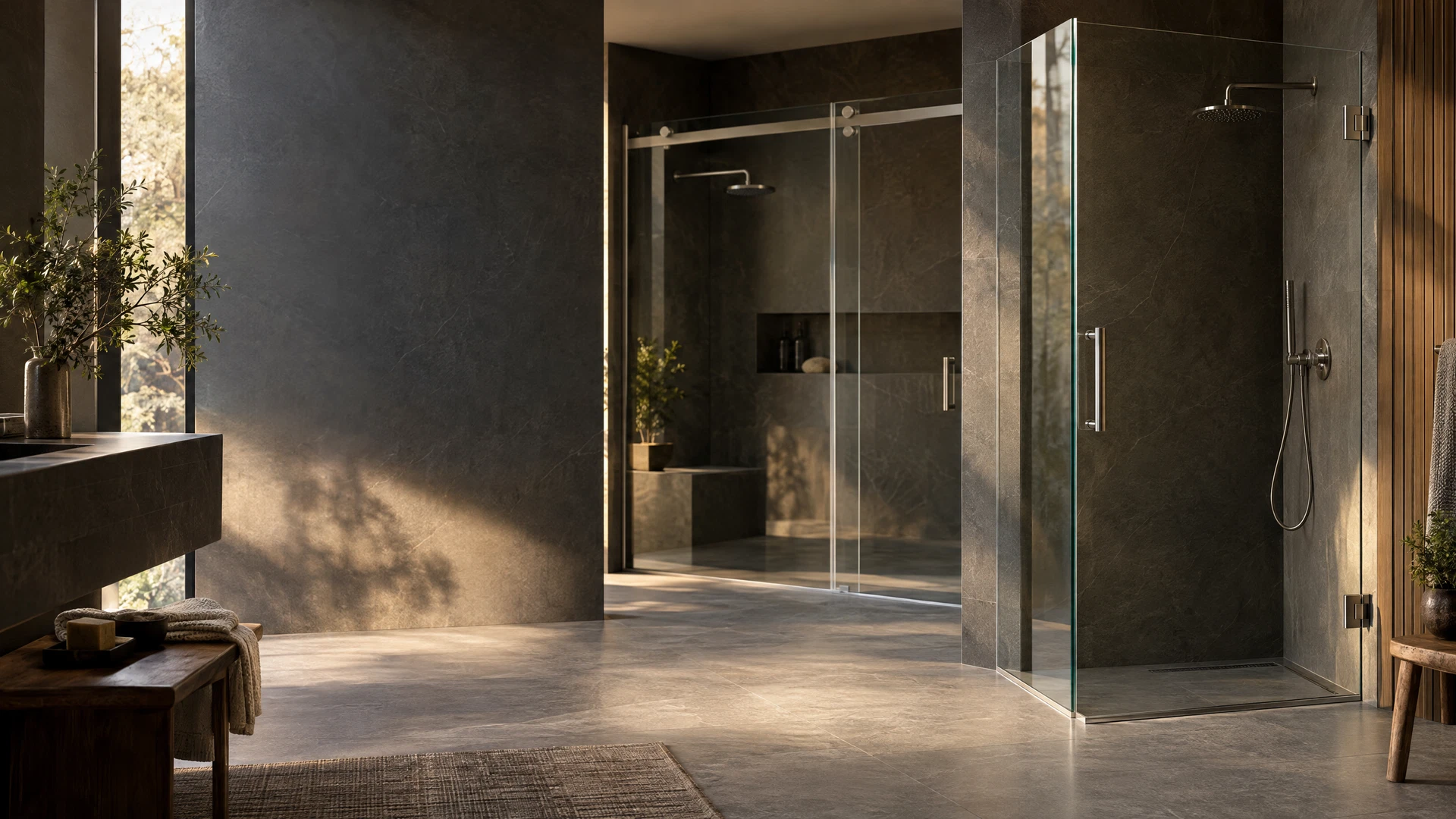
- A narrower door with a fixed panel beside it. The panel takes part of the opening, the door shrinks, and the arc shrinks with it. This is the standard rescue for a wide opening in a tight room — the door you end up with may be the width the room wanted all along.
- Hang the door from the other side. The arc mirrors to the other end of the opening. If the obstruction sits at one end only — a basin crowding the left, say — moving the hinges to the right can clear the swing completely.
- A sliding door. No arc at all: the panel travels along the wall inside the shower line. This is the usual answer in genuinely small bathrooms, and the full comparison of the two systems is in our guide to hinged vs sliding shower glass.
- A folding door. The door folds as it opens, sweeping roughly half the depth of a full swing — worth asking about where the range and the opening allow it.
- No door at all. Where the splash zone allows it, one of the fixed walk-in screens removes the swing question entirely.
None of these is a consolation prize. Measured glass is made for the room it is going into, and changing the geometry on paper costs nothing — changing it after the glass is cut costs a door.
Frequently asked questions
How much space does a hinged shower door need to open?
At minimum, its own width as a clear radius from the hinge line, plus a little working room for the handle and for the person opening it. A 700mm door therefore wants roughly 700mm of clear depth in front of the opening. The taped arc is the real test, and we confirm the margins when we measure.
Can a hinged shower door open inwards?
Yes — in larger enclosures where the inside arc is clear of the fittings and there is still standing room under the shower. Most doors open outward, for access and space reasons. The direction is settled at measurement, once both swings have been checked.
What happens if the door hits the basin?
Do not let it get that far. Repeated contact chips glass edges, works fixings loose and marks the basin. If the arc test shows a strike, change the geometry before the door is made — a narrower door, the other hinge side, or a sliding system — rather than accepting a door that knocks.
My bathroom is small. Is a hinged door automatically out?
No. Small rooms fail the arc only when something actually sits inside it. A narrower door with a fixed panel, or a door hung from the other side, fits many compact apartment bathrooms. Five minutes with a tape measure and masking tape will tell you which case yours is.
Can you check the swing from photos?
Yes. Send a wide photo of the bathroom on WhatsApp — ideally with the masking-tape arc marked on the floor — plus the rough opening width. We will tell you whether a hinged door can swing in that room, and what we would change if it cannot.
Talk to us about your swing clearance
If you are planning a hinged door and are not sure it can swing, message us on WhatsApp on 052 443 2655 with a photo of the bathroom and your rough opening width. We will check the arc with you, and if a hinged door cannot work in the space, we will tell you plainly which of the alternatives will.
This guide is part of our Hinged Shower Glass Doors series. Next: Wall-to-Glass vs Glass-to-Glass Hinges, Explained →

