
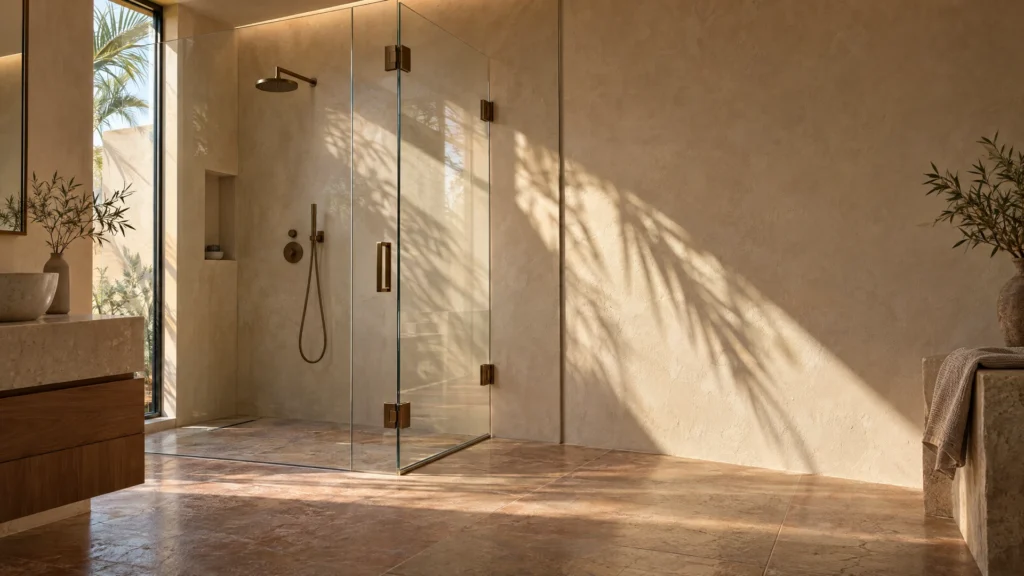
A hinged shower door is the only common shower door that closes against a seal on every side — which is why it has a reputation as the watertight option. The reputation is mostly earned, but it needs one honest qualification before anything else: a door line is a splash barrier, not a dam. It is designed to turn back the water of ordinary showering — spray bouncing off you, run-off running down the glass, splash arriving at the edges at low energy. It is not designed to hold back a jet of water aimed straight at it, and no door line of any type is. This article explains how the containment actually works: the three lines of defence around a hinged door, what the bottom sweep really does, when a threshold earns its place, the honest limit where direct spray is concerned, and how the whole door line is designed around your shower head. It is about expectations and design — if your existing door is letting water out and you want to know why, that is a diagnosis, and it starts with our guide to a shower door leaking at the bottom.
At a glance
- Three lines of defence: the hinge edge, the closing edge and the bottom edge each stop water a different way — small fixed gaps, seals that meet under light pressure, and a flexible sweep that wipes the floor line.
- The bottom sweep is the hardest-working part: it deflects running water and splash back into the tray. It wipes; it does not plug. It is also a consumable that hardens and wears.
- A threshold is a helper, not a default: it earns its place on low-lip and level floors, where the sweep needs a ridge to close against.
- The honest limit is direct spray: a handheld jet played along the door line will push water through any hinged door ever made. Normal spray and splash are what the line is built for.
- The door line is designed, not defaulted: head position, which edge takes the spray and which way the door opens are decided at measurement, before the glass is cut.
The three lines of defence
A hinged door has three open edges, and each one is defended differently, because each one faces a different kind of water.
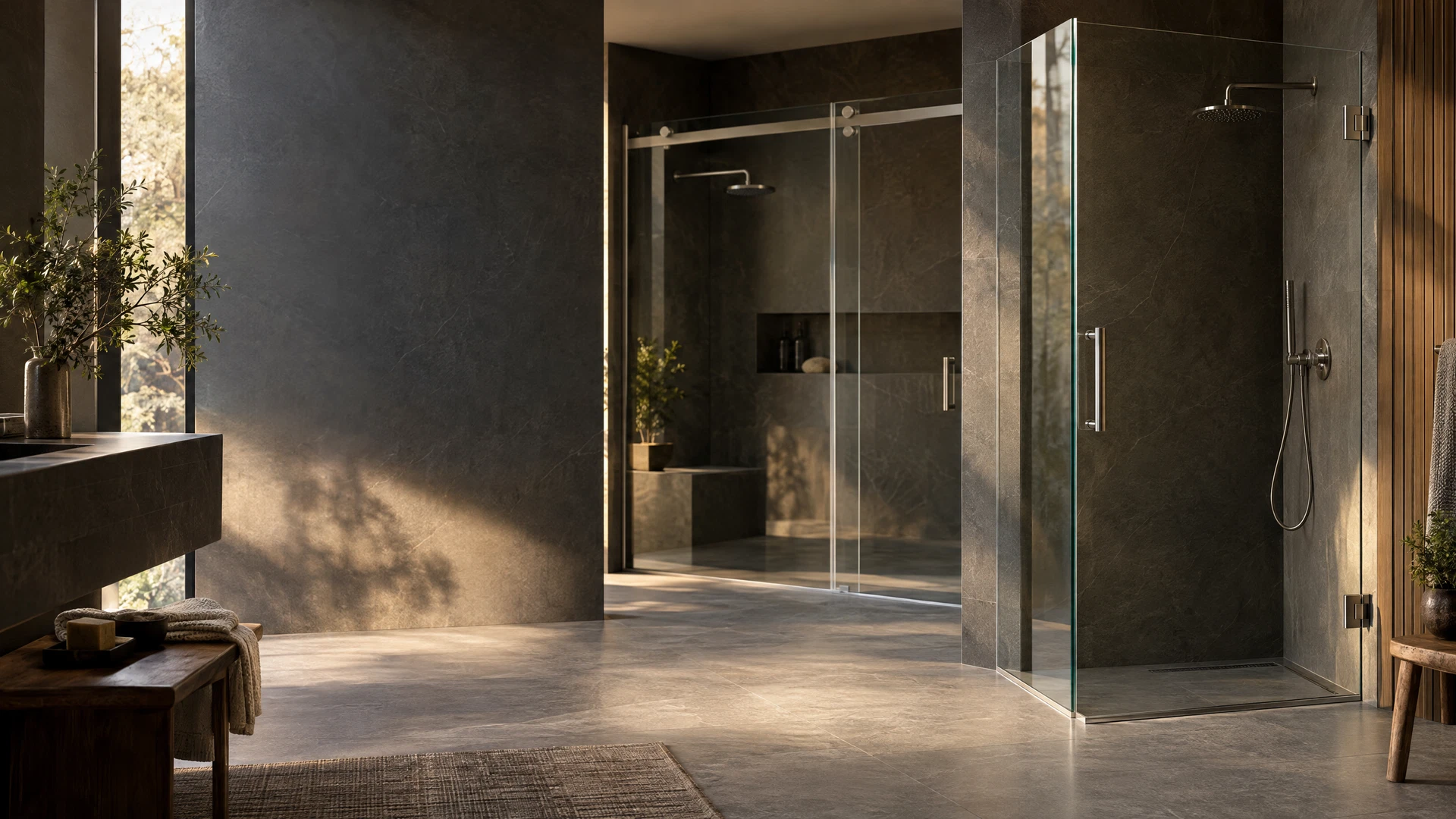
The hinge edge is the quiet line. The gap between the door and the wall or fixed panel it hangs from is small and fixed — it does not open and close — and it is usually closed further by a slim seal profile fitted to the glass edge. Water reaches this line mostly as run-off travelling sideways along the glass, at low energy, and a small, constant gap with a seal profile is enough for that. It is the line that asks least of the design, and the one that fails least.
The closing edge is where the door meets its frame, fixed panel or strike profile, and it is defended by contact: fin seals and magnetic strips that meet along the door’s full height as it closes, the magnets pulling the last few millimetres home so the fins sit compressed along the whole edge. This is the most positive seal on the door — the one that makes a hinged line feel sealed rather than merely close — and it works because the door arrives at it square and is held there. A closing edge seals as well as the door hangs; the seal itself cannot correct a door that arrives out of line.
The bottom edge is the hardest line, because it faces the most water with the least help. Gravity delivers every litre that hits the door to the bottom edge as run-off, the floor line is where tray water moves, and the door must stay free to swing above the floor — so this edge cannot close against a fixed seal the way the closing edge does. It is defended by the sweep, which gets its own section next.
Notice what is not on the list: the top edge. Spray does not travel upward, run-off does not climb, and the top of the door line is tested only by steam. Three lines, three mechanisms — and a door line that keeps water in is simply all three doing their different jobs at once.
What the bottom sweep really does
The bottom sweep is the clear or frosted flexible profile fitted along the bottom edge of the door, with one or more soft fins hanging below the glass. Its job is often misunderstood, so here it is plainly: the sweep does not seal the bottom of the door shut. The door has to swing, the floor or tray edge beneath it is never perfectly level, and a rigid seal dragged across it would judder, wear and eventually hold the door off its line. Instead, the fins sit lightly against the floor line and act as a deflector and a wiper. Water running down the face of the glass reaches the sweep and is turned back into the tray by the fin’s angle; splash arriving at the floor line meets a soft barrier moving at the speed of the door, not a gap. When you open the door after a shower, the sweep wipes the threshold line as it passes — which is also why an outward-opening door sheds its drips along the sweep’s path.
Two practical consequences follow. First, the sweep works at splash pressure, not jet pressure — it is the clearest example of the splash-barrier principle in this whole article. Second, the sweep is a consumable. The fins harden, flatten and tear with age, heat and cleaning chemicals, and a sweep that has gone stiff stops deflecting and starts channelling. Renewing it is ordinary maintenance — it belongs to the same family of work as the shower seals and silicone elsewhere on the door — and a hardened sweep is the first thing to suspect when a door line that used to behave starts leaving a wet line at one corner. What a new sweep will not do is rescue a bottom line that was designed wrong: if the gap under the door was cut too generous, or the floor falls the wrong way, the fix is in the design, not the fin.
Thresholds: when one is needed
A threshold — a low profile or dam strip fixed across the floor line under the door — gives the sweep something definite to close against: a ridge the fins meet, rather than a flat floor they skim. On a well-lipped shower tray it is often unnecessary, because the tray’s own upstand and fall already do the containing and the sweep only has to handle the door’s run-off. The threshold earns its place in three situations.
Low-lip and level-access floors. Where the shower floor runs nearly level with the bathroom floor — a wet-room-style tray or a minimal upstand — there is no tray geometry helping the door line, and moving water on a level floor travels. The threshold becomes the ridge that turns it back.
A door line at the wet edge. Where the door sits at the edge of the wet zone rather than set back inside it, the bottom line receives tray water moving at its fastest, and the sweep alone is being asked to do a tray’s work.
A floor that falls the wrong way. Floors are not always laid to fall toward the drain; where the fall carries water toward the door line, the threshold is the honest correction at the line itself.
The trade-off is stated plainly: a threshold is a small step at the entry. It is low — typically a slim profile rather than anything you climb — but it is there, it is felt underfoot, and for some households that settles the question the other way. Fitted where the floor needs it, it is the difference between a door line that copes and one that merely hopes. Fitted where the tray already contains, it is furniture. The decision belongs to the measurement, where the floor’s fall and the tray’s lip can actually be seen.
Direct spray vs splash: the honest limit
Every door line in this article is designed against two kinds of water: splash — droplets arriving at low speed from bouncing off a body, a wall or the tray — and run-off, water travelling down a surface under gravity. Against those two, a well-made hinged door line is complete: seals meet, the sweep deflects, the threshold turns back what reaches the floor.
The third kind of water defeats it, and pretending otherwise is how disappointment is sold. Direct spray — a shower jet arriving at mains pressure, aimed at the door line — will find the working gaps every door must have: the sweep’s flex, the closing edge’s fin line, the hinge edge’s profile. Some water will come through any of them. This is not a hinged-door weakness in particular; it is the terms of every operable door, because a door that could withstand a jet aimed at its edges would be a door sealed like a submarine hatch, and it would not swing.
In practice this limit is almost entirely about the shower head and the handheld. A fixed head doing its job delivers no direct spray to the door line at all. A handheld shower played along the bottom of the door while rinsing the tray, washing a child or a dog, delivers exactly that. If your door line only ever passes water in that moment, the line is not failing — it is being used outside its design terms, by the one person who can simply aim elsewhere. If it passes water under ordinary showering, that is different: something in the three lines has worn, moved or been cut wrong, and it is a fault with a cause, not a characteristic.
Designing the door line for your shower head
Because the honest limit is about where the water is aimed, the door line of a new installation is designed around the shower head, not just around the opening. Four decisions do most of the work.
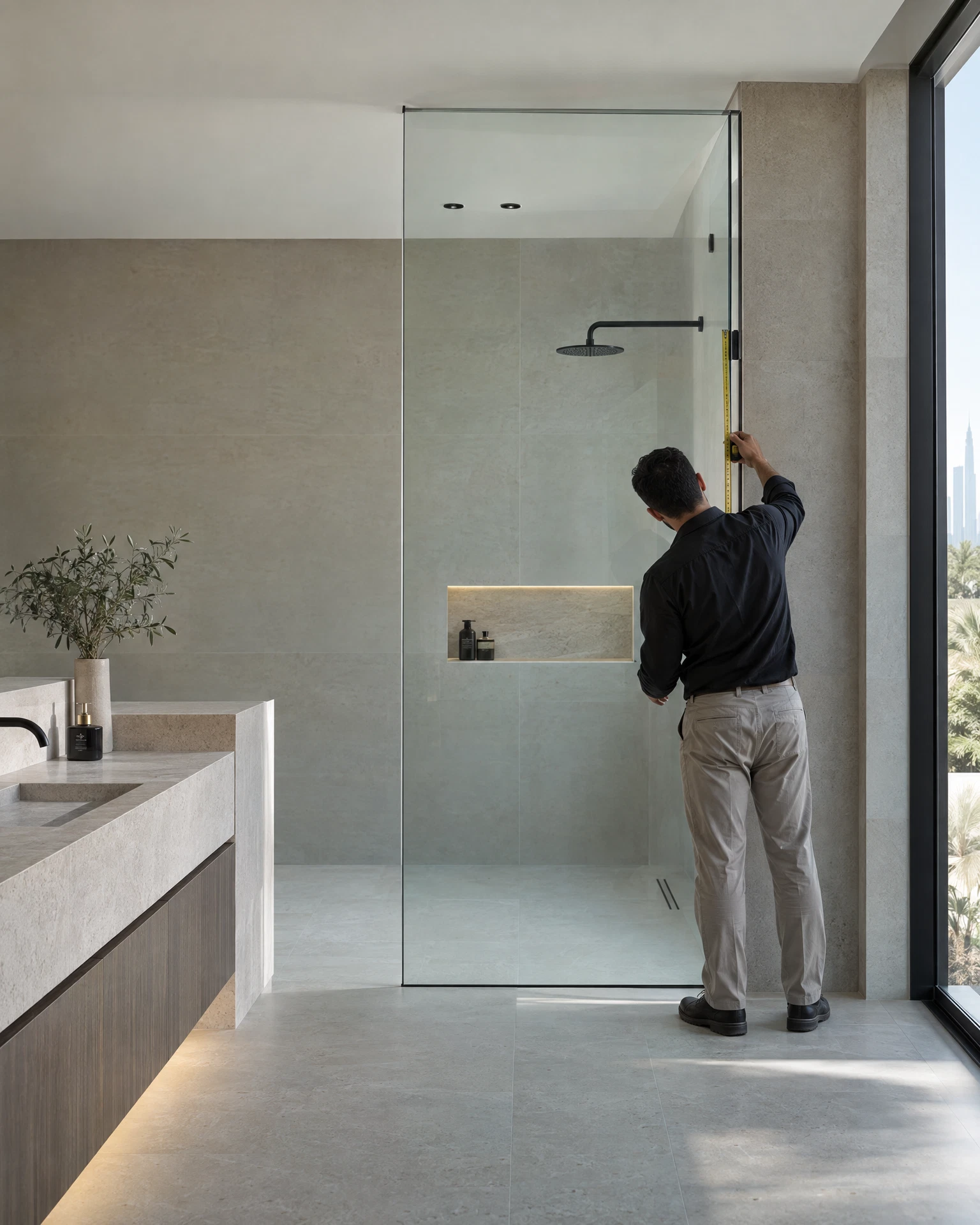
Head position relative to the door. The spray cone of a fixed head should land inside the enclosure, falling on the bather and the tray — not raking along the door line. Where the head must sit near the door, the geometry is checked at measurement, not discovered at the first shower.
Which panel takes the spray. In a door-and-fixed-panel layout, the fixed panel is the better spray-catcher: it has no opening edges on the spray side, only sealed fixed lines. Arranging the layout so the door sits on the drier side of the enclosure is free containment, bought with layout rather than parts.
Which way the door opens. An outward-opening door sheds its face water onto the bathroom floor as it opens; an inward-opening door sheds it into the tray. Where the swing allows a choice, that drip behaviour is part of the door-line decision, alongside the access and clearance questions that usually settle it.
The bottom line, specified deliberately. Sweep type, threshold or no threshold, and the door’s bottom gap are set for the actual floor — its tray, its lip, its fall — rather than left as whatever the standard fitting produces.
None of this is exotic. It is what “measured, not moulded” means applied to water: the door line is a small system designed around your head, your floor and your layout, and a door line designed that way behaves the way this article describes. One that was never designed — a standard door hung in a standard opening — behaves however the room decides.
Frequently asked questions
Is a hinged door line really sealed, then?
It is sealed the way a door can be sealed: fin and magnetic seals meeting along the closing edge, a profile on the hinge edge, a sweep deflecting the bottom line. Against splash and run-off — the water of ordinary showering — that is a complete barrier. Against a jet aimed directly at an edge, no swinging door is sealed, and anyone who promises you one is overselling.
Why is there water under my door after a shower?
If it arrived during ordinary showering, the usual suspects are a hardened or flattened bottom sweep that has stopped deflecting, or a door that no longer closes square so the closing-edge seals meet at one end only. If it only happens when the handheld shower is used near the door, that is direct spray — the design limit, not a fault. The two cases have different answers, which is why the pattern matters more than the puddle.
Can a threshold be added to an existing door?
Often, yes — a low threshold profile can be added across many floor lines, and it genuinely improves a bottom line on a low-lip or level floor. It will not improve the closing edge or the hinge edge, and it adds a small step at the entry. Whether it suits your floor line is a measurement question.
Does a hinged door keep water in better than a sliding door?
They contain water differently: the hinged door closes against seals on every side, the more positive barrier, while a sliding door relies on panels overlapping. For most bathrooms both contain ordinary showering well when they are designed and fitted properly; where the spray pattern is aggressive and the door line takes it directly, the sealed line has the wider margin.
Is a hinged door suitable for a level-access or wet-room shower?
Yes, with the door line designed for it: a threshold at the line, the sweep specified for a level floor, and the head positioned so its spray stays off the door. What a level floor removes is the tray’s help — so the door line has to do the whole job itself, and it is specified accordingly at measurement.
Talk to us about your door line
If you are planning a hinged door and want the containment designed properly from the start — seals, sweep, threshold and head position decided at the measurement — or if an existing door line is letting water through under ordinary showering and you want to know which of its three lines is responsible, message us on WhatsApp on 052 443 2655 with a photo of the shower and your area. Tell us where the water appears, and we will tell you honestly whether it is a design question, a worn part, or a door being sprayed outside its terms.
This guide is part of our Hinged Shower Glass Doors series. Next: Hinged vs Pivot Shower Doors: What’s the Difference? →
