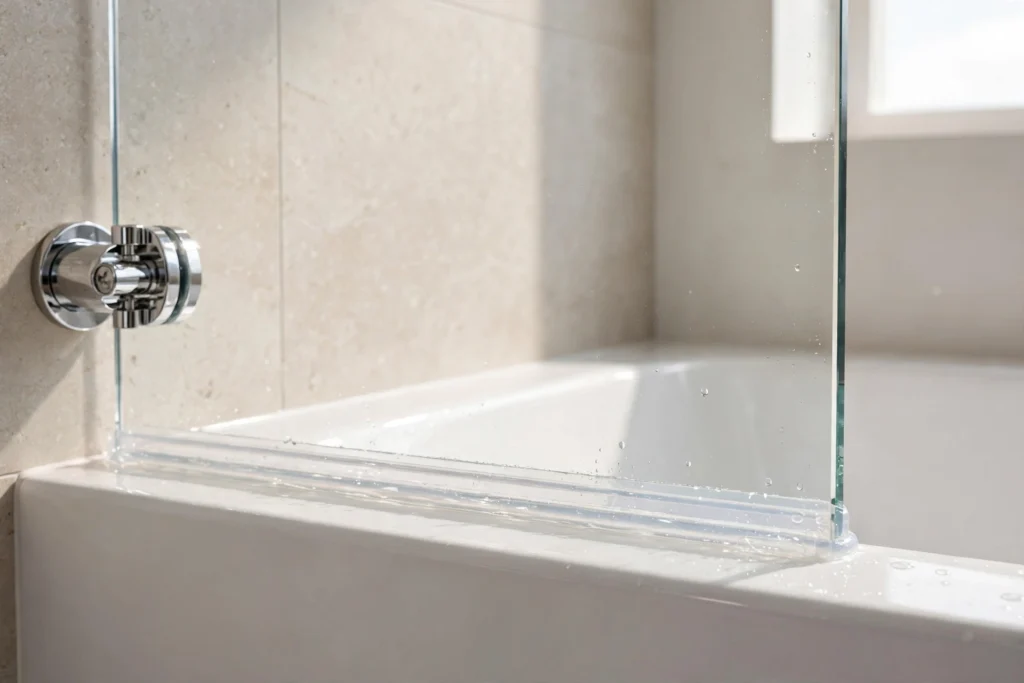
The hinges are the only moving parts on a glass shower door, and they carry the entire weight of the panel every time it swings. When they go wrong, the symptoms show up everywhere else — a door that drops, drags, leaks at the corner, or won’t close with its usual pull. Many people searching “shower door hinge replacement” are looking to buy one and swap it themselves, and this guide is honest about why that is harder than it looks: the glass in your door was cut for a specific hinge, and the wrong replacement simply will not fit. What follows explains how to tell a loose hinge from a worn or broken one, what adjustment and repair can genuinely recover, and when replacement is the only honest answer.
At a glance
- Loose is not worn: if the hinge body shifts against the wall or glass, the fixings need attention. If the door moves within a solid hinge, the mechanism is worn.
- Adjustment has limits: re-aligning a door works only while the hinge itself is sound. No adjustment restores a worn pivot.
- Most modern hinges are sealed units: fixings and gaskets can be serviced; the internal mechanism generally cannot be rebuilt.
- Replacement must match the glass: the cut-outs in your panel were made for a specific hinge pattern, glass thickness and door weight — the new hinge has to suit all three.
- Replace in pairs: the second hinge has lived the same life under the same load as the one that failed.
What a shower hinge actually has to do
A shower hinge does three jobs at once. It clamps the glass — gripping the panel through a cut-out with plates and gaskets. It carries the door’s full weight, transferred into the wall or into an adjacent fixed panel. And it pivots, usually with a self-closing action over the last part of the swing, so the door pulls itself onto its seals and stays shut against the water. That is a lot to ask of a fitting roughly the size of your palm, on a door made of 10mm glass.
On the enclosures we install and repair, hinges come in two arrangements. Wall-to-glass hinges fix the door directly to the wall. Glass-to-glass hinges hang the door from a fixed glass panel beside it, which means that panel and its own fixings share the load. Both types come in the finishes we fit — chrome, matte black and brushed gold — and both are rated for a maximum door weight and width. Those ratings matter more than the finish: an under-rated hinge on a wide, heavy door is a worn hinge waiting to happen.

Signs a hinge is the problem
Hinge trouble rarely announces itself at the hinge. It shows up as a door that has dropped a few millimetres and started dragging or touching the floor, a closing edge that no longer meets its seal evenly, a self-closing pull that has gone weak in the last part of the swing, clicking or grinding as the door moves, or a door you can lift slightly at the handle and feel move. Any of those can also come from other faults — which is why the deciding question is never the symptom but the location of the movement. Have someone lift and lower the door gently while you watch each hinge closely. Where the movement lives tells you which of the three problems below you have — and the full dragging diagnosis, symptom by symptom, is set out in our guide to a shower door dragging or touching the floor.
Loose means the hinge is sound but its grip has relaxed: wall screws or clamp bolts have worked slightly free, and the hinge body can be seen to shift when the door is lifted and lowered. The door may have dropped a few millimetres as a result. This is the adjustment case — the hardware is re-secured and the door re-hung true.
Worn means the movement is inside the hinge. The pivot has developed play, the swing may click, grind or feel notchy, the self-closing pull has gone weak, and the door hangs low even though every fixing is tight. A worn mechanism cannot be tightened back to life — it is a replacement case.
Broken means something has cracked, snapped or given way: a fractured hinge leaf, a failed pivot, a door that has dropped suddenly or is hanging at an angle it never had. A door on a broken hinge should be left shut and unused until it is seen to. It is being held by one hinge and its own seals, which is not an arrangement to test daily.
What adjustment can and cannot recover
Adjustment covers everything outside the hinge’s sealed mechanism: re-securing wall and clamp fixings into sound material, re-levelling the door so the gap beneath it is even and the closing edge meets its seal along its full length, and renewing the clamp gaskets that cushion glass against metal. Done on a sound hinge, it fully restores the door — this is the correct fix for most doors that have simply relaxed over the years.
What adjustment cannot do is remove play from a worn pivot, restore a tired self-closing action, or make a cracked hinge body trustworthy. If a quote for a worn hinge consists entirely of “we’ll adjust it”, you will be paying again within the year — the door will settle back to exactly where wear wants it. The honest sequence is the one we follow on our shower glass repair work: diagnose where the movement actually is, then adjust, repair or replace according to what is found, not according to what is easiest to sell.
When a hinge is worn out, not loose
The two states feel similar from the handle and are opposites in what they need. A loose hinge moves as a unit — the whole fitting shifts against the wall or the glass — and recovers completely once its fixings are sound. A worn-out hinge is solid at every fixing and still lets the door move, because the play is in the pivot the door swings on. The deciding test is the lift test with eyes on the hinge: fixings tight, hinge body still, door moving within the hinge means worn out. So does a self-closing action that no longer pulls the door home, and a swing that has developed a notch or click at the same point every time. Once those are present, the question is no longer whether the hinge can be saved — it is which replacement the glass was cut for, which is the subject of the replacement section below.
What “repair” realistically means
Between adjustment and replacement there is a narrow band of genuine repair. Fixings can be replaced — screws, plugs and clamp bolts renewed where threads or heads have suffered. Clamp gaskets, the shaped pads that sit between hinge plates and glass, perish and compress with age and can be renewed, which often removes a surprising amount of movement on an otherwise sound hinge. On some older, serviceable hinge designs, springs and pins can be attended to.
But most contemporary shower hinges are sealed units by design: the pivot and spring live inside a closed body that is not made to be opened, stripped and rebuilt. Anyone promising to rebuild the inside of a sealed hinge is describing work the manufacturer never intended. Where the mechanism has gone, replacement is not an upsell — it is the repair, done properly.
Replacing hinges on existing glass: how it works
This is where hinge-shopping usually goes wrong. Toughened shower glass cannot be drilled or cut after it has been toughened — the holes and notches for your hinges were made when the panel was fabricated, in the pattern of the hinge that was specified then. A replacement hinge therefore has to suit the existing cut-outs exactly, as well as the glass thickness — the doors we hang are 10mm — and the weight and width of the door. A hinge that is nearly right fits nothing: its plates won’t sit in the notches, its screws won’t align, and forcing it stresses the glass at its most vulnerable points.
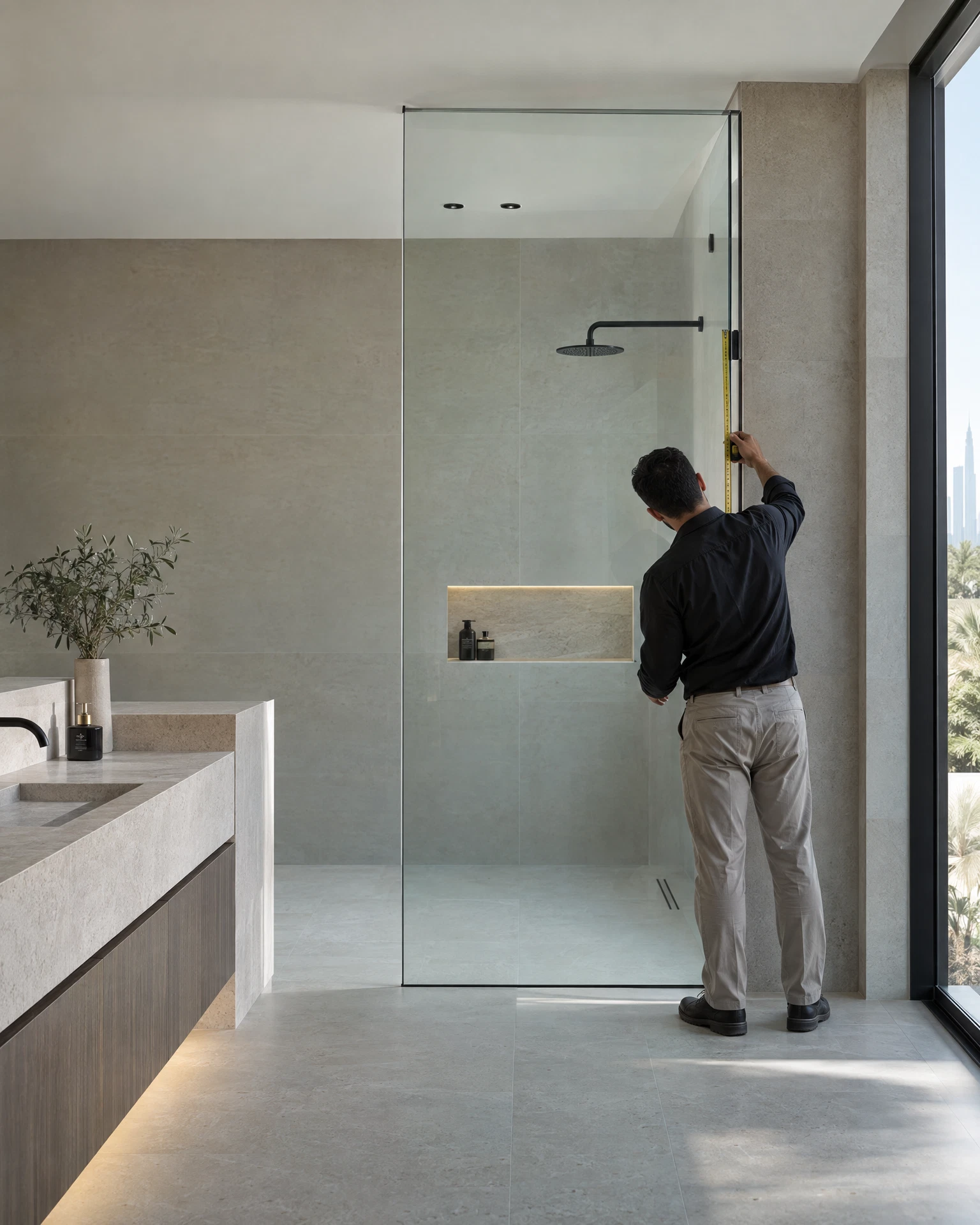
Matching also means rating and finish. A wide door may need heavy-duty hinges or a third hinge where two standard ones have been struggling. And the new pair should match the rest of the bathroom hardware — the handle, the other hinges, the profiles — in chrome, black or gold, or the door will announce its repair every time you look at it. In practice, the working method is identification: a clear photo of the existing hinge, the door open and closed, and the door’s width lets us identify the correct pattern before a visit, so the replacement arrives with the fitter instead of the job becoming two trips. On the day, the door is supported throughout, the old hinges come off, the new pair is clamped up with fresh gaskets seated, and the door is re-hung true and tested through its swing before the seals it has been crushing are renewed.
Why hinges wear out early
Good hinges on a correctly sized door last a long time. The early failures we see in UAE bathrooms follow patterns: doors hung on hinges rated below their weight, usually because the door is wider than standard; bathroom humidity and coastal air attacking poor-quality hinge bodies and springs; harsh cleaning chemicals sprayed directly onto the hardware; doors habitually opened hard against a wall or bath; and doors used as a support — grabbed and leaned on when stepping in and out. That last one is understandable and common, and it loads the top hinge in exactly the direction it is least able to resist.
There is also a knock-on cost to waiting. A door with one worn hinge transfers the load to the other, which then wears at double rate — and meanwhile the dropped door is crushing its bottom seal and leaking at the corner, so a hinge job quietly becomes a hinge-plus-seals job. A shower door leaking at the bottom that started after the door dropped is that story told from the other end.
One hinge or the pair?
Replace the pair. The two hinges have carried the same door, through the same number of swings, in the same steamy air, for the same years. If one mechanism has worn to the point of play, the other is close behind — and a door hung on one new hinge and one worn one will never sit perfectly true, because the worn side still sags. Pair replacement is also what keeps both sides ageing together from a known-good starting point. The exception is damage rather than wear: a single hinge cracked by a specific impact, with its partner testing sound, can be replaced alone.
Safety: why hinge work is not casual DIY
Everything above involves taking a heavy glass door off its hinges or working on it half-loose, and that is where the risk sits. A 10mm glass shower door is heavy, awkward to grip, and carried at exactly the height where a slip brings its edge down on tile, tray or toes. The door must be supported for the whole job — never left hanging on one hinge while the other is off, never rested on an unprotected edge — and it is a two-person lift throughout. A panel that twists while its fixings are loosened can crack at the hinge cut-outs, the most stressed points in the glass. And a door on a broken hinge should not be used at all until it has been seen to: it is being held by one hinge and its seals. The safe home contribution to a hinge problem is real but limited — the lift test, the photographs, and a clear description of the symptoms. The spanners-on-glass part is qualified-person work.
Frequently asked questions
Can I buy a shower hinge and fit it myself?
Only if you can identify the exact hinge pattern your glass was cut for, the door’s weight, and you have a second person to carry the panel while it is off — a 10mm glass door is heavy, and it must be supported throughout, because a door resting on its edge or twisting on one hinge can crack. The common outcome of a guessed hinge is discovering the mismatch with the door already off. Send us a photo of your hinge first; identifying it costs nothing, and it is the step most DIY hinge jobs skip.
My hinge creaks and clicks. Is it failing?
Creaking alone is often scale and soap residue around the pivot, or dry clamp gaskets — worth cleaning and watching. Clicking with movement is different: if you can feel play when you lift the door gently by its handle, or the door has visibly dropped, the mechanism is worn and cleaning will not restore it. Play, not noise, is the deciding test.
Do replacement hinges come in black and gold, or only chrome?
All three finishes we fit — chrome, matte black and brushed gold — are available for the common hinge patterns, and the replacement pair should match your handle and profiles. Our overview of hinge types and finishes: chrome, black and gold covers how the finishes behave in daily use. Occasionally an obsolete pattern exists in one finish only; if so, we will tell you before the visit, not during it.
The door slammed and now it hangs wrong. Hinge, fixings, or glass?
Most often the fixings shifted under the shock, which is an adjustment job. The inspection checks for the other two possibilities: a cracked hinge body, and — the one that matters most — a chip where the glass edge struck the floor or frame. Stop using the door until it is checked if the glass made contact with anything hard; edge damage on toughened glass is the thing we most need to see early.
How do I get the right hinge for my door?
Send us two or three photos on WhatsApp — the hinge close up, the whole door, and the door’s width — plus your area. From the photos we identify the pattern your glass was cut for and confirm the correct replacements, in the right rating and finish, before anyone visits. We cover Dubai, Sharjah, Abu Dhabi and Ras Al Khaimah.
How much does shower door hinge replacement cost?
It depends on the hinge itself — type, finish and load rating — on the weight of the door it has to carry, and on whether the door must come off the wall for the swap, which most full hinge replacements need. There is no honest flat figure without seeing the door; our guide to shower repair costs sets out what drives the bill, and photos on WhatsApp earn a first steer.
Talk to us about your hinges
If your shower door hinges are broken, worn, creaking, or simply no longer holding the door where they should, message us on WhatsApp on 052 443 2655 with a close-up photo of the hinge and a photo of the full door. We will identify the hinge from the photos and tell you honestly whether you are looking at an adjustment, a repair, or a replacement — before you commit to anything.
This guide is part of our Shower Glass Repair series. Next: Shower Seals & Silicone: Stop Water Escaping Under the Door →