

The handle is the hardest-worked fitting on a shower door. Every shower begins and ends with a pull on it, and when it starts to work loose, every one of those pulls wobbles its fixings in their holes and works the glass around them. So the reader’s question — can a loose or broken handle be replaced without damaging the glass? — has a reassuring answer with one firm condition. Yes: handles are replaceable components, designed to come off and be renewed on the existing door. The condition is that the replacement must fit the holes that are already in the glass. Those holes were drilled before the glass was toughened, and toughened glass can never be drilled again — so the hole pattern in your door is a fixed fact, and everything about the replacement is chosen to match it. This guide covers the handle types and their fixings, why handles loosen, when tightening is enough and when it isn’t, and how a replacement is matched to existing holes.
At a glance
- Handles are components, not part of the glass: knobs, bars and towel-bar combinations bolt through holes drilled in the panel before toughening, and they are made to be replaceable.
- The holes cannot be moved, added to or re-drilled. A replacement handle must match the existing hole positions and the glass thickness exactly.
- Most looseness is fixings and gaskets, not glass: re-seating a sound handle and tightening it gently solves the common case.
- Over-tightening is the real danger. Fixings through glass are snugged down with their gaskets compressed — never cranked — because excess torque stresses the glass at the hole.
- Chips or cracks around a hole change the job. Stop, don’t load the handle, and have the panel assessed before anything is refitted.
Handle types: knob, bar, towel-bar combos
Knobs are the simplest form: a single round or shaped grip fixed through one hole, usually by a through-bolt to a matching knob or a cap on the other face. One fixing point means one hole dictating everything, a compact look, and the least grip of the three types — with wet, soapy hands, a knob is the easiest handle to lose hold of.
Pull or bar handles fix through two holes and mount vertically or horizontally. The two-point fixing is inherently steadier — the load is shared, and there is no single bolt for the handle to rotate around — and a bar gives a full hand’s worth of grip, which matters on a heavy 10mm door. Bar handles are specified by their fixing centres: the distance between the two holes, which is the dimension your existing glass has already decided.
Towel-bar combinations pair a bar on the outside of the door — long enough to carry a towel — with a knob or short pull on the inside, bolted through the same holes. They are genuinely useful and genuinely loaded: a wet towel hanging on the bar is real weight hanging on two fixings in glass, all day. Hang towels on them by all means — that is what they are for — but a towel bar is not a grab rail, and hauling on it, or a child swinging on the towel, loads the fixings in ways no handle is meant to take.
Across all three types the fixing principle is the same: bolts pass through the drilled holes, and at every contact point a gasket or washer isolates the metal from the glass. Metal never bears directly on glass — the gaskets spread the clamping load and absorb the small movements of daily use. When those gaskets perish, the trouble starts.
Why handles loosen
A handle loosens under a perfectly ordinary load: leverage. The grip sits proud of the glass, so every pull is a small lever working on the fixings, thousands of cycles a year, in a room that is warm, wet and steamed daily. Against that, four things give way. The fixing screws or through-bolts ease a fraction at a time under repeated load and the vibration of the door closing. The gaskets compress and perish — rubber and nylon age in heat and cleaning chemicals — and once a gasket thins, the handle gains a fraction of movement, and movement accelerates everything else on this list. Corrosion attacks lower-grade fixings in a wet room: a corroding bolt can slacken as its thread wastes, or seize solid, both of which you discover at the handle first. And a door that is pulled askew — because it has dropped slightly and now needs a lift-and-pull to close — twists its handle fixings sideways on every use; a handle that keeps loosening on a door that has also changed how it closes is telling a bigger story, and that diagnosis belongs to our wider shower glass repair work, not to the handle itself.
One pattern is diagnostic by itself: a handle that you have tightened properly and that is loose again within weeks is not asking for more force. Something in the fixing — a perished gasket, a stripped thread, a corroded bolt — has already failed, and force applied to a failed fixing is how stress reaches the glass.
Tightening vs replacing
Tightening is the right first step when the handle itself is sound. The work is re-seating, not force: the door supported so its weight isn’t hanging on the handle being worked on, fixings eased back evenly, gaskets checked — renewed if they have flattened or perished — and then the fixings brought down evenly, a little at a time on each side, until the handle sits firm with its gaskets compressed. That is the whole specification: firm, seated, and no more. Fixings through glass are tightened to a feel. Cranking them down stresses the glass around the hole — the panel’s most vulnerable point — and a panel cracked at a handle hole by an over-tightened bolt is damage this article exists to prevent. Never use the handle itself as a lever to tighten its own fixings, never run one side fully down before the other, and stop if anything creaks, spins freely, or shows a chip at the hole.
Replacement is the answer when the handle is cracked, bent or broken; when threads have stripped so fixings spin or won’t hold; when fixings have corroded solid or wasted away; when the gasket seats are scored or damaged; or when you are changing the style — within the limits the holes set, covered next.
Where is the honest line between home and professional work? A sound knob or bar that has merely eased loose, re-seated gently with the correct hex key and the stop conditions above, is the cautious end of home maintenance. Seized or corroded fixings, broken handles with through-bolts that won’t release, any handle on a heavy door you cannot support safely while working, and anything where the glass around a hole is chipped or cracked — that is professional work, because the price of a mistake is not a handle. It is the panel.
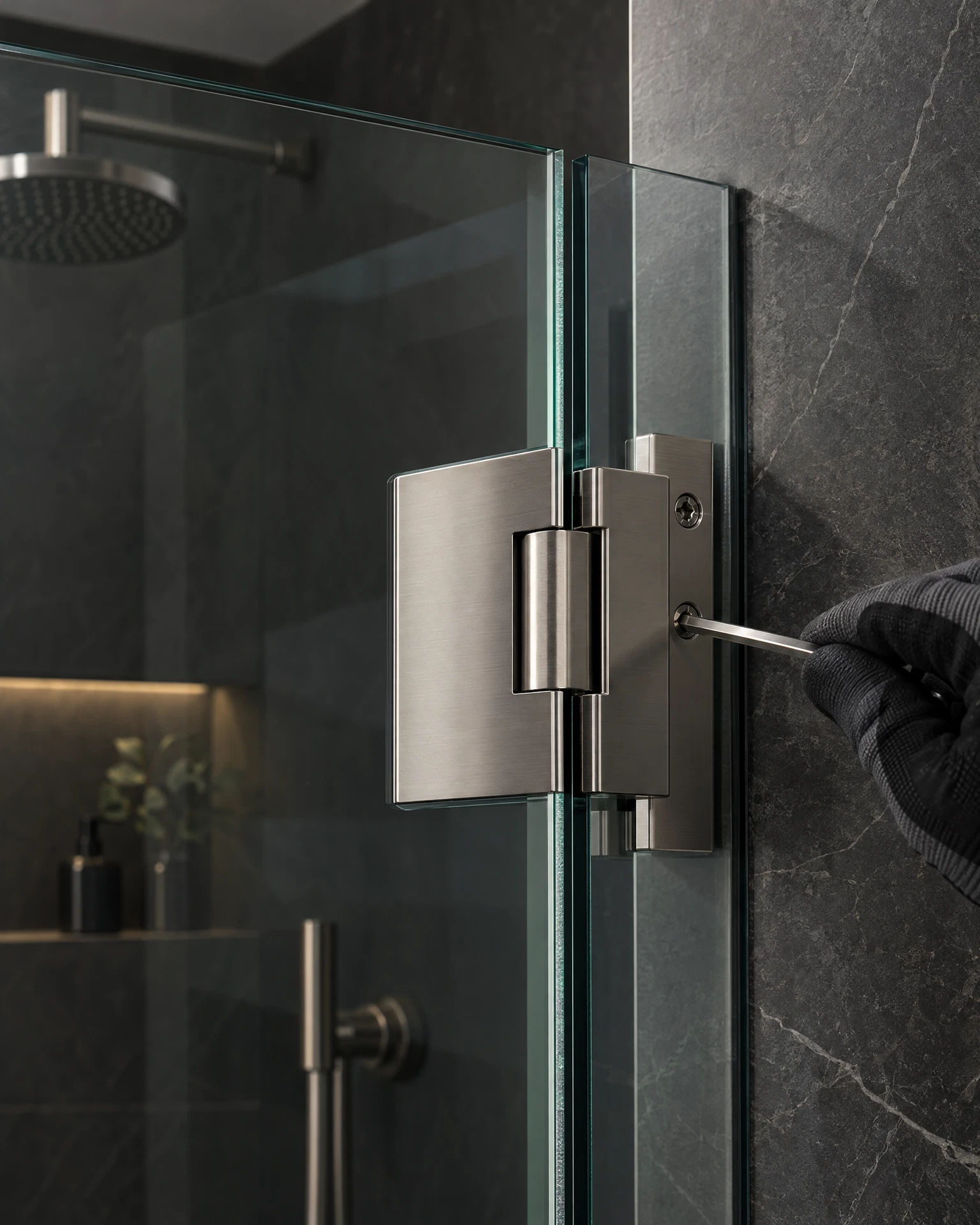
Matching fixings to existing holes
Start by measuring what the glass has already decided. How many holes: one for a knob, two for a bar or towel-bar combination. The centres: for two-hole handles, the distance between the holes, centre to centre — this is the number the replacement is chosen by. Position: the holes’ distance from the door’s edge, which sets how the new handle sits. Glass thickness: our standard work is 10mm, but an older door may not be — through-bolt lengths and gasket sets are sized to the thickness, so measure the glass at an edge rather than assuming.
The replacement’s fixings must land exactly on those centres. A few millimetres out is simply out: bolts forced in at an angle side-load the glass at the hole edge with every pull, which is precisely the stress pattern to avoid. Some handles are made with a choice of fixing centres (typical of the type, and worth confirming before ordering) — but no handle adjusts its way around a hole that isn’t there. And the absolute, stated plainly because people do ask: nobody drills toughened glass. A handle whose fitting needs a new hole needs new glass, not a drill — drilling a toughened panel shatters it, completely and immediately. If your heart is set on a handle your holes cannot take, the honest options are a different handle that fits the pattern you have, or a new door panel made with the holes you want.
If the glass at an existing hole is already chipped or cracked, the conversation changes before any handle is discussed: that panel needs assessing as damaged glass, the territory of our guide to cracked or shattered shower glass — do not refit a handle and keep loading it in the meantime.
Finishes and lengths
Handles are finished to match the rest of the door’s hardware, and the sensible reference is the hinges already on the door: chrome, black and gold are the finishes we work in, and a handle that matches the hinges reads as one set; a handle that nearly matches reads as a mistake. If you are replacing a handle anyway, it is also the moment to correct a finish that was never matched in the first place.
Length, on bar handles, is partly looks and partly leverage — with the constraint from the section above: it is the fixing centres that must match your holes, not the overall length, and handles of different lengths can share the same centres. As typical ranges, short pulls suit small doors and sit discreetly; longer bars give an easier, more deliberate pull on a wide, heavy door and carry the towel-bar role at the longest lengths. Choose the grip for the hands that will use it daily — a household that found a knob slippery will not be rescued by a prettier knob.
Frequently asked questions
Can I tighten a loose shower door handle myself?
If the handle is sound and has simply eased loose, cautious re-seating with the correct hex key is reasonable home maintenance: support the door, ease the fixings back evenly, check the gaskets, and bring the fixings down gently and evenly until firm — then stop. Firm is the specification. If a fixing is seized, corroded, spinning, or the glass at the hole is chipped, that is no longer a tightening job; leave it and have it looked at.
My handle has come off completely. Is the glass damaged?
Not necessarily — handles come off when fixings fail, and the glass is often unharmed. Check the edges of the holes without putting any load through them: if the glass around each hole is clean and unchipped, a refit or replacement handle is straightforward. If a hole edge is chipped or you can see a crack running from it, do not refit and use the handle — the panel needs assessing first, because the hole is the panel’s most stressed point.
Can I change from a knob to a bar handle?
Only if your door already has the holes for it. A knob door has one hole; a bar needs two at its fixing centres, and toughened glass cannot be given another hole. Most knob-to-bar changes therefore mean either a bar-pattern handle that works from the existing layout — rare — or a new door panel drilled for the handle you want. Measure your centres and send us a photo; we will tell you what your existing glass can take before you buy anything.
Why does the handle keep loosening after I tighten it?
Because something in the fixing has already failed — a perished gasket that no longer holds the clamp, a thread that has stripped, or corrosion wasting a bolt. Tightening harder does not repair any of those; it transfers the load to the glass around the hole. Repeated loosening is the handle asking for replacement of the fixing set or the handle itself, not for more torque.
Can you replace a shower door handle in Dubai, Sharjah, Abu Dhabi and Ras Al Khaimah?
Yes — handle replacement is part of our shower glass repair work across the four emirates we cover. Send a photo of the handle, a photo of the whole door, and tell us whether the glass around the fixings looks chipped or clean. If you want a different handle, a photo of the existing fixing positions lets us match the new one to your holes before we visit.
Talk to us about the handle
If your shower door handle is loose, broken or ready for a change, message us on WhatsApp on +971 52 443 2655 with a photo of the handle and one of the full door. Tell us your area and the finish you would like, and we will tell you whether it is a tightening job, a like-for-like replacement, or a new handle matched to your existing holes.
This guide is part of our Shower Glass Repair series. Next: Cracked or Shattered Shower Glass: What to Do, and How Replacement Works →
