You have already paid for this shower once. The glass is up, the job is signed off, and the bathroom floor is still wet after every use. The frustrating question — whose fault is it? — matters less than the practical one: what did the previous installation actually get wrong, and how much of what is hanging there can be kept? This article is about the second opinion. It sets out how a bad installation is assessed, what can usually be corrected on the existing glass, and the honest cases where part of the work genuinely has to be redone. Finding out why a shower door leaks in the first place is a separate diagnosis, covered in our guide to why a shower door leaks at the bottom; here we assume the leak exists and start from the workmanship.
At a glance
- A leak that survives a previous fix usually means the symptom was treated, not the geometry: silicone over a gap that is too wide, or a new seal on a door that hangs out of square, fails the same way twice.
- The rescue assessment measures the opening as it stands and compares it with the glass as fitted — most bad installs confess in that comparison.
- A lot is correctable on existing glass: proper re-sealing, the right seal profile, re-hanging, fixings secured into sound material.
- What cannot be corrected is the glass itself: toughened glass cannot be trimmed, so a wrong-size or wrong-handed panel is a replacement, not a repair.
- The verdict comes from photos first — send them before anyone books a visit.
Why “fixed” leaks come back
When a leak returns after an installation or a repair, it is rarely because the water found a new route. It is because the old route was never closed. The common pattern is surface treatment over a structural gap: a bead of silicone laid across a joint that is too wide for silicone to bridge, so it skins over, splits under movement, and lets water through exactly where it did before. Or a bottom seal replaced like-for-like on a door that hangs out of square — the new seal meets the floor at one end and stands off it at the other, and it leaks at the standing end within weeks. Or panels measured from the developer’s drawing rather than the finished opening, so the glass arrives a size the bathroom never was, and the difference gets packed out with sealant and hope.
Timing is the tell. A shower that leaked from its first week was almost certainly fitted wrong — wrong gaps, wrong seals, wrong alignment, or the wrong product for the opening. A shower that was watertight for years and then began to leak is a wear story, and a different article. The rescues below are about the first kind: work that never had a watertight week in it.
The rescue assessment: what we check
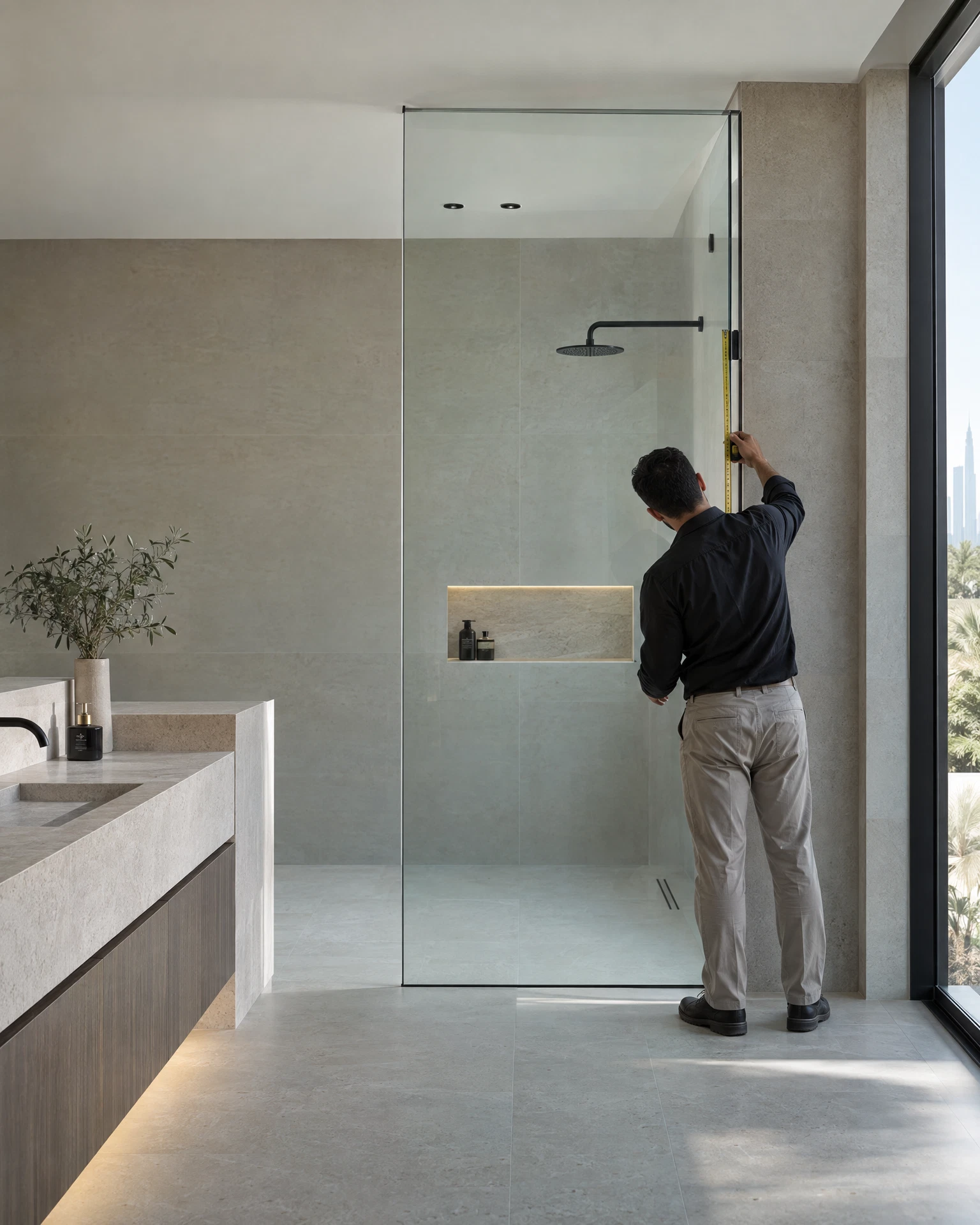
A rescue assessment works through the installation in the order it should have been built. First, the opening is measured as it stands — true widths at top, middle and bottom, walls checked for plumb, floor checked for fall — and those figures are compared with the glass as fitted. A panel that is even a few millimetres short for its opening, or a door cut square for a wall that leans, shows up here immediately. Second, alignment: does the door hang level, swing without binding, and meet its seals evenly along its full closing edge? Third, the seals themselves — the correct profile for the gap they serve, seated fully, continuous at the corners rather than butted and gapped. Fourth, the silicone: whether joints are actually filled and bonded, or smeared across the surface where they peel as a skin. Fifth, the fixings — hinges, clamps and channels secured into sound material, not into a failed plug or a tiled void.
Last, and most important, the product check: is what was fitted the right system for this opening at all? This is where the hardest cases surface — including the wrong-panel pattern every installer in this trade recognises: a panel cut for a different opening, or handed the wrong way, fitted anyway with the gaps packed out. Nothing about that panel is adjustable. The assessment’s job is to say plainly which layer has failed — seals, alignment, fixings, or the glass itself — because each layer has a different rescue. This is squarely shower glass repair work, and it starts from photographs: wide shots of the whole enclosure, close-ups of where the water escapes, and the corners where panels meet.
Correctable on existing glass
If the glass is the right size and the right product, most bad-install faults live in the layers around it, and those can be redone properly. Failed silicone can be stripped back to a sound, clean substrate and re-jointed correctly — new silicone over old, contaminated silicone is one of the reasons the first fix failed. Wrong-profile seals can be replaced with the profile the gap actually needs; seals and silicone renewal is covered in full in our guide to shower seals and silicone. A door that hangs out of square can usually be re-hung: hinges re-seated, fixings secured into sound material, the door lifted back to true so its seals meet evenly. Channels and clamps that were fixed out of level can be reset. Drip edges and thresholds that were omitted or fitted backwards can be corrected.
None of this requires new glass, and all of it is verifiable: after the work, the door is swung repeatedly, the gaps checked, and the shower run and watched. A rescue you cannot test is just a second opinion with an invoice.
Wrong product, wrong panel: the honest cases
Some assessments end with a harder answer. Toughened glass cannot be cut, drilled or trimmed after toughening — so if the panel itself is the wrong size, the wrong shape, or handed for the opposite swing, no seal, bead or adjustment rescues it. That panel has to be remade. The same applies where the system itself was wrong for the space from the start: a door specified where its swing is blocked by a basin or toilet, a fixed panel too short for the shower’s splash zone, an arrangement whose water path leads out of the enclosure by design. Those are specification failures, not workmanship failures, and correcting them means changing the layout, not polishing the install.
We will always separate the two for you: this much can be corrected on your existing glass, this part cannot, and here is why. What we will not do is sell a sealing job on glass we can see is the wrong panel — that is how you came to pay twice already.
When redoing is cheaper than rescuing
Rescue labour is real labour, and it is spent best on glass worth keeping. If the assessment shows the panel is wrong, every further visit spent sealing around it buys a temporary dry week on a permanent gap — the money goes into the gap, not into the shower. In those cases the honest arithmetic favours remaking the wrong part once, correctly measured, over serial rescues that each cost a visit and none of which can hold. Where the glass is right and only the layers around it failed, the arithmetic runs the other way: rescue it, and keep the glass you have already paid for.
Frequently asked questions
The company that fitted it will not come back. Can you fix someone else’s work?
Yes — that is exactly the situation this assessment exists for. We work on what is there: we will tell you what we find, which parts we can put right properly, and which parts we cannot stand behind. Send photos first and the verdict starts there.
Does the glass have to come down for a rescue?
Sometimes. Re-hanging a door means taking its weight and resetting its hinges, and a panel fixed out of level may need to be lifted and reset. Seals and silicone, by contrast, are usually renewed with everything in place. The assessment tells you which kind of job yours is before anyone visits.
A panel was fitted that is slightly too small. Can it be trimmed or extended?
Neither. Toughened glass cannot be trimmed after toughening, and a panel cannot be extended — a wrong-size panel is remade to the measured opening. What can sometimes be adjusted is everything around it, which is why the measurement comparison comes first.
How do we start?
With photographs on WhatsApp: the whole enclosure, the point where water escapes, and any corner or edge that looks wrong to you. Most rescue verdicts — correctable, or partly to be redone — can be given from those before a visit is booked.
Talk to us about the installation that still leaks
If another company fitted your shower glass and it still leaks, message us on WhatsApp on +971 52 443 2655 with photos of the whole enclosure and a close-up of where the water gets out. We will give you a straight assessment: what can be corrected on the glass you have, and what — if anything — genuinely has to be redone.
This guide is part of our Shower Glass Repair series. Next: Repair or Replace? The Honest Decision Guide for an Old Enclosure →