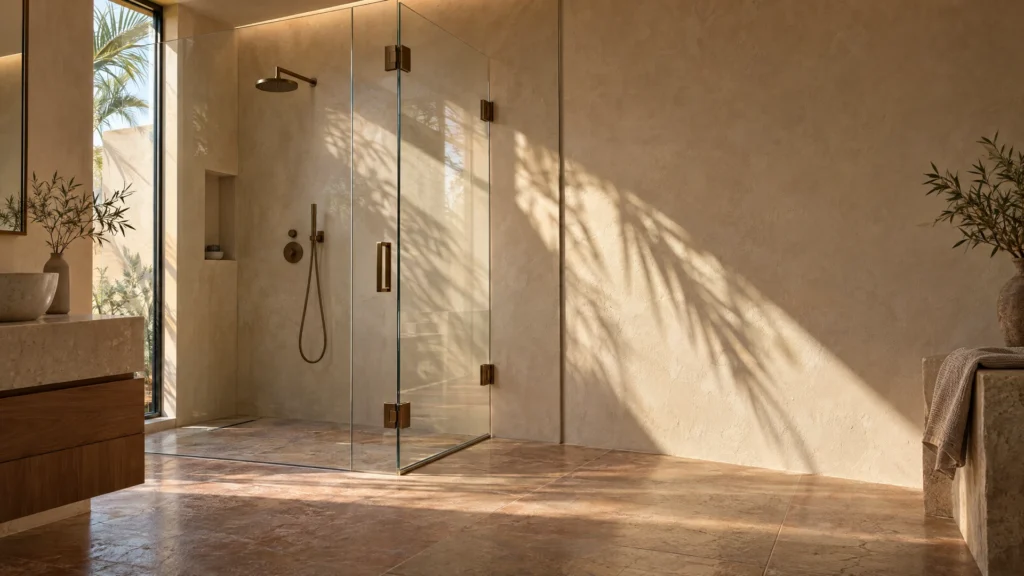
Once a shower opening gets wide, the layout question changes. Below a certain width nobody asks it — one door, on hinges, is the obvious answer. Above it, there are two: a single wide door, or a pair of doors that meet in the middle. A single door is the simpler machine — one set of hinges, one closing edge, no centre join. But glass is heavy, every kilo of a door hangs on the hinges at one edge, and physics sets a sensible limit to how wide one door should be. A pair of doors splits the width into two lighter panels and buys the widest clear opening of any hinged layout — at the price of a meeting stile in the centre that has to be sealed and kept true. This article works through that decision for wide openings: how wide one door can sensibly be, what a pair changes, how the centre join is sealed, and how the two options differ in daily use. Whether hinged doors suit your bathroom in the first place is covered on our hinged shower glass doors page; this is purely the one-or-two question.
At a glance
- Weight is the limit, not glass size: 10mm toughened glass weighs about 25 kg for every square metre, so a wide single door becomes a heavy panel hanging entirely on its hinges.
- Single doors are typically sensible up to around 800–900mm wide (indicative — installers set their own maximum by hinge and panel weight). Beyond that, a pair is the honest answer.
- A pair halves the load per door and each leaf needs only half the swing of one wide door — but the two doors close against each other, and that centre join must be sealed and stay aligned.
- With both doors open, a pair gives the full opening width as clear access — wider than any single hinged door can offer.
- Neither option can be improvised later: toughened glass can’t be cut down, so the choice is made at measurement and the glass is made for it.
How wide can one door sensibly be?
Do the weight sum first, because it explains everything else. Ten-millimetre glass weighs roughly 25 kg per square metre. A door 900mm wide and a typical 2,000mm tall is 1.8 square metres — about 45 kg of glass. All of that weight hangs on the hinges fixed along one edge, and every opening and closing cycles the full load through them, with the handle edge — nearly a metre from the hinge line on a wide door — acting as the lever. Hinges are rated hardware and a well-specified set carries its door properly, but width multiplies leverage, and leverage is what works fixings loose and starts a door dropping over the years.
Width costs in two other ways. The swing: a door sweeps an arc its own width deep, so a 900mm door needs 900mm of clear floor in front of it — clear of the basin, the WC, the towel rail — every time it opens. And the daily handling: a wide, heavy door is a deliberate object to move, which matters in a family bathroom and matters more as years pass.
Put together, that is why installers work to a maximum sensible width for a single door rather than simply making whatever is asked. As a typical range, single hinged doors in 10mm glass are commonly kept at or below roughly 800–900mm; beyond that the weight, the leverage and the swing are all arguing for a different configuration. If your opening is at or under that kind of width and the room gives the door its swing, a single door is the cleaner answer: one panel to keep true, one closing edge to seal, no centre join at all. The pair earns its place when the opening outgrows the single door — which is most wide openings.
What a pair of doors changes
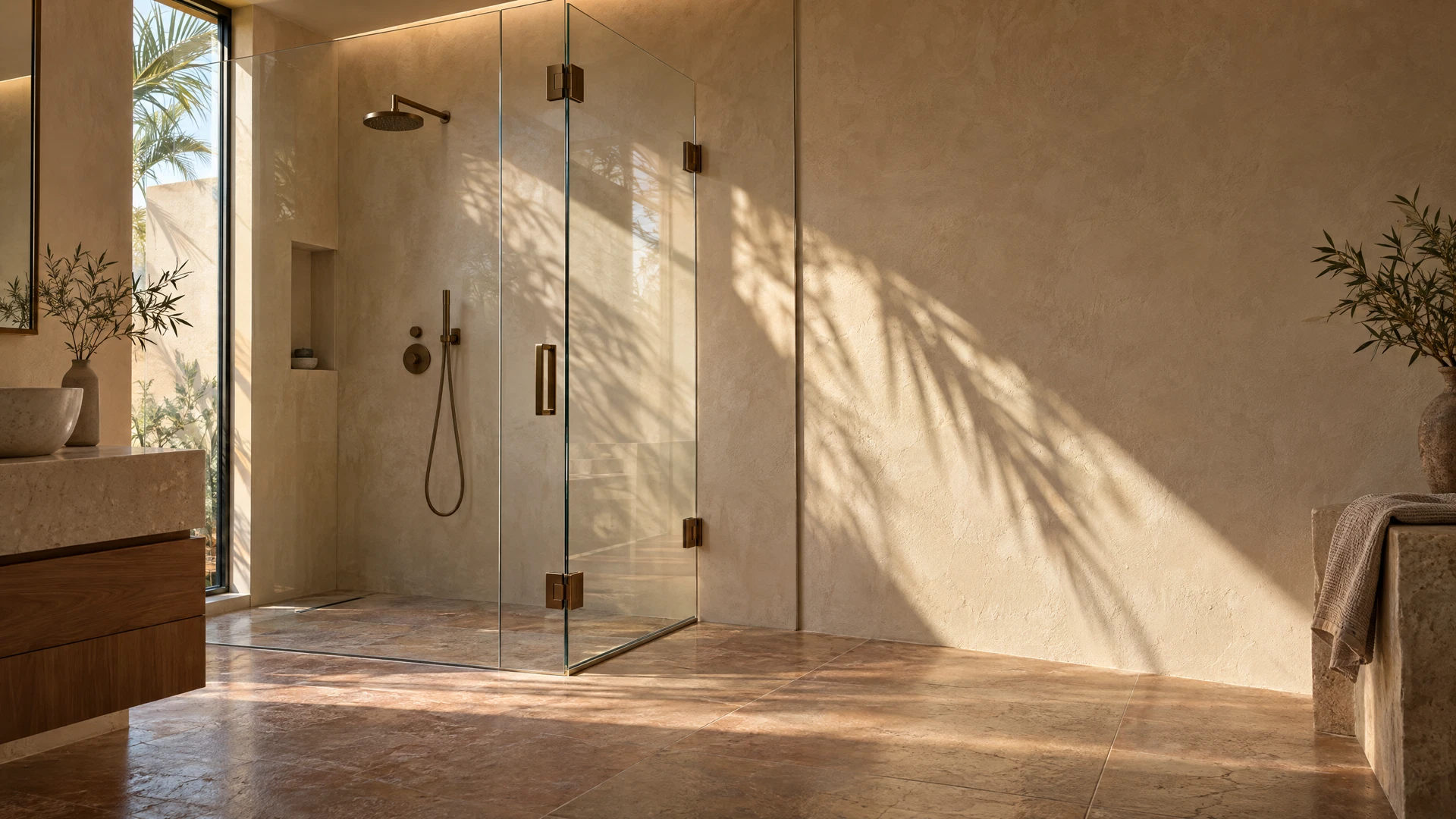
A pair divides the opening between two doors that meet at a centre stile. A 1,400mm opening, far beyond a sensible single door, becomes two doors of about 700mm each — roughly 35 kg a door, each on its own hinges carrying a manageable, ordinary load. The doors can be equal, or unequal: an asymmetric pair, with one full-size working door for daily use and a narrower second leaf that opens when the full width is wanted, is a legitimate layout and often the practical one.
Each leaf also swings only its own width, so the pair fits its swing into roughly half the floor arc a single wide door would demand — two modest arcs instead of one large one. Visually, the centre meeting line becomes the feature of the layout: a symmetric pair reads as a deliberate, formal front to the shower, and the hardware doubles with it — two sets of hinges, a handle or knob per door, in the finish the rest of the room’s hardware uses (chrome, black or gold).
What a pair does not do is simplify. There are two doors to hang true instead of one, twice the hinges and seals to keep in adjustment, and a join in the middle where neither door closes against anything solid. That join is the subject of the next section, and it is the honest trade at the heart of the choice: a pair exchanges the single door’s weight problem for a sealing-and-alignment discipline at the centre.
Sealing where two doors meet
A single door closes against a wall profile or a fixed panel — something that doesn’t move. In a pair, each door’s closing edge meets the other door, and both of them move. The meeting edges are sealed the same way a door’s closing edge is sealed anywhere: magnetic strips set into both meeting edges that come together face to face along their full height and pull the doors into line, backed by flexible seal blades that close the remaining gap. Some layouts add a slim strike profile on one door for the other to close against.
Done well, containment at the centre is genuinely good — the magnets hold the pair in the same plane and the seals do the same work they do at any closing edge. But the centre join has no tolerance for a door that has dropped. If one leaf sits a millimetre lower than its partner, the strips meet at one end and stand apart at the other, and the join weeps at exactly the point where it stands off — the first place, on any pair, where wear announces itself. The seals at the meeting stile are also consumables in the usual way: blades that harden or perish get renewed, and on a pair that renewal matters more, because the centre has no frame or channel behind it to catch what the seals miss.
The practical reading: a pair is not a leakier layout than a single door, but it is a less forgiving one. Both doors have to stay true for the centre to seal, which is an argument for sound hinges and proper adjustment from the start — and, years later, for treating a centre-join drip as an alignment symptom rather than reaching for sealant.
Access and cleaning
Open both doors of a pair and the entire opening is clear — the full width of the shower, unobstructed, the widest step-in any hinged configuration can give. For cleaning the tray, for helping a child or an older family member in and out, for simply moving around a large shower, that full-width access is the pair’s real advantage, and no single door of any width matches it, because a single door’s opening is always partly its own swing.
Daily life is different from the brochure version, and worth saying plainly: most households with a pair use one leaf as the everyday door and open the second for cleaning and full access. That is not a compromise — it is how the layout is meant to be lived with, and an asymmetric pair is designed around exactly that habit.
Cleaning cuts the other way. A pair has more edges, more profiles and the meeting-stile seals to wipe down; scale builds in the centre join’s seals as it does in any seal, and in hard-water bathrooms that join joins the list of places a squeegee and a wipe have to reach. A single wide door, by contrast, is one sheet of glass and one seal line — the simplest hinged front there is to keep clean, for as long as its width stays sensible.
Which openings suit which
- An opening up to roughly 800–900mm, with clear floor for the swing: a single door. Simpler sealing, one panel to keep true, the cleanest front.
- A wide opening — beyond a sensible single width, typically from around 1,000mm upward: a pair, equal for a symmetric front or asymmetric where one side is the daily door.
- A wide opening where full-width access genuinely matters — bathing children, assisted showering, a large tray to clean: a pair, and let both leaves be working doors from the start.
- A wide opening in a room where no swing is available at all, or an opening wider than even a pair serves well: the honest alternatives leave hinges behind — sliding doors or a fixed walk-in screen, which carry wide openings without any swing. Set the layout first; the one-or-two question only exists once hinged is right for the room.
- Any opening: the configuration follows the measured opening and the room as it is — walls out of plumb, the tray position, what stands in the swing — not the configuration in a photograph of someone else’s bathroom.
Frequently asked questions
What is the widest a single hinged shower door can be?
The limit is set by weight and leverage rather than by glass availability — a panel can be made wider than it should be hung. In 10mm glass, single doors are typically kept at or below roughly 800–900mm wide; beyond that, the load on the hinges and the swing the door needs both argue for a pair. Your installer’s own maximum, set by the hinges they fit and the panel weight, is the figure that governs your door.
Do double shower doors leak where they meet?
Not when both doors hang true. The meeting edges carry magnetic strips and seal blades that close the centre join the same way any closing edge is sealed. The centre is, though, the first place a pair shows wear: if one door drops slightly, the strips stop meeting evenly and the join can weep — an alignment symptom to correct, not a design fault to seal over.
Can both doors of a pair open, or is one fixed?
Both are working doors — each is a hinged door in its own right, and both can be opened to clear the full width. In practice most households use one as the daily door and open the second for cleaning or full access, and pairs can be made asymmetric with that habit in mind: a full-size everyday leaf and a narrower second leaf.
Can my existing wide single door be split into a pair?
No — not from the same glass. A toughened panel cannot be cut down: the wide door is one finished piece, and a pair is two different, smaller panels with their own hinge and handle holes made before toughening. Changing from a single wide door to a pair means new doors, measured and made for the opening — which is also the moment to check whether the original door’s width was part of its problems.
Is a pair more maintenance than a single door?
Somewhat, and honestly so: two doors mean two sets of hinges and seals to keep in adjustment, plus the meeting-stile seals at the centre. Set against that, each door carries half the weight, so no single hinge set works as hard as the hinges on an over-wide single door. The maintenance a pair asks for is adjustment and seal renewal; the maintenance an over-wide single door asks for tends to arrive as faults.
Talk to us about single vs double
If you have a wide opening and are weighing one door against a pair, message us on WhatsApp on +971 52 443 2655 with photos of the bathroom and your rough opening width. Tell us your area — we work across Dubai, Sharjah, Abu Dhabi and Ras Al Khaimah — and we will tell you honestly which configuration your opening suits, and where the single-door limit falls for it.
This guide is part of our Hinged Shower Glass Doors series. Next: Sizing the Fixed Panel Beside a Hinged Door: Ratios That Keep Water In →