
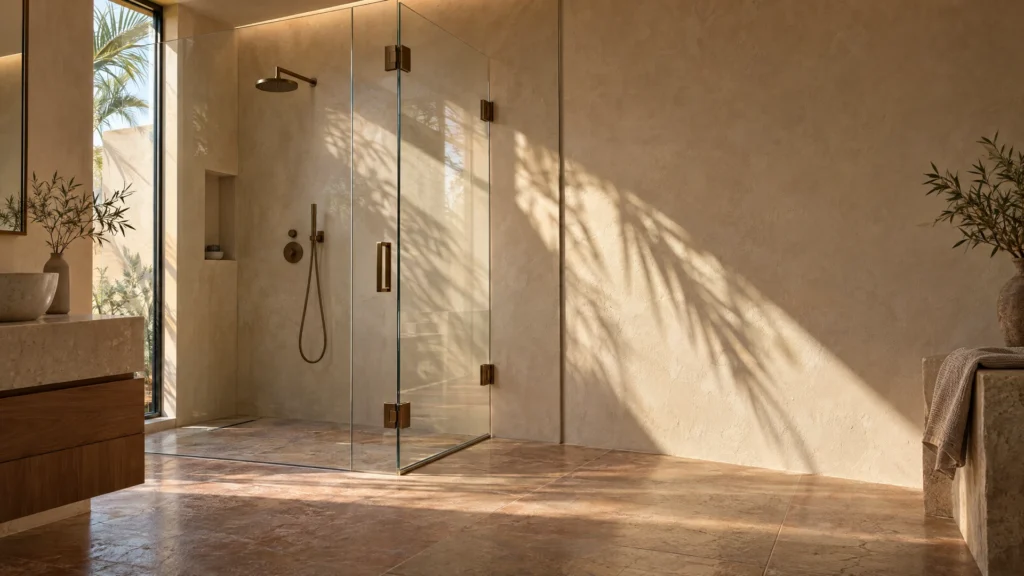
Closed, a hinged door and a pivot door look like the same thing: a sheet of glass that swings. The difference is invisible until the door moves — and it is entirely about where the door turns. A hinged door turns on its edge, hanging from hinges fixed along one side. A pivot door turns on a point set in from the edge, on pivot pins at the top and bottom of the door. That one geometric fact — where the pivot point sits — decides how the door’s weight is carried, how much swing each door needs on each side of the glass line, how well each one can be sealed, and what the hardware asks of the room over the years. This article works through those differences and ends with which openings suit which. It is a distinction between two swinging doors only; if you are choosing between swinging and sliding altogether, that wider comparison is our hinged vs sliding shower glass guide, and the home of both swinging systems here is the hinged shower glass doors page.
At a glance
- Hinged: the door hangs from hinges on its edge; its whole weight travels through those hinges into the wall or the panel beside it. The full width of the door sweeps outside the shower as it opens.
- Pivot: the door turns on pins set in from the edge — typically a short distance in, varying by system. Part of the door sweeps one way, a short tail sweeps the other, and the door’s weight runs down through the bottom pivot toward the floor.
- Swing: a pivot door needs less clear arc in the bathroom than a hinged door of the same width — but it spends some swing inside the shower, which a hinged door never does.
- Sealing: a hinged door closes against seals on every edge. A pivot door has a moving tail at its pivot edge, and that edge is harder to seal completely.
- The short version: hinged is the sealed, adjustable, proven default; pivot is the geometry you choose when a very wide door or a tight swing makes the edge-hinge case difficult.
How each door moves
A hinged door rotates around its edge. Two or three hinges fixed to the wall or to a fixed glass panel carry the door, and every part of the door describes an arc around that edge line: the leading edge — where the handle is — travels the widest path, a radius equal to the full width of the door. All of the swing happens on one side of the glass line: the door opens outward into the bathroom (or, in larger enclosures, inward into the shower), and nothing of the door crosses to the other side.
A pivot door rotates around a vertical axis set in from its edge. The door is held by a pivot pin at the top — into a frame head, a transom or a ceiling fixing, depending on the system — and a pivot at the bottom, into the floor, a threshold or a low profile. The inset is modest — typically somewhere in the range of a few centimetres to a noticeable fraction of the door’s width, set by the system — but it changes the movement completely. The main part of the door swings one way, and the short section on the other side of the pivot — the tail — swings the opposite way. Open a pivot door outward and most of it comes toward you while the tail swings into the shower.
The weight path differs as much as the movement. A hinged door’s weight hangs sideways off its hinges, which is why hinge quality and fixing strength dominate a hinged door’s life. A pivot door’s weight runs mostly downward, through the bottom pivot into whatever it is fixed to — the door is closer to standing on its hardware than hanging from it. Keep both facts; they explain the swing, the sealing and the longevity sections that follow.
Swing and clearance compared
The swing comparison follows from the radius. A hinged door’s clear arc in the bathroom is the door’s full width — a 700mm door sweeps roughly 700mm of depth in front of the opening. A pivot door of the same width sweeps less into the room: its leading edge travels on a radius equal to the door’s width minus the pivot inset, so the arc is shallower by exactly that inset, and the door also stands slightly differently when fully open. On a wide door in a tight bathroom, that saved depth can be the difference between clearing the basin and meeting it.
But the pivot door’s saving is not free — it is paid inside the shower. The tail sweeps an arc on the enclosure side of the glass line, and that arc needs its own clearance: clear of the shower fittings, clear of the fixed panel’s edge, and clear of the person standing under the water if the door is opened mid-shower. In a generous enclosure the tail’s arc is empty space and costs nothing. In a compact enclosure, the swing a pivot door saves in the bathroom can be spent again inside the shower — which is why “pivot doors need less room” is only half a sentence. The full clearance discipline for a swinging door — marking the arc, checking it at handle height, checking what you yourself stand in — is the same for both systems, and it is set out in our swing-clearance guide.
Sealing compared
A hinged door seals the way a door can seal: it closes against fin and magnetic seals along its closing edge, a seal profile along its hinge edge, and a sweep along the bottom — every edge defended, because every edge either meets something fixed or closes against something that is. The geometry cooperates: the door arrives at its seals square and is held against them.
A pivot door has one edge that cannot cooperate in the same way: the pivot edge. The tail must have room to swing through the glass line, so the pivot side of the door works with a working gap rather than a closing seal — profiles and brushes narrow it, but the edge cannot be compressed shut the way a hinged door’s closing edge is, because the door has to move through that space every time it opens. The closing edge of a pivot door seals well enough, with the same fin-and-magnetic arrangement as a hinged door, and its bottom line carries a sweep like any other. The honest summary: a pivot door line is a splash barrier with one softer edge; a hinged door line is a splash barrier on all sides. In a bathroom where the pivot edge sits away from the spray, that difference may never be felt. Where the shower head plays toward the pivot side, it is felt at once.
Hardware and longevity
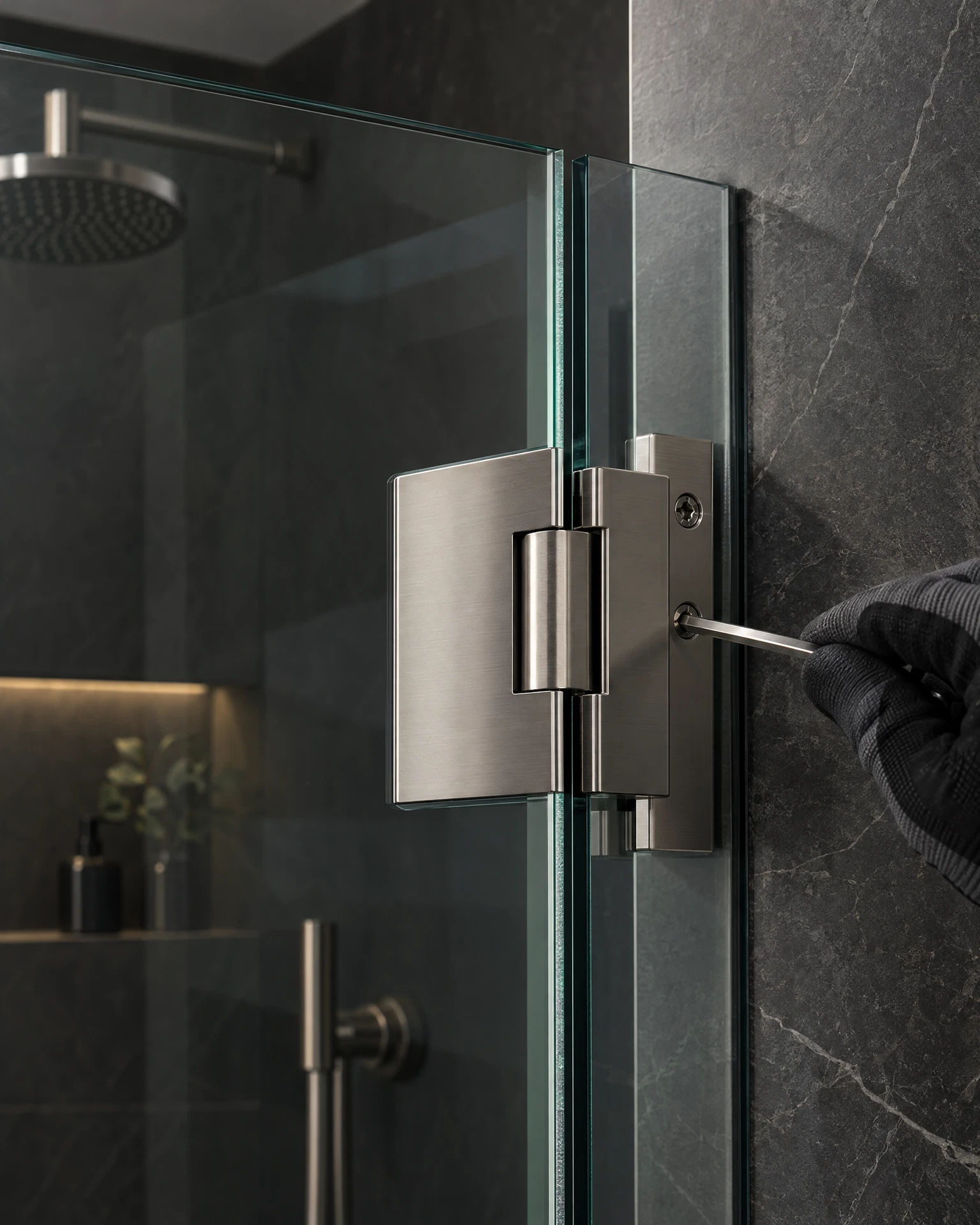
Hinged hardware is visible, conventional and serviceable. The hinges sit on the door’s edge where they can be seen, reached and — when they eventually wear — judged and replaced; the question of whether a worn hinge can be adjusted, repaired or should be replaced is its own decision, covered in our guide to broken or worn shower hinges. The load they carry is the door’s full weight in leverage, which is why heavy or wide doors ask more hinges, or more of them, and why fixing into sound material matters more than the hinge’s finish.
Pivot hardware is mostly concealed — pins and sockets in the head and floor lines rather than furniture on the glass — which is part of the pivot look: less visible metal on the panel. The load path is kinder to wide, heavy doors, because the weight stands on the bottom pivot instead of hanging off an edge; that is the mechanical reason pivot systems are the traditional answer for oversized swinging doors. The corresponding cost is access: hardware that lives inside a floor socket or a head profile is less casually inspected and adjusted than a hinge on an edge, and its fixings ask the floor line — tray edge, threshold or floor itself — to take a concentrated load permanently. A pivot fitted into a weak floor line has the same problem as a hinge fitted into a weak wall, one storey down.
Neither system is fragile, and neither is maintenance-free. Both are mechanical hardware in a wet room: seals harden, moving parts wear, and the difference that matters in ten years is usually not hinge versus pivot but whether the hardware was good quality and the fixings were sound on the day it was fitted.
Which openings suit which
- Standard openings, sealing first: hinged. For the great majority of showers — a door of ordinary width, containment that matters, hardware that can be serviced on the edge — the hinged door is the default because it has no weakness to design around.
- Very wide or heavy single doors: pivot earns its look. Where one wide panel must swing and an edge-hinge would put the whole load in leverage, the pivot’s floor-standing load path is the sounder geometry.
- Tight bathroom, generous shower: pivot can fit where hinged cannot — the shallower outside arc clears the basin, and the tail’s inside arc has an enclosure big enough to absorb it.
- Tight bathroom, small shower: usually hinged, or a different system altogether — the pivot tail has nowhere to go inside a small enclosure, and the hinged door’s problem (its outside arc) is better solved by a narrower door with a fixed panel than by a pivot geometry that spends the space indoors.
- Containment-critical lines — level floors, spray near the door: hinged, because the pivot edge’s working gap is the one line that cannot be sealed shut.
The pattern underneath the list: choose pivot for a geometric reason — width, weight, or a swing the room demands — not as a styling variant of hinged. Where no geometric reason exists, the hinged door does everything the pivot does, with the tighter seal and the simpler hardware.
Frequently asked questions
Is a pivot door just a hinged door with the hinges moved?
In effect, yes — and the moving is the whole story. Both doors swing on a vertical axis; the hinged door’s axis is its edge, the pivot door’s axis is inset from it. That inset is what creates the tail, shallows the outside arc, runs the weight to the floor, and leaves the working gap at the pivot edge. Same family, different geometry, different consequences.
Which door needs less room to open?
In the bathroom, the pivot — by the depth of its inset. Inside the shower, the hinged — by the whole of the pivot tail’s arc. Which one “needs less room” depends on which side of the glass line your room is short of space, which is why the arcs on both sides are checked at measurement.
Which seals better?
The hinged door. It closes against seals on every edge, while a pivot door keeps a working gap at its pivot edge that profiles can narrow but not close. Under ordinary spray placed away from that edge, a pivot door contains water well; the hinged door simply has no equivalent soft line.
Can a pivot door be wider than a hinged door?
Typically, yes — that is its classic use. Because the door’s weight stands on the bottom pivot rather than hanging in leverage off edge hinges, pivot systems carry wide, heavy single panels more comfortably. How wide a given opening should go is a measurement decision, but the geometry favours the pivot as width and weight climb.
Can an existing hinged door be converted to a pivot door?
Not as a conversion — the hardware positions, the holes and notches in the glass, and the fixings all belong to the hinged construction, and toughened glass cannot be re-drilled after it is made. Changing system means a new door, measured for the pivot geometry. The same is true in reverse.
Which lasts longer?
Neither has an inherent lifespan advantage. Hinges wear in leverage and are easy to inspect and replace; pivots wear in their sockets and are kinder to heavy doors but less accessible. In both systems the honest predictors are hardware quality and the soundness of what the hardware is fixed into.
Talk to us about hinged or pivot
If you are choosing between a hinged and a pivot door for a real opening — especially a wide one, or a room where the swing is tight on one side of the glass — message us on WhatsApp on 052 443 2655 with photos of the bathroom and the rough opening width. We will tell you honestly which geometry your opening suits, and where each door’s swing and seals would land in your room.
This guide is part of our Hinged Shower Glass Doors series. Back to the start of this series: How Much Clearance Does a Hinged Shower Door Need to Swing? →
