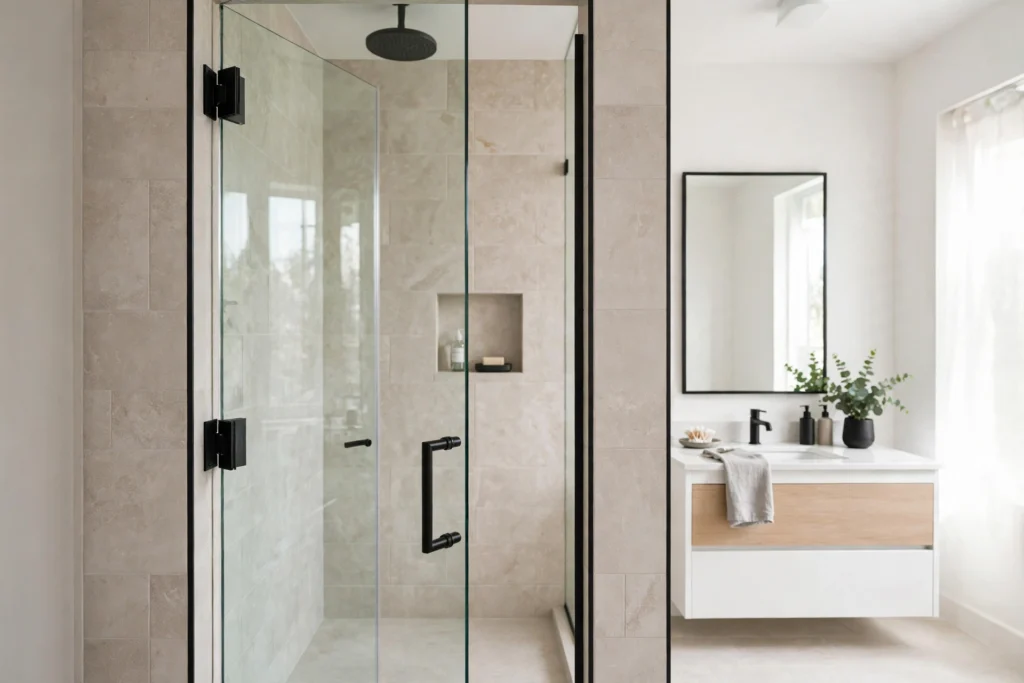
Ask how big a bath screen should be and the answers usually arrive as catalogue numbers — as if a screen’s size were a property of the screen. It is not. It is a property of your shower: where the head sits, where its spray lands, where the water bounces off the person standing under it, and how much of the bath all of that wets. A screen contains a shower only when it stands across the water’s actual paths, in both dimensions — long enough along the bath to close the spray’s escape route, and tall enough that the spray’s arc and bounce stay inside it. A screen sized from the bath’s total length, or copied from a neighbour’s bathroom, can be wrong in both directions at once: too short where the spray escapes, pointlessly long where it never reaches. This article sizes from the water backwards: start at the shower head, work out the splash zone your shower really makes, then set length and height against it — and finish with when an off-the-shelf size genuinely fits that zone and when only made-to-measure does.
At a glance
- Size to the splash zone, not the bath: the length of bath your shower actually wets — head spray plus bounce off the bather — is what the screen has to cover, plus a working margin.
- Length is measured from the shower-end wall: coverage is the distance the screen guards along the rim from that wall, and the head’s position sets it — a head beyond the screen’s end defeats any length.
- Height is set against the spray, not the ceiling: the screen’s top must stand above where direct spray and shoulder bounce travel; standard screen heights are typical/indicative only (commonly around 1,400–1,500mm off the rim) and are not automatically right for a high or angled head.
- The bather is part of the geometry: water bouncing off shoulders and elbows travels further and higher than the head’s own spray pattern suggests.
- Standard sizes fit standard geometry: a true rim, a typical head position and a splash zone comfortably inside the stock length. Anything else is made-to-measure territory.
Start from the shower head position
Every sizing decision hangs off one fixture: the head. Find where it sits relative to the bath’s length, and what kind it is, before any dimension is discussed.
A wall-mounted fixed head at the bath’s end throws its spray in an arc down and along the bath — the wetted zone starts under the head and extends as far as the arc and the bather carry it. A rainfall head mounted overhead drops its water in a near-vertical column: the direct zone is compact, but it is centred wherever the head is centred, which is not always over the end section a screen would guard. A hand shower on a riser rail is the least predictable — its zone is wherever it gets pointed, and sizing has to allow for how it is actually used, not how it hangs at rest. And a head positioned noticeably in from the bath’s end wall — or, worst case, beyond where any sensible screen would end — sets a limit no screen length fixes: glass guards from the wall outward, and spray that starts past the glass is outside by birth.
Note the head’s height too, and your own: the spray leaves the head, meets the bather, and leaves the bather in a fan. Taller bathers bounce water higher and further. Sizing that ignores the person is sizing for a shower nobody takes.
Length: how much of the bath to cover
Coverage length is measured from the shower-end wall, along the rim, to the screen’s far edge — not as a fraction of the bath and not from the bath’s brochure length. The screen has to cover the splash zone mapped in the next-but-one section, with margin beyond it, because the zone’s edge is not a line but a gradient: the last part of the wetted length gets occasional spray, and a screen that ends exactly at the average spray line will be passed by the energetic shower, the turned elbow, the rinsed wall.
As a typical, indicative picture only: many baths run somewhere around 1,500–1,800mm long, and single screens commonly guard somewhere in the region of the first 800–1,100mm of that — figures that describe the market’s habits, not a rule for your bathroom, because the zone, not the bath, is the specification. Two baths of identical length can want different coverage: one with the head tight to the end wall and a contained spray, another with the head mounted inboard and a hand shower in daily use. Equally, a longer bath does not automatically want a longer screen — if the spray zone is unchanged, extra glass guards dry air and costs swing clearance and access for nothing.
Where the required coverage runs to most of the bath’s length, the sizing conversation becomes a product conversation — a full-length fixed screen, a screen with a hinged section, or a half door each cover length differently, and that choice is the fixed vs hinged bath screens comparison. This article’s point stops at the dimension: know the length your zone needs before you choose the thing that provides it.
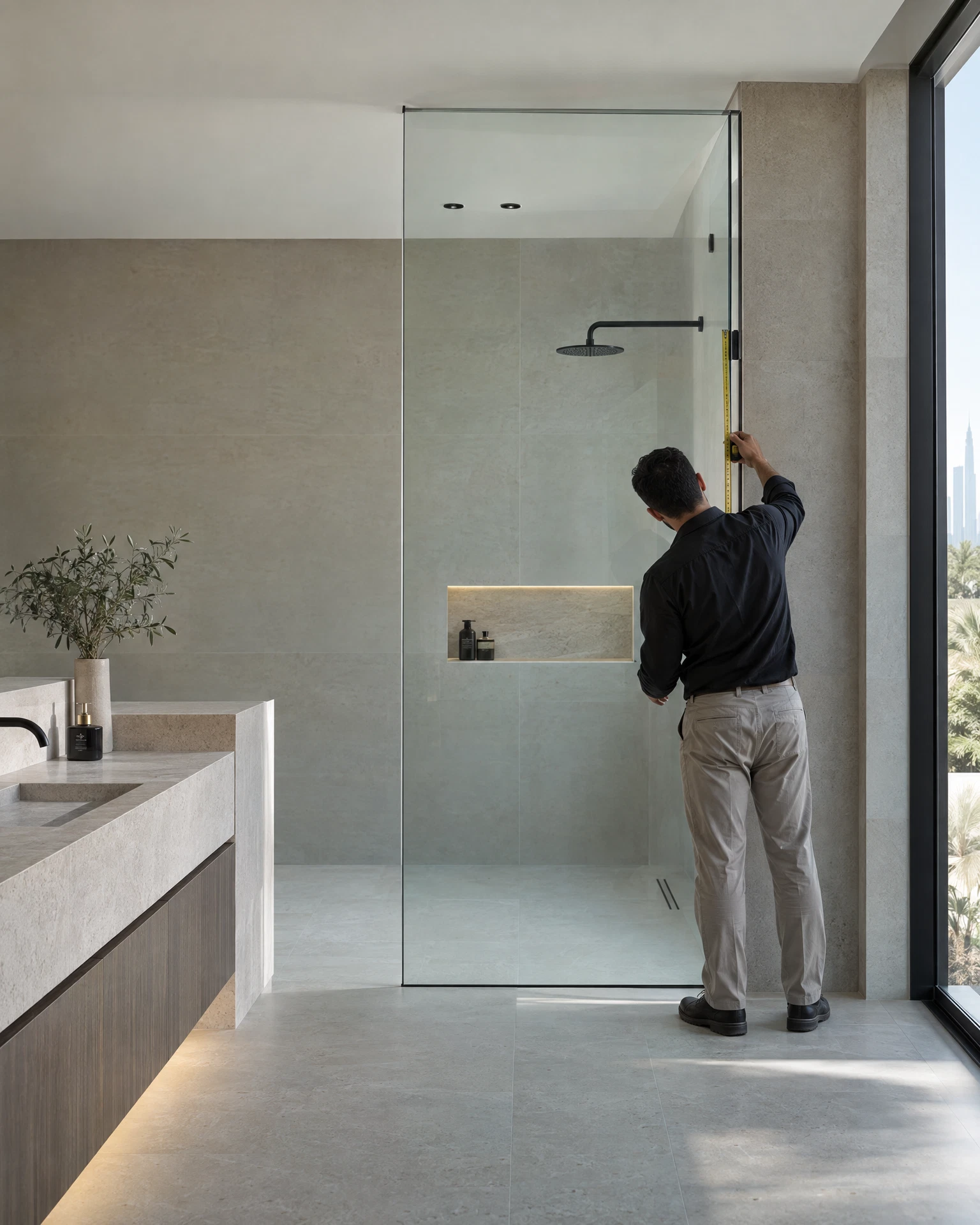
Height: head height and spray arc
Height is the dimension people under-size, because a screen looks tall standing on a bath — its top is typically somewhere around 1,400–1,500mm above the rim on standard screens (typical/indicative, as sold) — yet still gets cleared by the water that matters. Direct spray from an angled wall-mounted head travels in an arc, and an arc aimed along the bath can carry over a screen whose top sits below the arc’s path near the wall. Bounce is the bigger factor: water striking shoulders and upper arms leaves in a fan that travels higher than intuition says, and it leaves from the bather’s height, not the rim’s. A tall bather under a high head produces the highest bounce fan of all — the combination most likely to wet the wall and floor above and past a standard-height screen.
Rainfall heads invert part of this: their water falls nearly straight, so the arc problem largely disappears and coverage position matters more than height — but the bounce fan off the bather’s head and shoulders remains, and it radiates in every direction, including over the screen’s top if the screen is short and the bather stands close behind it. The working principle is simple to state: the screen’s top edge must stand above the paths the water actually travels, judged with the bather in place — and where the room allows, extra height is cheap insurance compared with extra length, because it asks nothing of access or swing. Made-to-measure screens can be taken taller than stock heights where the zone demands it; the ceiling height and any soffit or sloping ceiling over the bath are the only real limits, and they rarely bind.
The splash zone, mapped
Everything above reduces to one exercise, and it takes one shower. Shower exactly as you normally do — same head setting, same hand-shower habits, same turning and reaching — then, before drying anything, look at where the water is: the wetted stretch of the far wall, the wet length of the bath rim and edge, any water on the floor and where along the bath it sits. That wet map is your splash zone, measured by the only instrument that matters. Size the screen to stand across it: coverage from the end wall to beyond the wet length’s far edge, height above the wet marks on the wall behind where the screen will stand.
Three features of the map deserve attention. The far edge — how far along the bath the wetness reaches — sets the length, and it is set by the worst part of the shower (the rinse, the turn), not the average. The floor water’s position tells you the escape route: water appearing beyond a certain point along the bath is water travelling past where a screen’s end would be; water appearing beside the bath along its length is travelling over or under, which is a height or sealing matter, not a length one. The hand shower’s contribution — if the map changes completely when the hand shower is used freely, size for the free use, or accept honestly that the screen is sized for the fixed head only. A screen is a promise made to a pattern of behaviour; mapping the real pattern is what makes the promise keepable.
Standard sizes vs made-to-measure
Standard screens exist because many bathrooms share a geometry: a straight, true rim, a head at the end wall, a splash zone that sits comfortably inside a stock length and height. Where yours matches that picture, a standard size is a rational buy — the zone is covered, and the glass is a known product. The fit fails at the edges of the pattern: a zone that runs a little past the stock length (the screen that almost covers is the most regretted purchase in this category, because it performs like a promise broken daily), a head mounted inboard or high enough to want non-stock height, a rim or wall that is out of true so the panel must be shaped as well as sized, or a bath whose length makes stock coverage land at an awkward fraction.
Made-to-measure answers by setting length and height from your mapped zone rather than from a catalogue — and by shaping the panel to the bath as it stands. It is the route our own work takes: every screen we fit is measured and made for its bath, in 10mm glass, because the zone, the rim and the wall are the specification. Which route suits you is genuinely decidable from the map: if your wet zone sits well inside a stock screen’s coverage with margin to spare, standard sizing has done its job; if you find yourself hoping the zone is smaller than your shower just showed you, it has not. The screen types themselves — and the figures — are set out on our bathtub glass screens page and the shower glass price guide; sizing comes first, because a screen of the wrong dimensions is the wrong screen at any price.
Frequently asked questions
How long should a bath screen be?
Long enough to cover your splash zone with margin — measured from the shower-end wall to beyond the far edge of where your shower actually wets the bath. As a rough orientation only, single screens commonly cover somewhere around the first 800–1,100mm of the bath, but baths and heads vary enough that the zone, not the typical figure, is the answer. If your head sits inboard or you use a hand shower freely, expect to need the longer end of things — or full-length coverage.
How tall should a bath screen be?
Tall enough that its top edge stands above the spray’s arc and the bounce fan off the bather — judged with the tallest regular bather standing in place. Standard screens typically stand around 1,400–1,500mm above the rim, which suits many setups; high or steeply angled heads, rainfall heads over tall bathers, and close standing positions can all want more, which is a made-to-measure dimension rather than a stock one.
My shower head is mounted partway along the bath. What then?
Then length alone cannot save the sizing: a screen guards from the end wall outward, and spray that starts beyond the screen’s coverage is outside it from the first second. The honest options are coverage long enough to stand past the head’s spray origin — which may mean most of the bath — or moving the head as part of a wider bathroom change. What will not work is a standard screen fitted hopefully at the end.
Will a longer screen definitely stop all the splash?
No — length closes one escape route. Water also travels over the top (a height question), under the rim line (a sealing question — the subject of our seals guidance), and around behaviour: a hand shower aimed out of the bath defeats any dimensions. Sizing handles the geometry honestly; it does not repeal physics, and a screen sold as total containment on dimensions alone is being oversold.
Can a screen be made taller or longer than the standard sizes?
Yes — made-to-measure glass is cut to the specified dimensions before toughening, so length and height are set by your splash zone and your room rather than by a catalogue, within the practical limits of panel handling and the ceiling above the bath. That is the normal route when the mapped zone falls between or beyond stock sizes.
How do I measure my splash zone?
Shower normally, then look before you dry: how far along the bath the rim and far wall are wet, where any floor water sits along the bath’s length, and how high the wall is wet behind where a screen would stand. Those three observations — far edge, floor position, wet height — are the measurements a sizing conversation starts from, and a photo of each is worth more than a tape measure over the dry bath.
Talk to us about sizing your screen
If you have mapped your splash zone — or want us to read it from photos — message us on WhatsApp on +971 52 443 2655 with a wide photo of the bath and shower position, and tell us the bath’s rough length and where the water reaches when you shower. We will tell you the coverage length and height your zone actually needs — and whether a standard size honestly covers it, or whether yours is a made-to-measure bath.
This guide is part of our Bathtub Glass Screens series. Next: Frameless Bath Screens: Look, Weight and Hardware →