

“Frameless” sliding glass sounds like a contradiction — a sliding door is hardware all the way down, carried on rollers in a track it cannot work without. So what does the word actually buy you, and what does the alternative — a slim profile — give you back? Within the sliding family, the two terms describe how much of that unavoidable hardware is on show and how the panel edges are treated. A frameless sliding system keeps the metal to the functional minimum: visible rollers or clamps, a header rail, exposed polished glass edges, nothing around the panels themselves. A slim-profile sliding system wraps the working edges in fine aluminium sections — a channel that houses the track and rollers, slim rails on the panel edges — so the mechanism disappears into a deliberate metal line. This guide compares the two on look, track visibility, panel sizes and maintenance. It is about shower enclosures specifically; the wider constructions across all door types are compared in our guide to shower glass partition types, and sliding screens over a bath are a different arrangement again, covered in our bathtub screen guides.
At a glance
- Frameless sliding: no profile around the glass. The rollers, clamps and header rail are the visible engineering — chosen, finished and meant to be seen. Edges are exposed polished glass.
- Slim-profile sliding: slim aluminium sections house the track, wrap the fixing edges and give the panels a fine metal outline. The mechanism is hidden; the line is the look.
- Track visibility is the honest difference: both systems have a track. Frameless shows a rail and rollers; slim-profile shows a clean channel. Neither makes the track disappear.
- Panel sizes: frameless leans on the glass itself for stiffness, so panels follow the thicker-glass discipline; a profile shares the work and can forgive more.
- Maintenance is a trade, not a win: exposed hardware is easy to see and wipe but collects splash openly; profile channels hide the grime and the rollers — and collect scale inside themselves.
What ‘frameless sliding’ physically means
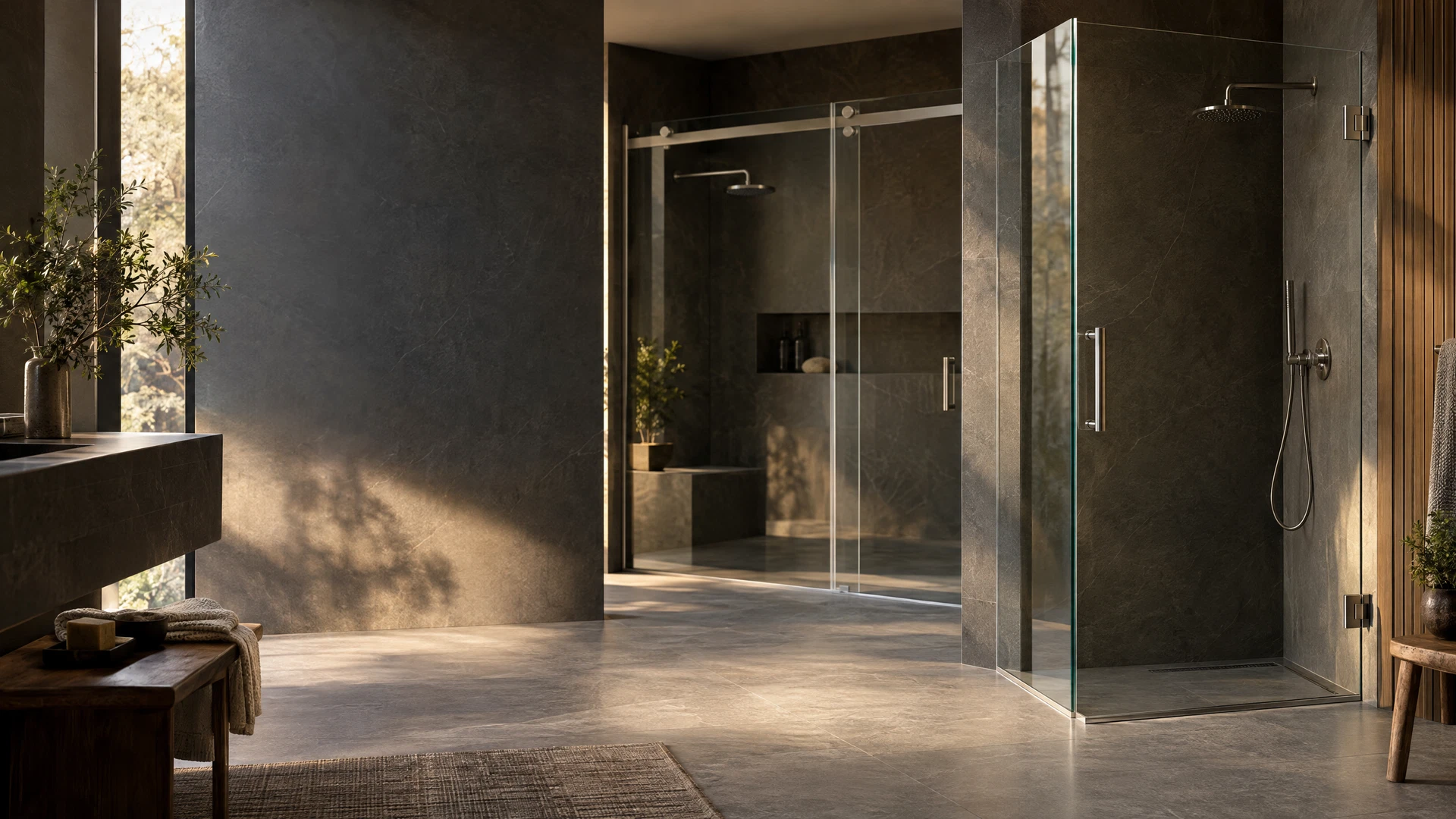
Strip the marketing off and a frameless sliding panel is a sheet of toughened glass with its running gear attached directly to it. Rollers are mounted at the panel’s top edge (on the common top-hung layouts) on visible carriages, or clamped through the glass, and they run in or on a header rail fixed across the opening. The panel’s vertical edges are bare polished glass; where panels cross, they cross glass-to-glass, closed by clear seals fitted to the edges. At the floor there is a small guide and nothing else. Hardware finishes — chrome, black, gold — are doing visual work here, because the hardware is the visible metal, and it is specified like jewellery on the panel: few pieces, each deliberate.
Two consequences follow from the physics, not the styling. First, the glass is the structure: with no profile to stiffen it, the panel’s own thickness and the quality of its carriages decide how firm and true it runs, which is why frameless sliding is built in substantial glass and why its hardware is engineered rather than decorative. Second, tolerances are unforgiving in the same way frameless construction always is: there is no channel to absorb a wall that leans or a panel edge that meets its neighbour imperfectly — the gaps you see are the gaps that were measured, and they stay visible.
Slim-profile: what the profile adds
A slim-profile system puts a fine aluminium section back around the working parts — and only the working parts; this is not the full framing of an older enclosure, a distinction the general partition-types guide draws out in full. The header becomes a channel that the rollers run inside, hidden from view. The panels’ fixing edges, and sometimes their vertical edges, sit in slim rails. The glass is still the visual event — the profile is a line, not a frame — but the line is continuous and deliberate.
What that line buys, practically: the rollers and track are sheltered from direct spray and from view, so the system reads calm and stays visually clean even when the mechanism is ordinary; the profile gives the panel edges a degree of protection against the knocks that exposed edges take; the channel can share stiffness with the glass, so the build feels firm without asking everything of the panel; and at the edges the profile gives water a channel to be caught and directed in, a small containment assist that frameless edges handle with seals alone. What it costs: the uninterrupted-glass look is interrupted, by exactly the width of the profile, forever; and the inside of that channel is a place — hidden, damp, and in hard-water homes scaly — that exists whether or not anyone cleans it.
Panel sizes and weights
Both families work in the same 10mm glass and across the same ordinary range of openings, and both are bound by the same arithmetic: glass is heavy — roughly 25kg per square metre in 10mm — and every panel is carried by its rollers for its whole travel, every day. Where the families differ is in how a large panel behaves.
A frameless panel carries its size naked. A wide panel’s stiffness is its own; its rollers are visible and sized to it; and the sense of a big sheet of glass moving on exposed engineering is precisely the effect the style is bought for. Push width too far, though, and the panel’s flex and the load on its carriages stop being characterful and start being wear — panel widths in frameless sliding tend to stay disciplined for exactly this reason.
A slim profile shares the panel’s work. The rails add edge stiffness, the channel supports the running gear along its length, and the system can generally be specified a touch more forgivingly at the larger end — wider panels that still feel composed, because the profile is quietly doing part of the job. Treat both descriptions as typical character rather than specification: the real limits belong to the system chosen for your opening and are confirmed at measurement, and in both families the sensible response to a very wide opening is usually two panels rather than one heroic one.
Cleaning and track care
This is the section the showroom conversation skips, and in a hard-water region it is the one that decides how you feel about the door in year three.
Frameless hardware is all on the surface. Rollers, rail and clamps can be seen, reached and wiped; scale shows on them honestly and comes off with the same cloth that does the glass. There are no hidden channels. The corresponding truth is that everything is exposed to splash and soap, so the wiping is not optional if the look is the point — frameless keeps its looks by being kept.
Slim-profile hardware hides. Day to day, the channel needs nothing and shows nothing, and the panels wipe like any glass. But the inside of the header channel and the bottom line of a profile are exactly where scale and soap residue accumulate unseen, and the cleaning, when it comes, is fiddlier: into the channel, along the rails, around the seals the profile carries. The rollers inside run sheltered from direct spray — a genuine kindness to the mechanism — and correspondingly out of sight when they begin to wear.
Neither is the low-effort winner in absolute terms; they spend the effort differently. Frameless asks small and often, in the open. Slim-profile asks rarely and thoroughly, in the channel. Choose by which of those your household will actually do — the honest answer, not the aspirational one.
Look vs practicality: choosing
The look case is real and should not be embarrassed about itself. Frameless sliding is the minimal end of the sliding family: plain glass, fine hardware, nothing else — in a bathroom designed around that restraint, a profile line, however slim, is a visible compromise. Slim-profile’s look is calmer and more forgiving: the continuous line tidies the top of the enclosure, hides the machinery, and suits bathrooms where the shower is one element among several rather than the room’s set piece.
The practicality case cuts across the look case in specific bathrooms. Walls measurably out of true argue for the profile’s forgiveness over frameless exposure. A household that will not wipe hardware argues, honestly, for hiding it. A bathroom where the door takes knocks — busy family use, edges swung past vanities — argues for protected edges. And a design built on hardware as a feature, in a finish chosen to be seen, argues frameless all the way down. The systems on our sliding shower glass doors page span this family; the choice between them is the last decision in a sliding design, made after layout and sizing, and it is the one most worth making with your eyes open about cleaning rather than about photographs.
Frequently asked questions
Is frameless sliding really frameless?
It is frameless the way the term is used for sliding systems: no profile around the panels and no frame at the edges — the glass edges are bare. It does not mean hardware-free. A sliding panel must be carried, so a header rail, rollers and a floor guide are always present; on a frameless system they are visible and finished to be seen.
Which one hides the track better?
Slim-profile, by construction: the track sits inside a channel and the rollers are enclosed. A frameless system’s rail is exposed and its rollers visible. Neither eliminates the track — the difference is whether it reads as a piece of engineering or disappears into a metal line.
Does the profile make the door stronger?
It makes the build stiffer at the edges and shares the panel’s work, which can make a large panel feel more composed. It does not make the glass itself stronger — both families use the same toughened glass — and a frameless panel in the right thickness on quality carriages is not the fragile option. Under-specification is the fragile option, in either family.
Which is easier to live with in hard water?
They spend the effort differently. Frameless hardware is exposed: it shows scale quickly and wipes clean just as quickly, in the open. Slim-profile channels hide scale until it is established, then ask for a thorough clean inside the channel. In Dubai and Abu Dhabi water, households that wipe little and often suit frameless; households that clean rarely but properly can suit slim-profile.
Can a frameless sliding door be converted to slim-profile later?
No — the panels are made for their system: different edges, different carrying points, different hardware. Changing family means new glass specified for the new system. This is a choose-at-the-start decision, which is why it deserves its own comparison rather than a line in a brochure.
Talk to us about the two systems
If you are choosing between frameless and slim-profile for a sliding door, message us on WhatsApp on 052 443 2655 with photos of your bathroom and the opening, and tell us your area. We will tell you honestly which system your walls, your opening and your cleaning habits suit — and show you what each would actually look like at the top of your shower.
This guide is part of our Sliding Shower Glass Doors series. Next: Sliding Doors in Corner and L-Shaped Showers →

