
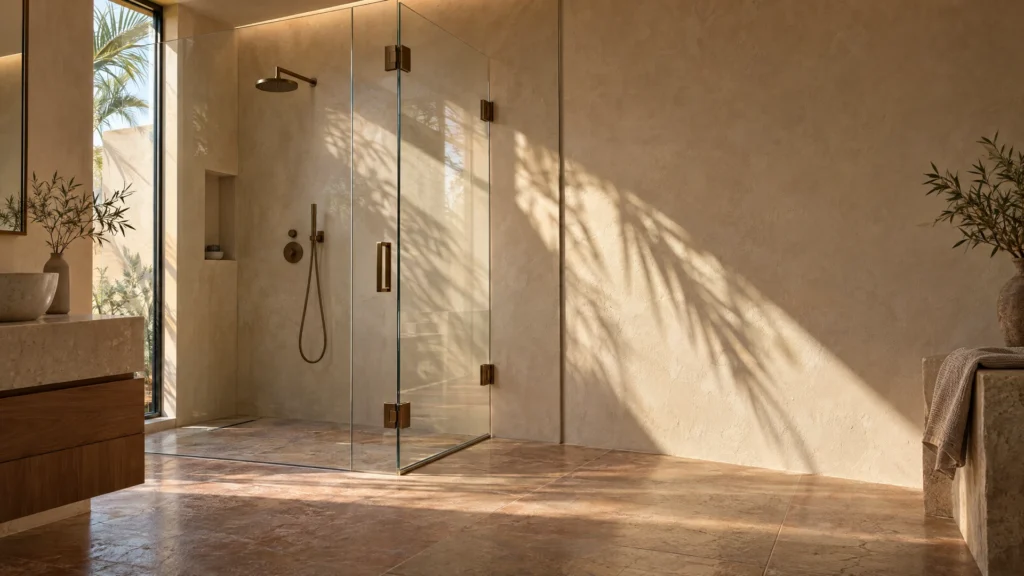
A corner shower uses two walls and closes the other two sides with glass. That sounds like a small variation on an ordinary enclosure, but for a hinged door it changes every question. The door can hang in three different places. Its swing moves through a room where fixtures tend to gather near corners. And the two glass lines have to meet at a corner joint that must be rigid, sealed and true, because everything the door does — hang, swing, close, seal — is referenced to it. Corner enclosures are among the most common layouts we fit, and hinged doors work beautifully in them, but the decisions are corner decisions, not straight-run decisions transplanted. This article covers the geometry briefly, the three door positions, the swing conflicts unique to corners, how the corner post is built and sealed, and when a corner is better served by something else. The door range itself is on our hinged shower glass doors page.
At a glance
- Three door positions: on the front run (hung from the return panel), on the return itself, or at the corner — meeting a second door or closing a diagonal entry.
- Corner swings conflict in corner ways: the door can meet the opposite glass line, its own return panel, or the fixtures that cluster beside corner showers.
- The corner joint is structure: a fixed post or a glass-to-glass corner, braced and sealed — the door’s alignment is only as good as the corner it references.
- Entry is the prize: a well-placed corner door gives a wide, direct entry into a shower that uses otherwise dead corner space.
- Small corners are the limit: below a certain size the swing eats the room or the enclosure, and a sliding or doorless layout serves better.
Corner geometry, briefly
A corner enclosure is a rectangle (occasionally a square) built into the corner of the room: two sides are the room’s walls, two sides are glass. One glass side runs out from one wall — call it the front. The other runs back to the second wall — the return. The two glass lines meet at the corner, the point furthest from both walls.
Everything in this article follows from three facts of that geometry. First, there is only one corner, and both glass lines depend on it: if the corner moves, both sides move. Second, the entry can be placed on either glass line or at the corner between them, and each placement produces a different shower — different approach, different swing, different relationship to the shower head. Third, the fixtures of the bathroom — basin, WC, towel rail — very often stand immediately beside a corner shower, because corners are where compact bathrooms put things. The door’s swing is designed against that reality, not against an empty room.
Door position options
Door on the front, hung from the return panel. The most common arrangement: the front run is divided between a fixed panel and the door, and the door hangs at the corner end of the front, hinged from the return panel that runs back to the wall. Entry faces the room squarely, the approach is direct, and the fixed front panel takes the spray if the head is on that side. The consequence to understand is structural: the door hangs glass-to-glass, from the return panel, so that panel is a structural part — braced and fixed to carry a swinging door — and the corner joint between the two panels is part of the same assembly.
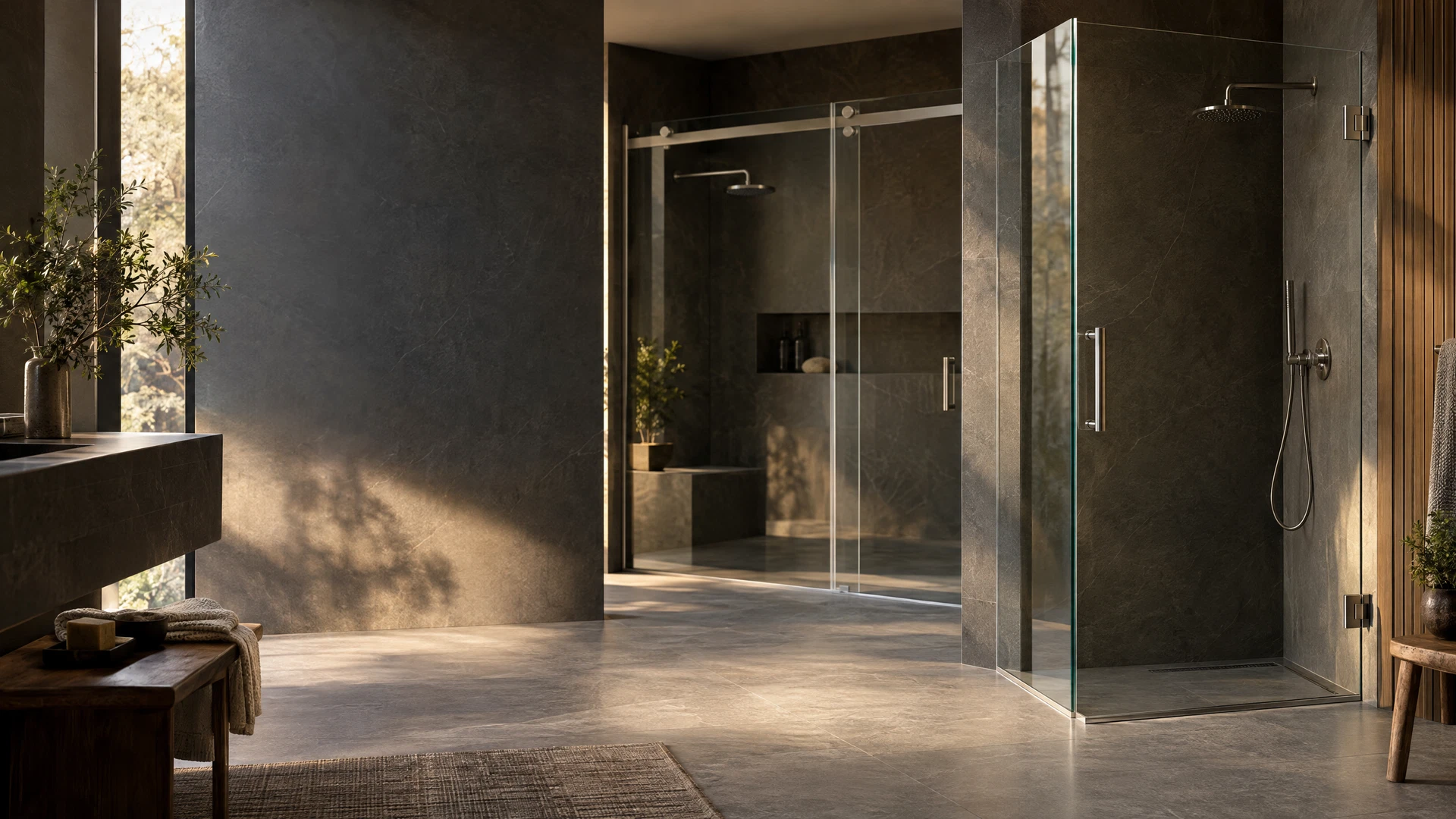
Door on the return. The mirror arrangement: the front is one fixed panel, and the door sits in the return line, entered from the side of the enclosure. This suits rooms where the front of the shower faces a wall or a fixture the door cannot swing towards, but the side approach is clear — long ensuites are the typical case, where you walk along the front panel and step in at the end. The head usually sits at the far end, so the side entry is also the dry entry.
Door at the corner. The entry itself goes on the corner. In one version, two doors — one in each glass line — meet at the corner and open together, giving a wide entry straight into the corner of the shower; they close against a slim corner post or against each other with magnetic seals. In another, a single door closes a diagonal line cut across the corner (the neo-angle arrangement), hung from one side panel and closing against the other. Corner entry gives the most generous access of any position and makes a small enclosure feel larger, because you enter its widest point. It is also the most demanding to build and seal: two moving edges meet where a straight run has none, and the corner geometry — post, seals, alignment — has to be right for both doors at once.
Which position your corner takes is decided by the approach (where you walk from), the head position (fixed glass belongs in front of the spray, the door at the drier side) and the swing, which is the next subject — and in corners, it deserves its own.
Swing conflicts unique to corners
A straight-run door has one arc to check. A corner door has the same arc, plus a set of conflicts that only exist because the enclosure turns a bend.
- The door meets its own enclosure. A front door opened fully comes back towards the return panel. On a narrow return, the door or its handle can reach the return glass — handle-to-glass contact is the corner version of the basin strike, and just as unwelcome: contact lands on glass edges and hardware, repeatedly. The check is made at measurement, and the answers are hinge stops, a different hang side, or a different door position.
- The door crosses the other glass line’s space. Where the shower is small and the room’s door, basin or WC stands close to the corner, a corner door’s swing sweeps a wide area of the room’s most contested floor. Corner entries swing two doors through it. The tape-the-arc check from straight runs applies unchanged — but in corners it must be run for every candidate position, because moving the door around the bend moves the arc with it.
- In-swing is rarely available. An outward swing needs room outside; an inward swing needs room inside, and a corner enclosure’s inside is exactly where its space is tightest — an inward door sweeps across the person showering and the fittings. Most corner doors open outward, which puts the fixtures question back into the room, where it has to be answered honestly.
- Two-door corners meet each other. On a corner-entry pair, both doors swing and both close at the same point. Alignment is a pair problem: if one door sits a fraction low, the meeting seals show it, and the adjustment is made across both doors and the corner they share.
None of these makes a corner door impractical — they are the standard checks of a corner measurement, and most corners pass at least one door position cleanly. The failure mode is skipping the checks because the enclosure “is only a corner shower”.
The corner post and sealing
Where the two glass lines meet, something has to hold them in relation to each other and keep the water in. Two constructions do that job.
A fixed corner post is a slim vertical profile at the corner that both panels fix into. It gives the corner rigidity, a straight reference edge for the panels (and for a door hung from the return), and a sealed line by construction — the panels are fixed and siliconed into it once. On a corner-entry layout, the post is also what the doors close against: a fixed meeting point with the seals mounted on it. The post is visible — a thin vertical line of metal at the corner — which is the price of its straightforward strength.
A glass-to-glass corner joins the panels directly, with the polished edges meeting and the joint sealed, often stabilised by the panels’ own fixings and, where a door hangs from the return, by bracing that panel. The corner reads as nearly invisible — the premium look — and it asks more of the installation: both panels must be set truly, because there is no post to absorb a small error, and the sealed joint is a worked line, renewed if it ever perishes, not a fixed channel.
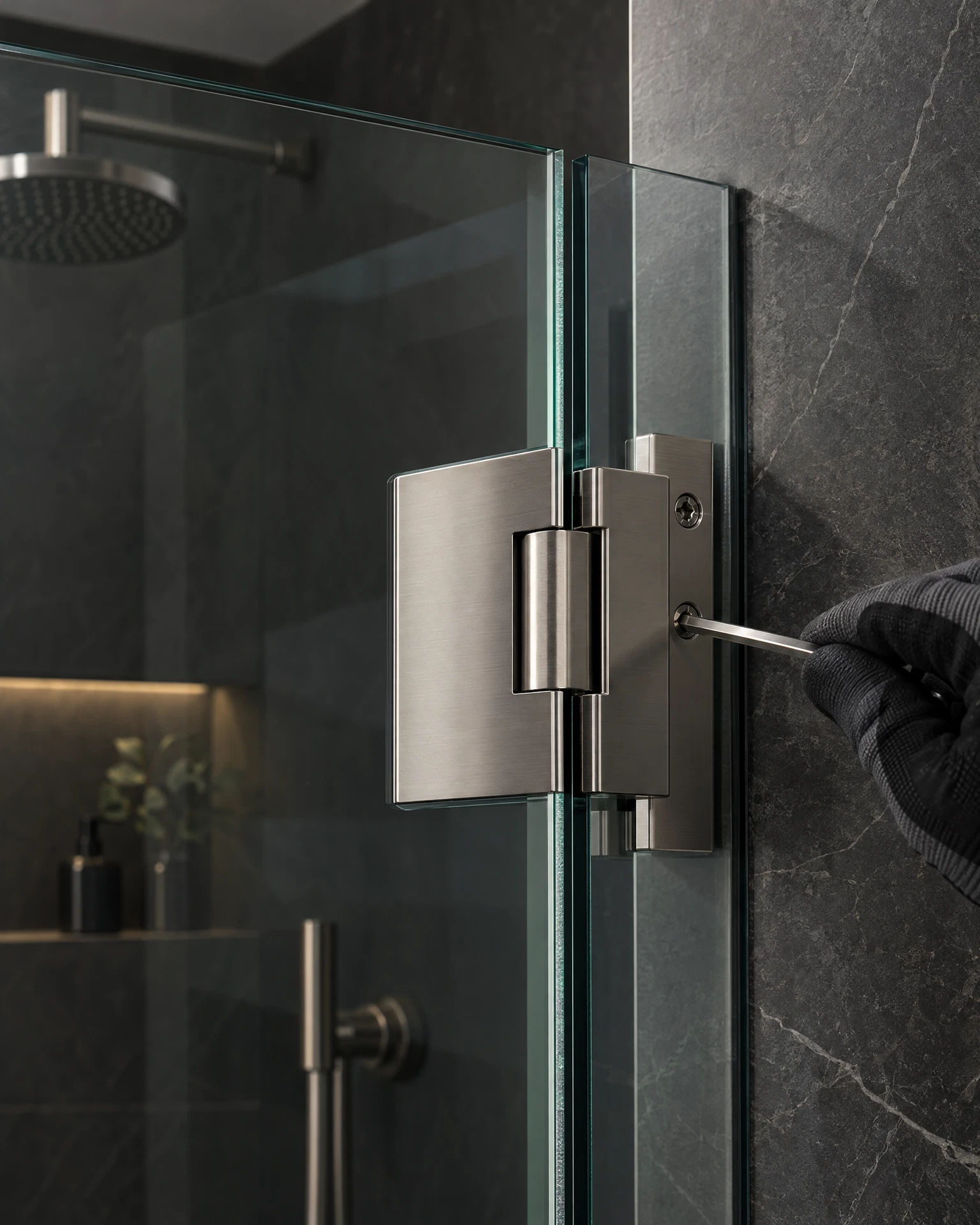
Either way, sealing a corner is about the vertical line. Water reaches the corner as splash and run-off down the glass, and the joint — post seals or a glass-to-glass bead — is what turns it back into the tray. The corner is not a leak-prone weak point by nature; it is a fixed joint, and fixed joints are the reliable kind. What corners do punish is movement: a return panel that flexes — because it is carrying a door without adequate bracing — works its corner joint with every swing. That is why the bracing of a door-carrying return panel is a structural decision taken at survey, and why “the corner leaks” on an older enclosure so often traces back to a panel that was never held still.
When corner hinged is the wrong choice
- The corner is very small. In a compact corner enclosure, a hinged door’s swing claims floor the room does not have, or the enclosure itself cannot spare the arc. A sliding door on the front run keeps the entry and drops the swing entirely — the full comparison is in our guide to hinged vs sliding shower glass.
- Every door position fails the swing check. If the basin crowds the front and the WC crowds the side and the corner entry sweeps both, the honest answer is a different system, not the least-bad swing.
- The shower is used by someone who needs step-free, wide access and the corner is tight. Corner entry can be generous, but in a small corner a doorless return — one of the fixed walk-in screens — sometimes serves daily life better than any door that has to be opened and closed in a confined arc.
- The walls are far out of square. Corner geometry multiplies a wall error: it appears in both glass lines and at the corner between them. Measured glass handles ordinary out-of-plumb work routinely, but a badly distorted corner may suit a framed construction or a re-planned layout — a survey conversation, had before glass is specified, not after.
A corner that fails for hinged is not a failed shower. It is a corner asking for a different door — and corners, being compact by nature, are where sliding systems earn their keep most often.
Frequently asked questions
Which side of a corner shower should the door go on?
The side you approach from, with the fixed glass in front of the shower head and the door at the drier side. In most rooms that means the door on the front run, hung from the return panel; in long rooms it can mean the door in the return. If both approaches work, the swing check decides.
Can two doors meet at the corner?
Yes — a corner-entry pair, one door in each glass line, meeting at a corner post or on magnetic seals. It gives the widest entry of any corner arrangement. It is also the most alignment-sensitive, because both doors and the corner between them have to agree; it is specified and set as one assembly.
Does a corner shower need a corner post?
No — a post is one of the two standard constructions. A glass-to-glass corner, with the panels meeting directly and the joint sealed, is the alternative; it looks cleaner and demands truer setting. Where a door hangs from the return panel, that panel needs bracing either way, and the choice is made at survey.
My corner door’s handle hits the other glass panel. Can that be fixed?
Usually, yes — it is a swing-geometry fault, and the remedies range from hinge adjustment or stops to re-hanging the door from the other end of its line, depending on what the measurement shows. What should not happen is the door continuing to strike glass: repeated contact is how edges get damaged. Send us a photo of the corner with the door open and we will tell you which remedy yours points to.
Are corner showers measured differently?
The opening is measured on both walls — both runs, the corner angle as built, and the squareness of each wall — because the glass is made for the corner that exists, not the right angle the plan assumed. The swing checks for each door position are part of the same visit.
Talk to us about your corner shower
If you are planning a corner enclosure — or living with a corner door that swings into trouble — message us on WhatsApp on 052 443 2655 with a photo of the corner and the rough sizes of both runs. We will tell you which door position your corner supports, and what we would fit instead if a hinged door is the wrong answer there.
This guide is part of our Hinged Shower Glass Doors series. Next: Hinge Types and Finishes: Chrome, Black, Gold — and Heavy-Duty Ratings →
