
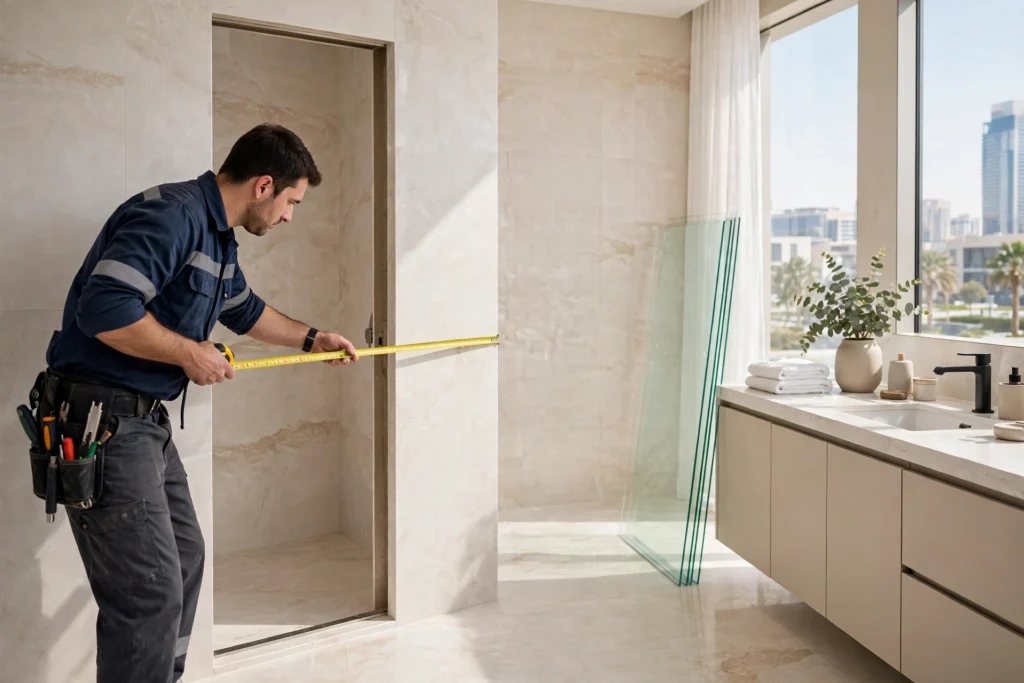
The direct answer first: it depends on what is actually being replaced, and any installer who names a figure without asking that question is guessing with your money. Where the replacement is a complete new door, the published guide ranges for a new 10mm door apply — a hinged door at approximately AED 2,500–3,500 and a sliding door at AED 2,800–4,500, with a fixed bath screen from AED 1,500 — always with the exact quote confirmed after measurement. A like-for-like swap of a single panel has no honest standard figure — it is priced from the measurement, on the components below. This guide walks through what a replacement quote is made of, why a door, a screen and a whole enclosure behave differently, and how to tell a complete quote from a thin one. It sits alongside the rest of our shower glass prices guidance.
At a glance
- A complete new door prices like a new door — the published hinged and sliding ranges above are the reference points.
- A single panel swap has no standard price — removal, matching and making good weigh differently on every job, so it is quoted from measurement.
- The glass is only one line. Removal and disposal of the old glass, hardware, seals and making good are all real components — check they are in the quote.
- Reusing old hardware is not automatically a saving — new glass is drilled for specific hardware before it is toughened.
- Photos earn a first steer; measurement confirms the figure. Toughened glass is made to the measured opening and cannot be adjusted afterwards.
What a replacement quote is made of
Removing and disposing of the old glass. The old door or panel has to come out safely — shattered glass especially — and go somewhere. Removal and disposal are a genuine line in a replacement quote; if they are missing, they usually reappear later.
The new made-to-measure glass. Cut to size, drilled and notched for its hardware, edges finished, then toughened. Size, thickness and the number of panels drive this line: the glass is made to the opening as measured, not copied from the panel that failed.
Hardware — new, or reused where it honestly can be. Hinges, rollers, handles and channels. Sound hardware in the right pattern can sometimes be reused; worn or corroded hardware cannot — fitting tired hinges to new glass imports the old fault into the new door.
Seals and finishing. New edge seals, bottom seals and silicone — the parts that decide whether the replacement keeps water in from day one.
Making good. The work the old installation leaves behind: redundant fixing holes, old silicone lines stripped back, a channel that has to come off a finished wall. Small on most jobs, decisive on quotes that skip it.
Door, screen or whole enclosure — why the numbers behave differently
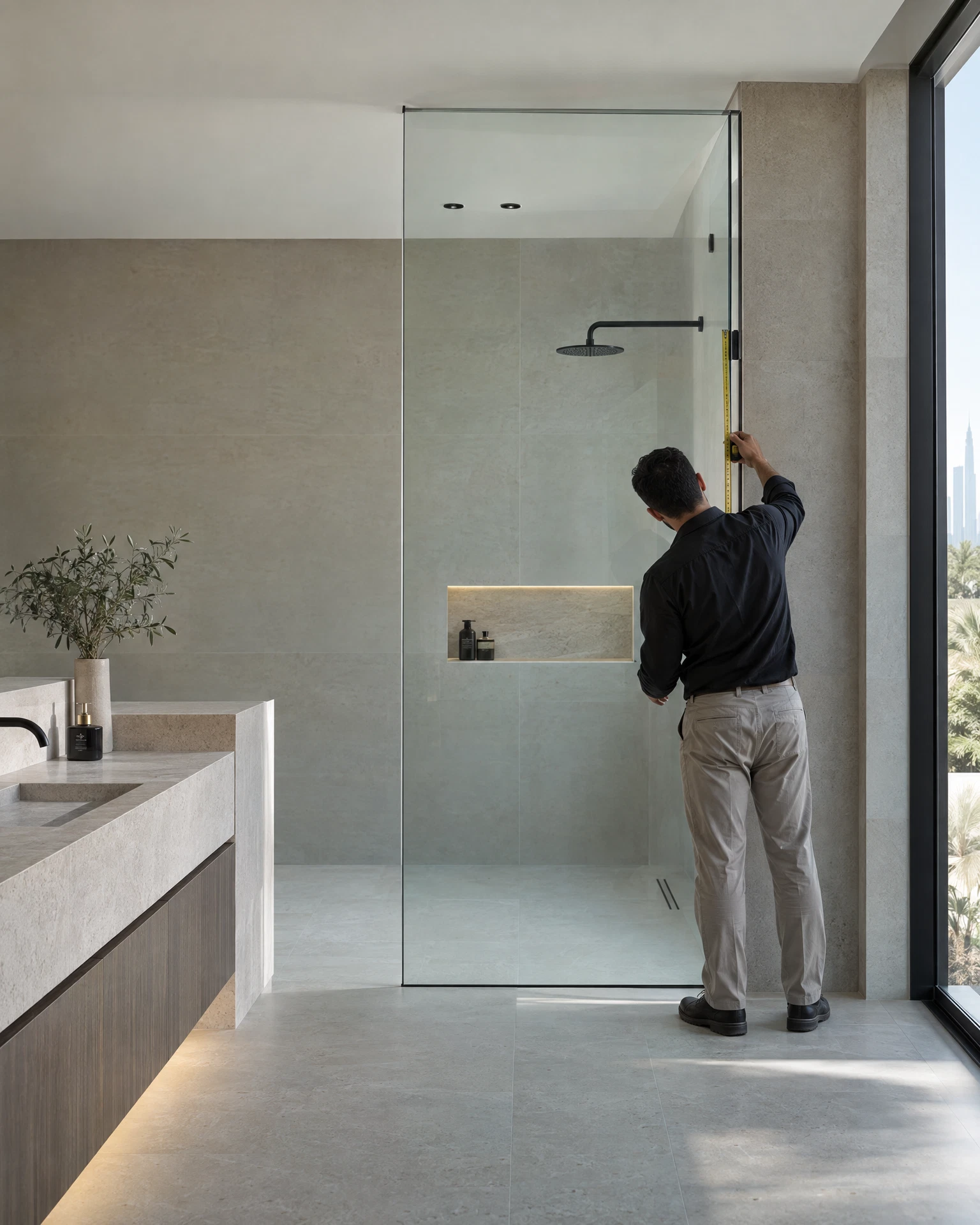
A door carries hardware — hinges or rollers, a handle, seals — so a door replacement is glass plus a moving-parts package, and a complete new door tracks the published new-door ranges. A fixed screen or panel is glass and fixings only: the glass line dominates, and the quote turns on size and on how cleanly the old panel comes away. A whole enclosure is several panels and a door priced together, where removal and making good multiply across every junction — which is why full-enclosure replacements vary more between quotes than any other replacement job: the scope lines matter more than the headline figure.
When the published ranges apply — and when they don’t
The ranges at the top of this article describe a complete new 10mm door or a complete new fixed bath screen, supplied and fitted. They are the right reference when your replacement is exactly that. They are not the reference when only one panel of an enclosure is being swapped, when the existing hardware is being reused, or when the opening itself needs correcting before new glass can go in — those jobs are quoted from the components above, after measurement. If a quote for a single panel looks suspiciously like the full-door range, ask for the lines; our guide to comparing shower glass quotes shows what each line should say.
Why reusing the old hinges and channels is not always a saving
It sounds like simple thrift: keep the hardware, pay only for glass. Three things get in the way. First, new glass is drilled for its hardware before toughening — the hole pattern has to match the hinges exactly, and older hardware patterns are not always available to drill for. Second, hardware wears: a hinge that has started to sag on the old door will sag on the new one, and the replacement inherits the fault you were paying to escape. Third, fixings that have corroded in a wet enclosure often do not survive removal intact. Where the hardware is sound, current and matched, reusing it is a legitimate saving and we will say so at the measurement — but it is an assessment, not an assumption.
Two worked examples, line by line
Example one — a hinged door with a cracked leaf, replaced complete. The quote lines run: removal and disposal of the cracked door; new made-to-measure 10mm door glass; new hinges and handle in the matching finish; new seals and finishing; making good at the old fixing points. As a complete new hinged door, the total sits in the published guide range — approximately AED 2,500–3,500, exact figure after measurement.
Example two — the same bathroom, only the fixed side panel etched and cloudy. The lines run: removal and disposal of one panel; new panel glass made to match the kept door; fixings; seals and finishing; making good along one wall. There is no published range for this scope — the glass is smaller than a door’s, but the matching work is fiddlier — and any installer quoting it flat from a photo is guessing. It is priced from the measurement, on the breakdown above.
For the neighbouring question — what the repair version of the bill looks like — our guide to shower repair costs sets out those drivers.
Getting an exact figure
Send photos of the enclosure and the damage on WhatsApp for a first steer on scope — repair, one panel, or a complete door — and which pricing basis applies. The exact figure follows a measurement visit — the new glass is made from that measurement. The service itself, step by step, is set out on our shower glass replacement page.
FAQs
Is replacement always more expensive than repair?
No. A repair is cheaper when the glass is sound — that is the whole basis of our shower glass repair work. But repeated repairs to failing glass, or hardware faults that return because the panel itself is wrong, can soon pass the cost of one proper replacement.
Can I replace just the door and keep the fixed panel?
Usually yes, if the panel is sound. The new door is measured against the opening and matched to the kept glass in thickness and finish; the measurement visit confirms the kept panel is worth building around.
Is removing and disposing of the old glass included?
It should appear as a line in the quote. If it doesn’t, ask — old glass has to go somewhere, and an unlisted cost is not a saved cost.
Why can’t I get an exact price from photos?
Because the glass is made from the measurement, not the photograph. Photos show the damage and the layout, which is enough for a steer and the right pricing basis; the exact figure needs the opening measured, the kept glass assessed and the hardware confirmed.
Does a replacement cost the same as a brand-new installation?
A complete new door, yes — it is the same glass, hardware and fitting work, plus removal of the old one. A panel swap differs: less glass, but matching and making-good work a new installation never has.
Next step
WhatsApp us the photos — +971 52 443 2655 — and say what has failed: door, panel or screen. We will tell you which pricing basis applies and book a measurement if you want the exact figure. First steers are free of obligation; exact quotes always follow measurement.
This guide is part of our Shower Glass Prices series. Next: Chrome, Black or Gold: How Hardware Finish Affects Price →


