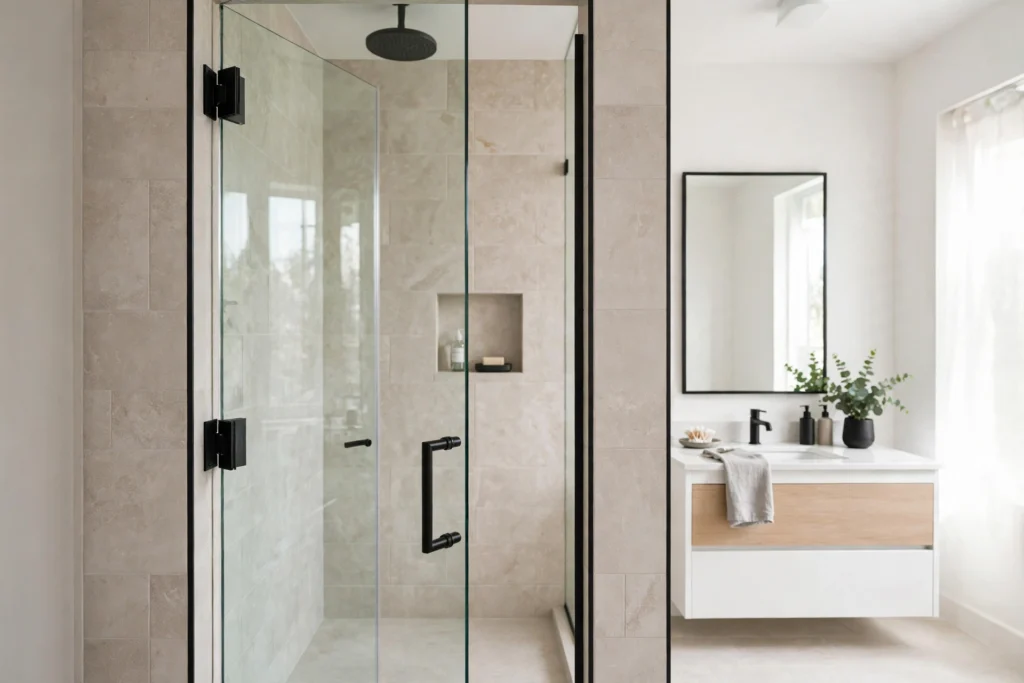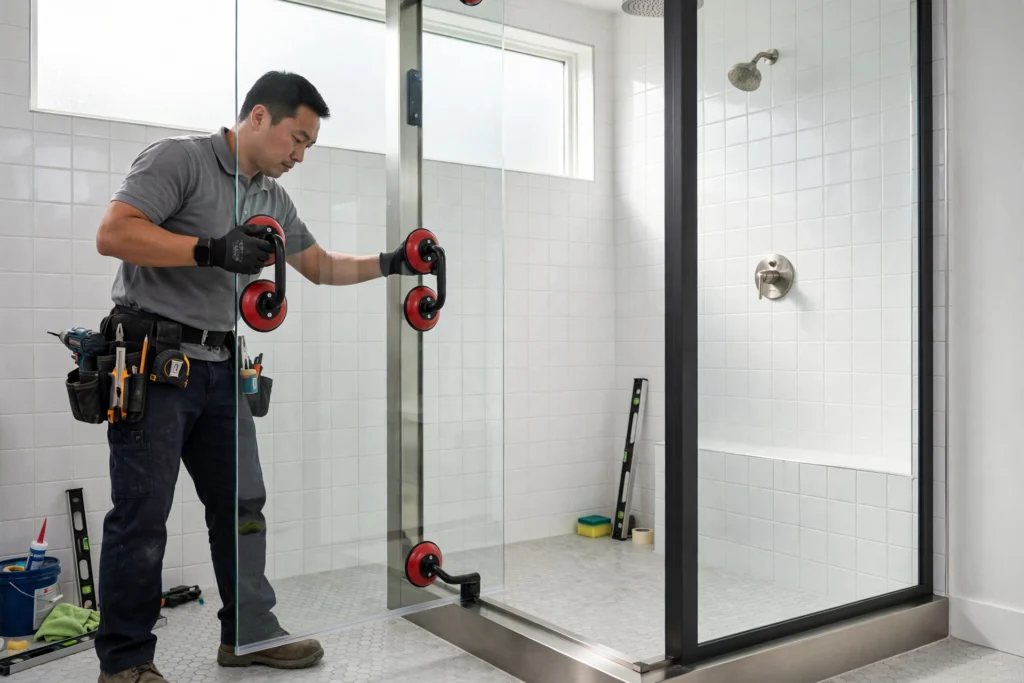
Most bath screen enquiries start with the glass: how long, how tall, fixed or hinged. On most baths that order works, because most baths present a rim that is flat, level and wide enough to take a screen without argument. But a significant minority of baths present something else — a rim too narrow for the channel a fixed screen wants to stand in, a top edge that slopes or rolls instead of sitting flat, a rim that dips and steps along its length, or tiles at the shower end that are visibly out of plumb. On those baths the glass is the easy part. The real question is the edge: what can be fixed to it, what can be sealed against it, and whether it can hold a screen’s line for years rather than months. This article works through the edge first — how to read yours, what still works on a narrow edge, the sealing reality of sloped and rolled profiles, what uneven rims and tiles do to the fitting, and the cases where the honest answer is that a glass screen should not go on that bath at all.
At a glance
- A screen stands on the rim, and the rim decides: width sets the fixing footprint, slope sets which way water runs under the seal, and evenness sets whether the seal line can be continuous at all.
- Narrow edges narrow the options, not always to zero: a long channel needs a flat landing along its run; a hinged screen concentrates its fixing at the wall end, which suits some narrow rims better.
- Slope direction matters more than slope amount: an edge falling gently back into the bath returns water; an edge falling outward delivers water under the seal line and out.
- Silicone is a seal, not a levelling bed: a thick wedge of it under a channel is a future leak, not a solution to an uneven rim.
- Some edges should not take a screen — a rim that is too narrow and rolled and outward-sloping, or a rim that flexes under load. A good fitter says so before the glass is ordered, not after the first leak.
Look at your bath edge first
Before any option is discussed, read the edge itself. Three properties decide everything that follows, and all three can be checked with a straightedge, a small level — a phone level app is honestly enough for a first read — and a fingertip.
Width. How much flat landing does the rim offer, measured across its top? Bath rims vary widely — as a rough guide they commonly run from around 50mm to well over 100mm across — but what matters is not the rim’s total width; it is the width of the part that is genuinely flat and level, because that is the only part a channel or seal can sit on. A rim that is 80mm wide but curved across its whole top may offer less usable landing than a plain 50mm rim that is flat.
Slope. Lay the straightedge along the rim’s top and look at the fall. Does the edge fall back into the bath, sit level, or fall outward toward the room? Then check along the length as well: an edge can be level across its width yet dip along its run.
Evenness and profile. Run the straightedge along the full length the screen would cover and look for daylight beneath it — dips, steps where rim sections join, a rolled or rounded profile instead of a flat one. Finish at the wall end: look at the tiles the screen’s wall profile must fix to, and check them for plumb and for lipped tiles that would hold the profile off the wall.
Those four observations — usable flat width, slope direction, evenness along the run, and the state of the wall end — are the fitting, in embryo. Every section below hangs off one of them.
Narrow edges: what still works
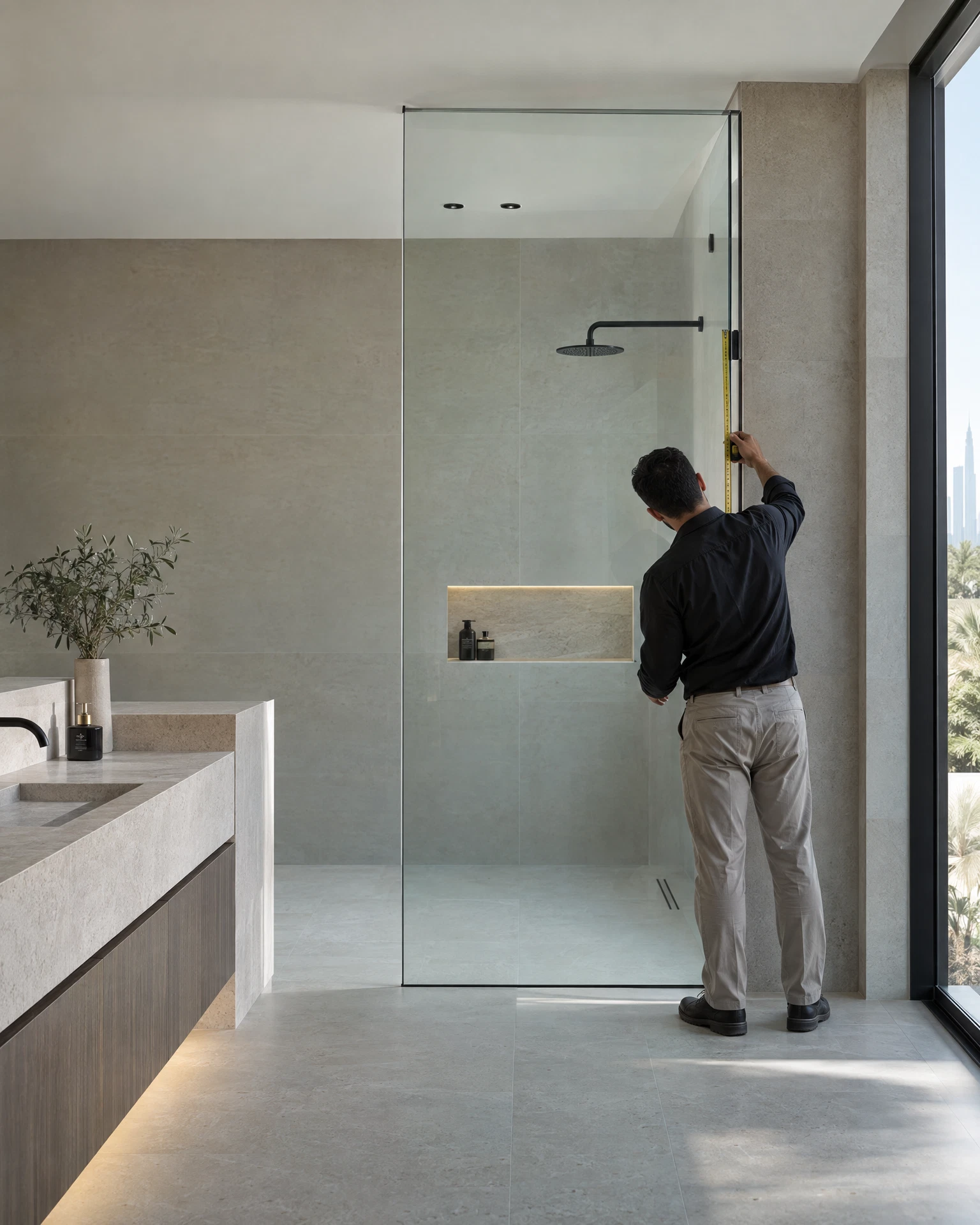
A fixed screen is usually held in a channel or by brackets along the bath edge, and both want the same thing: a flat landing they can sit on and be sealed along, for the screen’s whole length. On a rim whose flat landing is too narrow for that run, a fixed screen in a channel is being asked to stand on a strip it cannot grip — it may be fittable on the day, but the seal line is compromised from the start. Narrowness, though, does not rule out every screen. It changes which fixing carries the load.
A hinged screen concentrates its fixing at the wall end: the panel hangs on hinges from a wall profile, and along the bath edge it carries a seal rather than a structural channel. Its footprint on the rim is short, which means a narrow rim that is sound — flat where the seal runs, even if only just wide enough — can suit a hinged arrangement where a channel-fixed panel would struggle. Bracket-fixed panels sit between the two: point fixings need flat pads rather than a continuous flat run, so a rim that is narrow but locally flat at intervals can sometimes take brackets where it cannot take a channel. Choosing between those arrangements as products is the fixed vs hinged bath screens decision; the point here is narrower — on a narrow edge, the question is which fixing footprint your rim can honestly host, and a rim too narrow for any of them, or one whose flat strip is interrupted by the rim’s own profile, is where narrow stops being a constraint and becomes a verdict.
Two cautions go with all of it. The seal beneath any screen still needs enough flat rim to compress against continuously — a fixing can be cleverer than an edge, but a seal cannot. And narrow rims often belong to older or slimmer baths whose edges were designed for a curtain, not a load; the rim’s soundness matters as much as its width.
Sloped and rolled edges: sealing reality
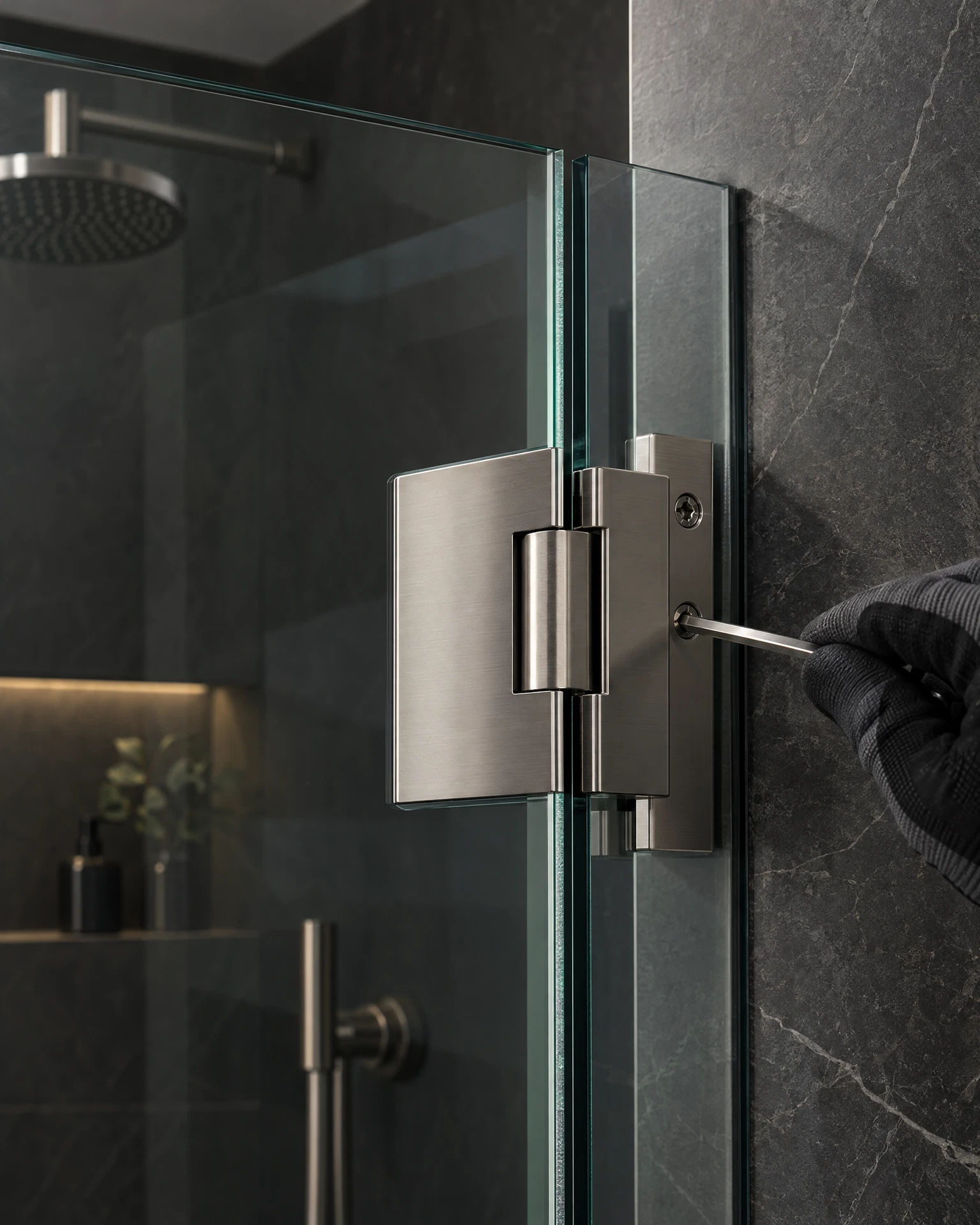
Slope is where bath edges quietly defeat screens, because slope decides where water goes. A bath edge that falls gently back toward the bath is an ally: water landing on the rim runs inward, and the screen’s bottom seal is a backstop. An edge that falls outward reverses the plumbing — water landing on the rim runs toward the room, arrives at the seal line from the wet side with gravity behind it, and treats any imperfection in that line as an exit. Screens can be fitted on mildly outward-sloping edges, but the sealing has to be understood for what it is: the only thing between a directed water supply and your floor.
Rolled and rounded profiles are the other version of the problem. A channel or seal designed for a flat landing, set on a rim that curves away beneath it, touches along a line rather than sitting on a surface — and a seal that touches along a line leaks along it too, in both directions: water out under the screen, and a channel that cannot be bedded evenly. The honest techniques are unglamorous: seat the fixing on the flattest section the rim offers, choose a seal profile shaped for the contact the rim actually gives, and keep the screen’s line where the rim is truest. What does not work — and is worth naming, because it is the bodge this fault attracts — is building the channel up on a thick bed of silicone to fake a flat surface. Silicone seals a joint between two sound faces; it is not a structural levelling compound, it creeps and splits under a screen’s movement, and a screen standing on a silicone wedge has a dated leak built into it from the first shower.
Uneven tiles and rim profiles
Unevenness along the rim’s length plays out as gaps: the screen is straight — glass is always straight — so every dip in the rim becomes a gap under the seal, and every step becomes a point where the seal is over-compressed beside a point where it barely touches. Small departures can be absorbed, because bottom seals are flexible and are chosen with some tolerance in them. Beyond that tolerance, the options are the made-to-measure ones: a panel can be shaped before toughening to follow a rim’s profile — glass is cut to its final shape before it is toughened, so a step or a scribe can be built into the panel itself rather than bridged by sealant — and the wall end can be handled the same way when tiles run out of plumb, with the panel’s edge shaped to the wall instead of leaving a tapering gap for a seal to fail in.
The limits deserve stating plainly. Shaping follows a stable profile; it cannot follow a rim that moves. And some unevenness is a symptom rather than a shape — a rim section that has dropped because what supports it has failed, or tiles that are loose on their bed. Fitting a screen over either is building on the fault. Where the unevenness is in the tiling or the bath’s support rather than in the rim’s manufactured shape, the honest sequence is to make the substrate good first — which may be another trade’s work, and is better named before the glass is ordered than discovered with it on site.
When the honest answer is no screen
Some edges fail in combination rather than singly, and combinations are what produce the genuine no. A rim that is narrow and rolled and falls outward offers no fixing a foothold, no seal a surface, and directs its water at both. A rim that flexes under load — press firmly along the edge of a thin acrylic bath and some rims visibly give — will work any seal line loose in time, because the screen is rigid and the rim is not, and the joint between them takes the argument. A wall end with no sound fixing — loose tiles, a stud or void where the profile must anchor — removes the one fixing a hinged screen cannot do without. And a rim that is damaged, cracked or previously repaired at the fixing line is a surface nothing should be asked to grip.
In those cases the right advice is not a more expensive screen; it is no screen for now. A curtain contains water honestly while the bath stays as it is. Or the sequence reverses — the bath or its support is sorted first, and the screen becomes a straightforward job on a sound edge. If your photos show us one of these edges, we will tell you it is one before you spend anything: a screen sold onto an edge that defeats it is a leak with a delivery date, and it is our name on the fitting. For the edges that pass, the bathtub glass screens page sets out the screen types themselves — and if your bath is a candidate, the figures are on the shower glass price guide, with the exact quote always following measurement of the edge as it actually is.
Frequently asked questions
How wide does my bath edge need to be for a glass screen?
There is no single number, because the fixing decides: a channel-fixed panel needs a continuous flat landing along its run, brackets need flat pads at intervals, and a hinged screen concentrates its fixing at the wall end and needs less rim — but every screen needs enough flat rim for its bottom seal to sit on continuously. The usable question is not your rim’s total width but how much of it is flat and level, which is exactly what we read from a close photo of the edge.
My bath rim is curved. Can the screen still be fitted?
Sometimes. A mildly rolled profile can be worked with — the fixing seated on the flattest section, a seal profile chosen for the contact the rim gives — but a rim that curves away across its whole width leaves a channel touching along a line, and line contact leaks. It depends on how much flat the profile actually offers, which is a measurement, not a judgement from a description.
Will extra silicone fix a sloped or uneven edge?
No — and this is the repair we are most often called to undo. Silicone seals a joint between two faces that already meet properly; used as a wedge to level a channel or bridge a dip, it creeps, splits and lets water through, usually within the first year of showers. The fixes that last are fixing choice, seal profile and, where the rim’s shape is stable, glass shaped to the profile — not sealant thickness.
Does a hinged screen cope with a narrow edge better than a fixed one?
Often, yes, for a specific reason: its structural fixing is at the wall end, and along the rim it carries only a seal, so its demand on the rim’s width is smaller. It still needs the rim to be flat and even enough for that seal to sit continuously, and it needs a sound wall to hang from — a narrow rim paired with loose tiles at the wall end trades one problem for another.
My bath edge flexes when I press it. Is a screen still possible?
Treat that as a warning rather than a detail. A rigid screen sealed to a moving rim has its seal line worked open and closed with every use, and no seal profile survives that for long. The bath’s support needs attention first; once the rim is stable, the screen conversation can restart on honest ground.
What photos do you need to judge my bath edge?
Three: one along the rim from the shower end, so its line and any dips show; one close across the rim’s top, so its width and profile read clearly; and one of the wall end and its tiles, where the screen’s wall fixing would go. With those, most edges can be given a straight answer — including, where it applies, no.
Talk to us about your bath edge
If your bath edge is narrow, sloped or uneven and you want a straight answer on whether it will take a glass screen, message us on WhatsApp on +971 52 443 2655 with a photo along the rim, a close-up across its top, and a shot of the wall end. We will tell you which fixing — if any — your edge honestly supports, and if the answer is that the edge needs sorting first, we will tell you that instead of selling you a leak.
This guide is part of our Bathtub Glass Screens series. Next: Fitting Glass on a Bathtub: How Bath Screen Installation Works →