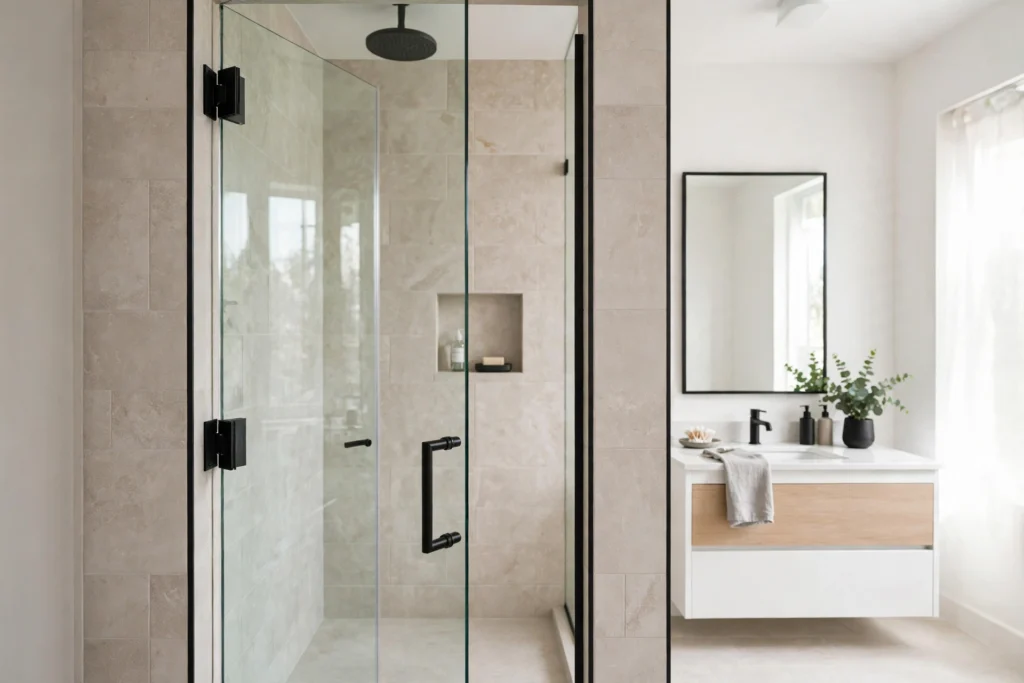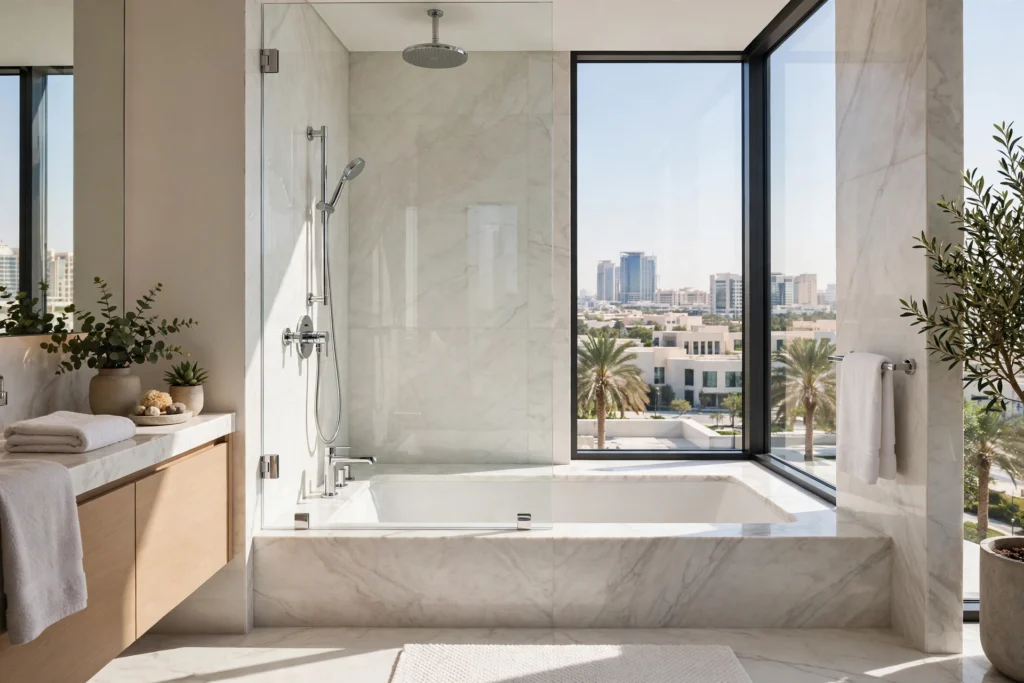
Most searches for bathtub glass door installation, tub glass door installation or bathtub glass panel installation are asking one question: how does glass get from an idea to a finished screen on my bath? It is never an off-the-shelf job. A bath is not a standard opening — edges slope, walls run out of square, and the taps decide where the glass can even stand. So bathtub shower door installation is a two-visit process: measure first, make the glass to those exact dimensions, then fit it. This guide walks through each stage, for the screens we fit — fixed panels and hinged screens.
At a glance
- Measurement comes first. The bath edge, the wall and the tap positions are the specification.
- Fixed or hinged is decided before the glass is made. The panel is cut to size, drilled and notched, edge-finished, then toughened — nothing can be trimmed afterwards.
- Fitting is a single visit in most cases: fixings set, panel aligned, seals fitted, fixed joints siliconed, everything checked.
- Fixed bath glass starts from AED 1,500 — the exact quote is confirmed after measurement.
- First use follows the sealant’s timing, confirmed in writing at handover.
What gets measured on the bath
The measurement visit is where installing glass shower doors on tub setups succeeds or fails — and it covers far more than the bath’s length.
The bath edge is the foundation. We measure its width — the profile or hinges need a flat landing of usable width — and its level along the full length. Many rims slope toward the taps or roll at the corners, and a screen made to the nominal size will rock, gap or strain its fixings. Flat, rolled and lipped rims each take the seal differently.
The wall is the other half of the fixing: plumb or not, tiles sound where fixings will land, and how far out of square the corner runs. A wall leaning a few millimetres over a screen’s height is normal — the glass is made to suit it, which is why measuring comes first.
Taps and shower positions decide the layout: where the spray actually falls, where lever taps sit, and whether a hinged screen would swing clear of them. The screen has to cover the splash zone the shower really creates. Awkward combinations — a narrow rim, a sloping edge, taps where a hinge wants to be — are everyday work, covered in our guide to narrow, sloped or uneven bath edges. The underlying method is set out in how shower glass is measured.
Choosing fixed or hinged before the glass is made
Because the glass is made to order, the fixed-versus-hinged decision happens at measurement, not on fitting day. A fixed screen is a single toughened panel sealed along the bath edge: no moving parts and the simplest thing to keep clean. A hinged screen swings in over the bath for access and cleaning, then closes against a seal — it needs swing room past the taps and a wall fixing that takes the hinge load. Our comparison of fixed vs hinged bath screens works through which suits which bathroom.
Length and height are settled at the same visit. The numbers behind that are in our guide to bath screen sizing. Most screens are frameless; our page on frameless bath screens covers the look, weight and hardware.
One honest note on formats. Sliding and folding bath screens exist, and some suppliers fit them — we do not. Our fitted range is fixed and hinged, because on a bath edge those are the formats that seal reliably and stay aligned. If your heart is set on a sliding screen over the bath, we will say so plainly at the quote stage.
On price: fixed bath glass starts from AED 1,500, with the exact quote confirmed after measurement — bath length, glass size and edge condition all move the figure. Hinged screens are quoted the same way once size, hinges and finish are known. Our guide to bathtub glass screen prices explains what changes the number.
How the glass is made to order
With the measurements final, the order of work is fixed — and the order is the point:
- Cut to size from the measured dimensions.
- Drilled and notched — every hole and cut-out done now.
- Edges finished — polished smooth, including the edge that will sit on the bath.
- Toughened — heat-treated into safety glass.
Once glass is toughened it cannot be cut, drilled or trimmed — a panel made 5mm too wide stays 5mm too wide. That is why the measurements are treated as the specification. Hardware is matched to the panel and your finish — chrome, black or gold — at the same stage, so fitting day is pure assembly.
Fitting day, step by step
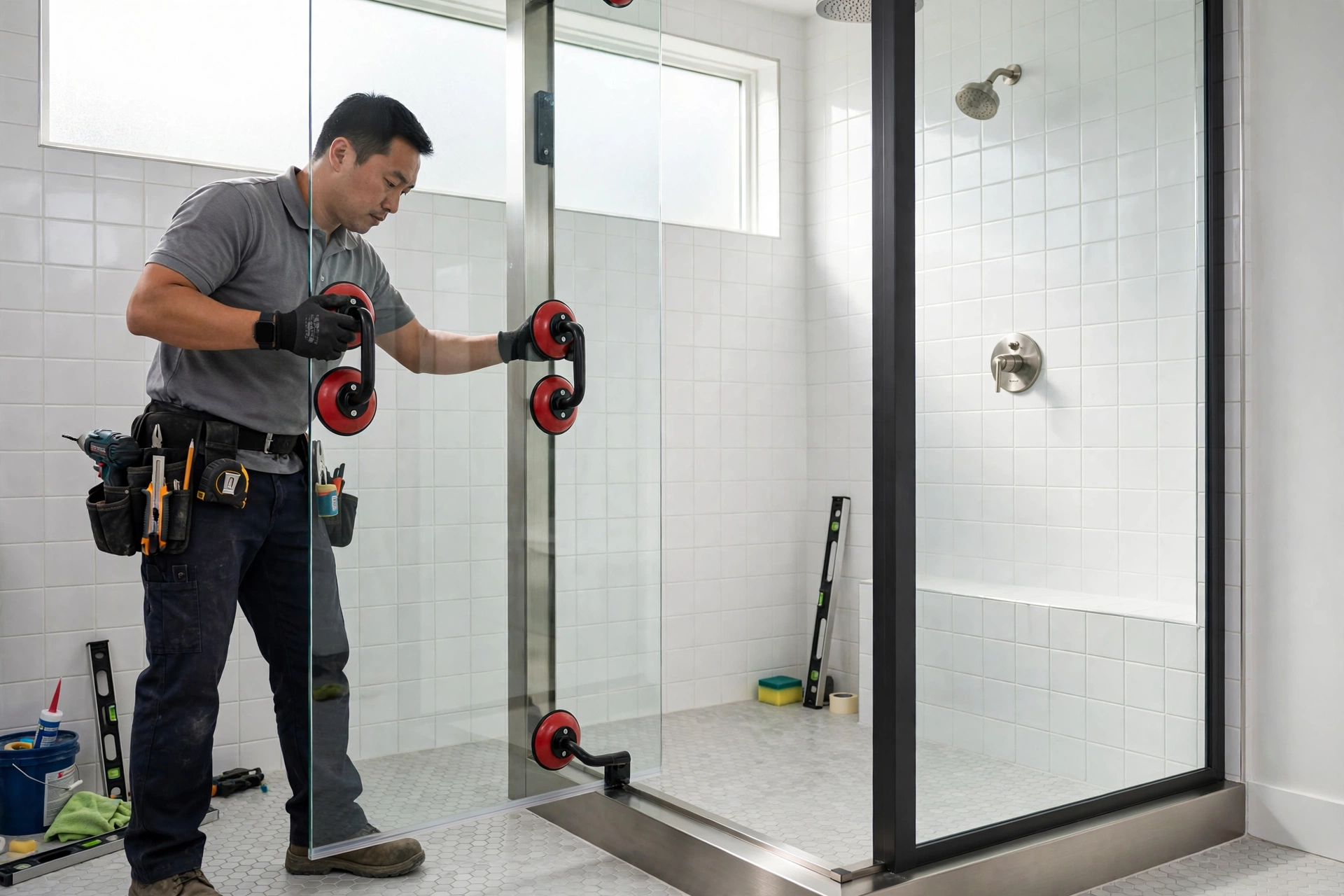
Fitting is a single visit in most cases. The bath is protected first, then:
- Fixings are set — the wall profile for a fixed screen, the hinges for a hinged one — into sound tile and structure.
- The panel is lifted in, set onto the bath edge and aligned: plumb, level, even gaps at the wall.
- A hinged screen is hung and swung — checked for tap clearance and a clean close against its seal.
- Seals are fitted along the bath edge and closing edges — the waterproof line, as our guide to bath screen seals explains.
- Fixed joints are siliconed with sanitary silicone; moving edges are never smeared with sealant.
- Everything is checked — alignment, swing, seal contact along the full length; the mechanical checks are completed on the day.
See the finished results on the bathtub glass screens page.
Seals, curing and first use
A new screen looks finished the moment it is fitted, but the silicone needs its time first. Water testing and first use follow the sealant’s curing time, confirmed in writing at handover — treat that note, not a generic internet figure, as your instruction. Until then, keep the screen and bath edge dry, and do not lean on a hinged screen or hang towels over the glass — early strain can knock a well-fitted screen out of true.
Frequently asked questions
How long does bath screen installation take from start to finish?
Two visits: measurement first, then fitting once the glass has been made to your measurements; fitting itself is a single visit in most cases. Scheduling is confirmed with your quote — edge condition and format both play a part.
Can glass be fitted to any bathtub?
Most, yes. The bath needs a rim with a usable flat landing and a sound wall to fix to. Narrow, sloped or uneven edges are usually still workable — the cases in our awkward-edges guide. A damaged wall occasionally needs preparatory work first; we tell you at measurement, before any glass is made.
Do you fit sliding or folding bath screens?
No — our fitted range for baths is fixed and hinged screens, and we would rather say that plainly than fit a format we do not stand behind. The pillar guides explain those formats honestly so you can compare, but if you choose one, we are not the fitter for that job.
What does it cost to have glass fitted on a bathtub?
Fixed bath glass starts from AED 1,500, the exact quote always confirmed after measurement — bath size, edge condition, glass dimensions and hardware finish all feed into it. Hinged screens are quoted the same way. Photos of your bath on WhatsApp earn a first steer before anyone visits.
When can I use the shower after the screen is fitted?
Once the sealant has cured according to its own timing — confirmed in writing at handover, because it depends on the sealant used. Mechanical checks are completed on fitting day; only the first water waits.
Talk to us about glass for your bath
Message us on WhatsApp on +971 52 443 2655 with a photo of the bath, one of the taps and shower, and a rough bath length. We will give you a first steer on fixed or hinged and likely cost — and book the measurement visit.
This guide is part of our Bathtub Glass Screens series. Next: Half Glass Door for a Bathtub: Pros, Cons and Splash Reality →