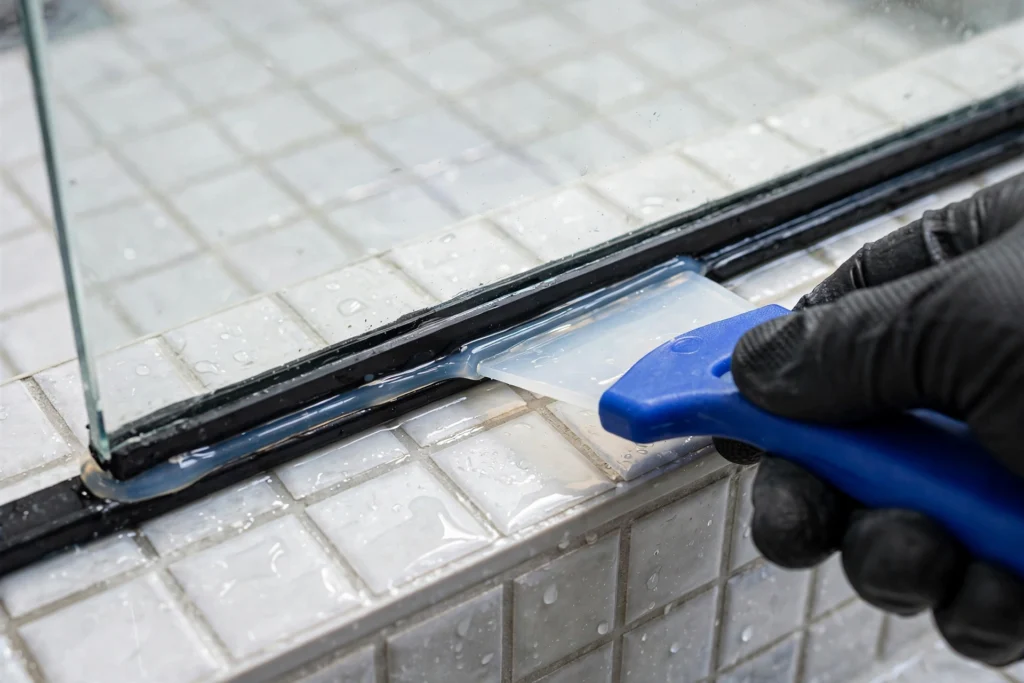
Shower doors rarely fail overnight. The leak, the scrape and the door that will not shut almost always announced themselves months earlier — a seal going stiff, grit building in a track, a hinge losing a fraction of its hold. Shower door maintenance catches those announcements while they are still cheap: not a deep clean, not a service contract, but a five-minute monthly routine that finds wear while it is still a wear part. This is that routine — and the point at which to stop, take photos, and let a fitter look instead.
At a glance
- Five minutes a month: swing and close the door slowly, look at the seals, clear the track, glance at the silicone.
- Seals are wear parts. Stiff, flattened or split means renewal is coming — caught early, it stays a seal, not water damage behind the frame.
- Never over-tighten screws against glass, and never force a dropped door. Both turn a small job into a big one.
- Grit in a sliding track scores rollers and glass edges. Clear it monthly.
- Photos on WhatsApp earn a first steer. A confirmed diagnosis — and a confirmed repair price — follows inspection.
The five-minute monthly check
Once a month, give the door sixty slow seconds. Open and close it slowly: one smooth arc, gaps staying even. Listen as much as look — a new scrape, click or rumble is information. Close it: a hinged door should meet its seals or magnetic strips evenly along the full height; a sliding door should roll home without a shove. After the next shower, look at the floor outside the door — where water appears tells you which check below deserves attention.
Seals: the wear part that does the waterproofing
Press the bottom seal with a fingertip. A healthy seal is soft and springs straight back; a tired one has flattened, hardened, split at the ends, or shrunk so the corners stand open. Run the same eye over the vertical and closing-edge seals. Wipe seals clean as you go — soap residue and scale stiffen the flexible fin — and leave the door ajar when the bathroom is idle so seals dry rather than sitting permanently damp. A perished seal is not a crisis, but it is a clock: every week it leaks, water goes somewhere it should not. Renewal stays simple when the profile is matched properly — method in our guide to shower seals and silicone.
Hinges, handles and screws: look, don’t crank
Hinges carry the whole weight of a glass door, and the first sign of trouble is play — a handle that moves before the door does, a gap that has tapered, a door sitting a touch lower than it did. Handles and hinge screws can be checked by hand — a gentle snug check with the correct driver, stopping when the screw feels firm. Never crank a screw hard against glass or use tightening to cure a dropped door: over-tightening stresses the glass around its holes, and a dropped door needs alignment, not torque. Never hang on the door or haul yourself up by the handle. A visibly dropped or catching door is hinge territory — our guide to broken or worn shower hinges covers how it is assessed.
Rollers and tracks on sliding doors
Sliding doors fail from the bottom up: grit, hair and scale collect in the track, and a rumble becomes a door that jumps or sticks. Monthly, brush or vacuum the track and wipe it dry. Roll each panel slowly and feel for flat spots or grinding. A soft-close should catch the panel gently; a door that slams or stalls mid-track is asking for attention. The checks professionals run are in our sliding door hardware quality checks. Whatever a sliding door does, do not force it — forcing bends brackets and jumps rollers, converting a cleaning job into a repair.

Silicone: condition is the whole story
Glance along the fixed lines: silicone should be continuous, bonded on both faces and smooth. Peeling, cracking, or black spots that will not scrub off mean the bead is at the end of its life: those spots are mould growing in the bead, not on it. Renewal means cutting the old bead out completely, cleaning and drying the joint, and applying fresh sanitary silicone — never beading over the old. The full method is in the seals and silicone guide linked above.
Limescale and glass care
UAE water is hard, and scale is the slow enemy of glass and seals alike. The best habit is the squeegee: seconds down the glass after showering stops scale establishing. Mild detergent and a soft cloth are enough for cleaning. Never use scouring pads or abrasive creams, and keep harsh chemicals off black and gold hardware — they strip finishes that cannot be reapplied. Our guide to hard water and limescale on shower glass covers what is safe and what to avoid.
When a check becomes a repair
Some findings are beyond maintenance, and recognising them early is itself good maintenance:
- The door catches the floor or will not close square. The door is out of alignment — see a shower door that won’t close properly.
- A sliding door jumps its track or stops sliding smoothly. Rollers, track or alignment — causes worked through in a sliding shower door not sliding.
- Any chip, crack or damaged glass edge. Stop using the door, keep people away, and message us — damaged toughened glass is not a DIY subject.
- A seal perished along its whole length, or silicone failed behind the frame. Renewal territory.
All of these sit within our everyday shower glass repair work across Dubai, Sharjah, Abu Dhabi and Ras Al Khaimah.
Frequently asked questions
How often should I check my shower door?
Monthly for the five-minute routine — swing, seals, track, silicone. In a busy family bathroom the monthly habit earns its keep.
Can I tighten the hinge screws myself?
A gentle hand check is fine: correct driver, a quarter-turn at most, stop when the screw feels firm. Never power tools, never crank against glass, and never use tightening to chase a dropped door — that needs alignment work.
What cleaner is safe on shower glass, seals and hardware?
Mild detergent, warm water and a soft cloth; a squeegee after showers keeps scale away. Keep scouring pads, abrasive creams and harsh chemicals off glass, seals and especially black and gold finishes.
My door has started catching the floor. Is that maintenance or a repair?
A repair. Catching means the door has dropped or drifted out of alignment — usually hinges or fixings — and cleaning changes nothing. Left alone it wears the bottom seal and stresses the glass edge, so have it assessed sooner rather than later.
The black spots in my silicone won’t scrub off. What now?
Mould growing inside the bead, beyond any cleaner’s reach. The fix is renewal: old silicone cut out completely, joint cleaned and dried, fresh sanitary silicone applied. Ventilation and leaving the door ajar slows its return.
Found something on your check?
If a check has turned up a stiff seal, a loose handle, a gritty track or a door that no longer closes true, message us on WhatsApp on +971 52 443 2655 with a wide photo of the enclosure and a close-up of what you found. Photos earn a first steer on what it is and what it needs; a confirmed diagnosis and confirmed price follow an inspection. Small findings are cheapest on the day you spot them.
This guide is part of our Shower Glass Repair series. Next: Sliding Shower Door Not Sliding? Rollers, Tracks and Alignment →