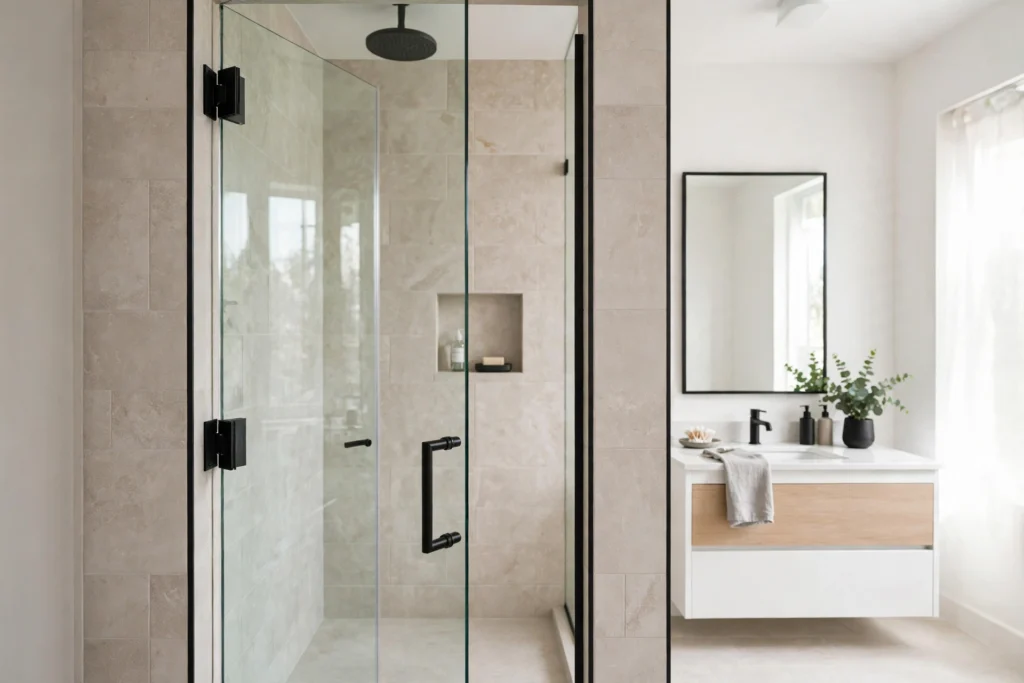
Most bath screens are a variation on standing still or swinging on hinges. Folding and pivot screens are the two that move differently, and they exist for one reason: the bath itself. A screen that guards the shower is exactly the thing in your way when you want to bathe a child, wash the dog, or simply climb in and soak — so both of these systems are answers to the same question, how to make the glass leave when the bath is being a bath. They answer it differently. A folding screen concertinas away, panel folding against panel, until the bath edge is nearly clear. A pivot screen swings on pins set in from its edge, opening in both directions within a modest arc. Each movement buys its access at a price — paid in seal lines, hardware and leak points — and this article works through how each one moves, what the movement does to its sealing, and who each system genuinely suits.
If your choice is between the mainstream options, our comparison of fixed vs hinged bath screens covers it; this article is only about the two movers. Sliding screens, the remaining moving option, are covered in our sliding vs fixed bath screens guide.
At a glance
- A folding screen is two or more panels hinged to each other: it folds back against the wall or into the bath, clearing most of the edge for bathing, and unfolds into a line for showering.
- A pivot screen is one panel swinging on top and bottom pivot pins set in from its edge: it swings both ways, needs less clear arc than an edge-hinged door, and leaves a gap at each side of the pivot line.
- Every joint is a seal line: folding screens have the most joints of any bath screen, and therefore the most potential leak points; pivot screens have fewer, concentrated at the pivot gaps.
- Neither seals like a fixed panel. Both are splash-management systems chosen for access, and they should be chosen with that understood.
- Folding suits households that bathe often and want the screen gone; pivot suits smaller rooms and anyone who wants a two-way swing without a full door’s arc.
How folding screens move
A folding bath screen is a small glass concertina. Two, three or occasionally more narrow panels are hinged edge to edge; the first is hinged or fixed at the wall. To shower, you pull the train straight along the bath edge, where it stands as a screen of joined panels. To bathe, you fold it back — panel against panel, zig-zag — until it stacks flat against the wall or folds away inside the bath end, leaving most of the edge open. The movement is genuinely useful: no other glass screen clears as much of the bath as completely, and for bathing children it is the difference between leaning around glass and simply standing at an open bath.
The compromises ride on the same hinges that make it work. Each panel is narrow, so a folding screen reads as a row of sections rather than one sheet of glass — the most segmented look of any screen type. Each hinge line is a joint that moves every time the screen is folded, and joints that move wear: a folding screen has more moving hardware per metre than anything else over a bath, and it asks to be folded with a little care rather than swept along by one corner. And because the panels are narrow and the train is long, a folded stack still occupies its folded depth at the bath end — “away” means stacked, not vanished.
How pivot screens move
A pivot bath screen is a single panel mounted on two pivot pins — one at the top, one at the bath edge — set a short distance in from the panel’s edge rather than at it. The panel rotates on that vertical axis. Because the pivot line is inset, the panel swings in both directions, into the bath and out over the room, and the swing is split: part of the panel travels one side of the pivot line, part the other, so the clear arc the door sweeps is smaller than an edge-hinged panel of the same width. The panel usually carries a small fixed section or returns to the wall beside the pivot line, closing the side the pivot geometry leaves open.
What the pivot buys is manners in a small room. A door that swings both ways never has to be pulled towards you past the basin or the toilet; it can be pushed into the bath to step in and pulled to close, and its reduced arc is forgiving where a full hinged swing would clash. What it costs is written into the geometry: there is a gap at each side of the pivot line — between the panel and its fixed section on one side, and at the panel’s free edge on the other — and the pivot pins themselves are concentrated hardware, carrying the panel’s weight and its alignment on two points rather than along a hinge line. A pivot screen whose pins wear or slip shows it quickly in a panel that sits off its line.
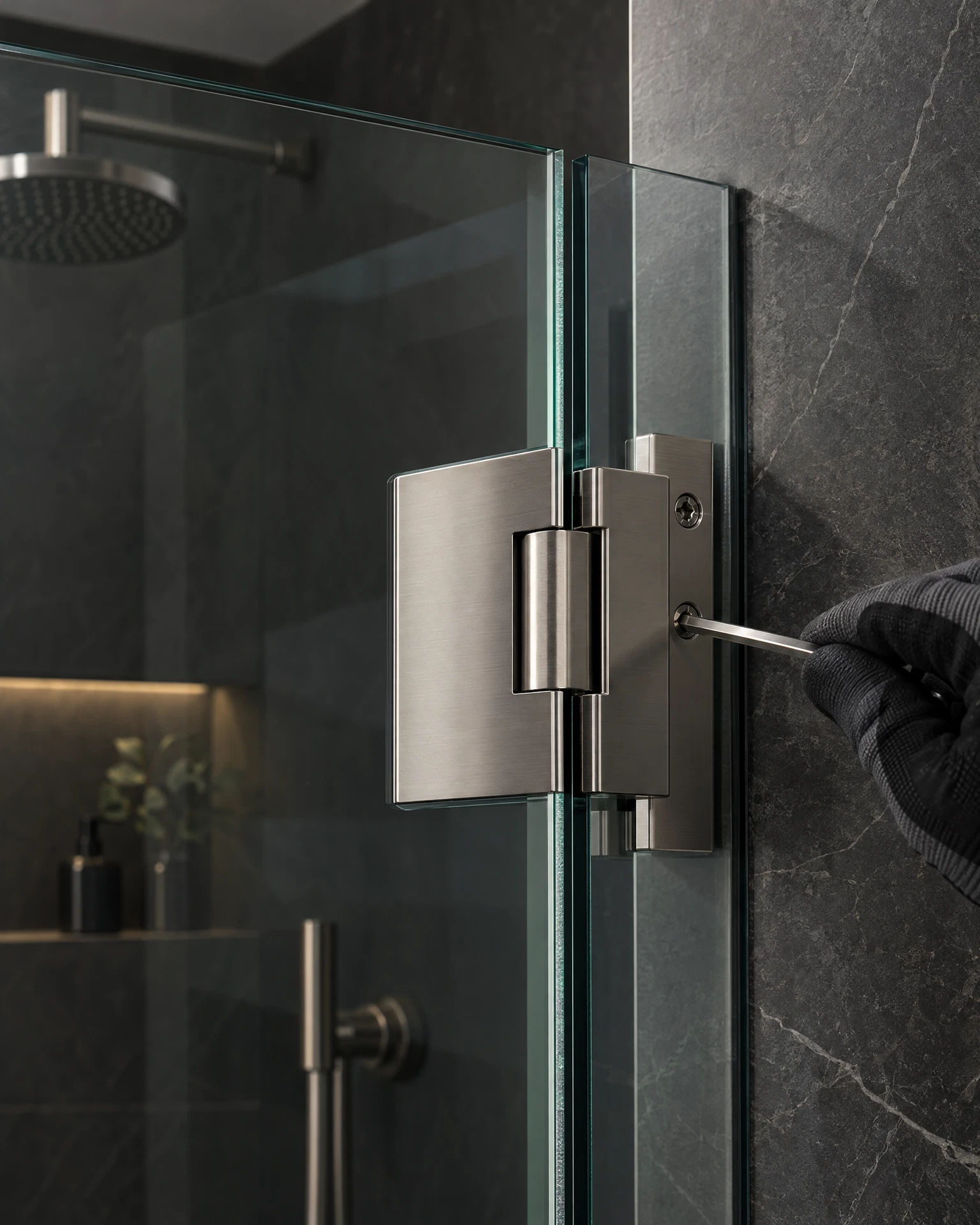
EVERY MOVING SCREEN LIVES OR DIES AT ITS HARDWARE — PIVOT PINS AND HINGES CARRY THE PANEL AND SET ITS LINE.
Access for bathing and cleaning
Access is the reason both systems exist, so judge them on it honestly. For bathing, folding wins outright: folded back, it opens nearly the whole edge — children in and out, a proper lean-free soak, bath toys and dogs all unobstructed. A pivot screen opens its panel’s width and no more; you step around or through its arc, and the fixed section beside the pivot stays where it is. For cleaning the bath, the same order holds: a folded screen leaves the tub bare, while a pivot panel can be swung in to reach behind it but still stands in the room. For cleaning the screen itself, the order reverses: the pivot’s single flat panel is one squeegee pass, where the folding screen’s panels, hinges and meeting edges collect soap and scale in every joint, and in hard water those joints are a wiping-out chore on a schedule. Households choosing folding are choosing bathing access and accepting cleaning; households choosing pivot are splitting the difference in both directions.
Seal lines and leak points
Water escapes a bath screen where the screen is interrupted, and moving systems are interrupted by design — so read their leak behaviour off their joints. A folding screen has a seal line at the bath edge along its whole length, a vertical seal at the wall, and a joint at every hinge line between panels, each closed by a seal strip or the panels’ meeting profiles. Every one of those joints is a potential drip line, and the hinge-line joints are the busiest: they flex with every fold, their seals age fastest, and spray aimed directly at a joint finds the weakest of them. A pivot screen has the bath-edge seal and wall line, plus its two built-in gaps: at the pivot side, where the panel turns against its fixed section, and along the free edge. Those gaps are managed with seals and by the panel’s overlap, but they are passages in a way a continuous fixed panel’s edge is not, and a pivot screen under a vigorous hand shower will pass more water at its pivot side than anywhere else.
The fair summary is a ranking, and it is the same ranking as the joints count: fixed panels seal best, hinged screens next, then pivot, then folding — because each step adds interruptions. That does not make the movers bad screens; it makes them screens whose containment is the price of their access, and the households that are happy with them shower with that in mind. Where a screen leaks despite its design — perished seals, a lifted bath-edge line — that is a different matter of seal condition rather than system choice, and it is covered in our bath screen seals guide.
Who each suits
Choose folding if the bath is a bath first in your household — children bathed in it, soaks actually taken — and the over-bath shower is the secondary use by people who shower reasonably gently; if the room is small enough that even a pivot’s arc is awkward; and if you will give its joints their cleaning. Choose pivot if you want a moving screen but one panel’s simplicity: a two-way swing in a tight room, easier cleaning than a folder, and access that is good rather than total. Choose neither if the over-bath shower is the household’s main shower, used hard and expected to leave a dry floor — the interrupted seal lines will not give you enclosure behaviour, and a fixed or hinged screen from the main range on our bathtub glass screens page is the honest route. And choose neither if you dislike maintenance: both systems have hardware and seals that reward attention, and a household that wants to fit a screen and forget it should fit the screen with the fewest moving parts — which is a fixed panel.
Frequently asked questions
Do folding bath screens leak more?
They have more opportunities to. A folding screen’s hinge lines are joints with seals, and each joint is a potential drip path in a way a single panel’s edge is not — especially under direct, vigorous spray. Folded and unfolded gently, with seals in good condition, a folding screen manages ordinary showering; it will never match a fixed panel for containment, and it should not be sold to you as if it does.
Is a pivot screen better than a hinged one?
Different, rather than better. A pivot swings both ways on a smaller arc, which is a real advantage in a tight bathroom; a hinged screen closes against a continuous edge with a simpler seal picture and carries its weight along a hinge line. If a hinged door’s swing clears everything in your room, it is the simpler system; the pivot earns its place where the swing is the problem.
Can a folding or pivot screen replace my existing hinged screen?
Usually the opening can take a change of system — the bath edge and wall are the same — but the fixings are not shared: a folding train and a pivot’s pin positions are their own layouts, so replacement means new fixings and new glass made for them, not a swap onto the old hardware. Send us a photo of the existing screen and the bath edge and we will tell you what a change of system involves on your bath.
Which is easier to keep clean?
The pivot, clearly: one panel, few joints. A folding screen’s hinge lines and meeting edges are where scale and soap collect, and in hard-water areas they need regular wiping out. Either screen’s seals are consumables in the usual way — renewed when they harden or split.
What do you need from me to advise between them?
A photo of the whole bath and the room around it — what the screen’s swing or fold has to clear is half the answer — and an honest word about how the bath is used: who bathes, who showers, and how hard. From those we can tell you which movement your household actually needs, and whether either mover beats a plain hinged screen for you.
Talk to us about your bath screen
One honest note before the invitation: we fit fixed and hinged bath screens — we do not fit folding or pivot models, and this page is guidance, not a product listing. So message us on WhatsApp on +971 52 443 2655 with a photo of the whole bath and the room around it, and tell us how the bath is used — bathing, showering, or both, and by whom — and what you will get is a straight steer: whether a moving screen genuinely suits your household, and what the fixed or hinged equivalent does better, sealing included. If a mover is honestly the answer for your bath, we will say so — and you will know it is advice rather than a sales line, because it is not a screen we sell. For figures, the shower glass price guide sets out how bath screens are priced; the exact number follows measurement, as always.
This guide is part of our Bathtub Glass Screens series. Next: Bath Screen Replacement: From a Tired Old Screen to New Glass →